<?xml version="1.0" encoding="utf-8"?>
<feed xmlns="http://www.w3.org/2005/Atom" xmlns:media="http://search.yahoo.com/mrss/">
  <title>Old Town Home Category: 'Transoms'</title>
  <updated>2014-08-20T10:29:00.000-04:00</updated>
  <id>http://www.oldtownhome.com/transoms/index.atom</id>
  <link rel="alternate" href="http://www.oldtownhome.com/transoms/index.atom" />
  <author>
    <name>Alex and Wendy</name>
    <uri>http://www.oldtownhome.com/</uri>
    <email>wendy@oldtownhome.com</email>
  </author>
  <entry>
    <guid>9a48c41e-d1a8-461a-8638-ebd37586e011</guid>
    <id>https://www.oldtownhome.com/2014/8/20/Throw-it-Over-the-Transom-and-See-What-Happens/</id>
    <title>Throw it Over the Transom and See What Happens</title>
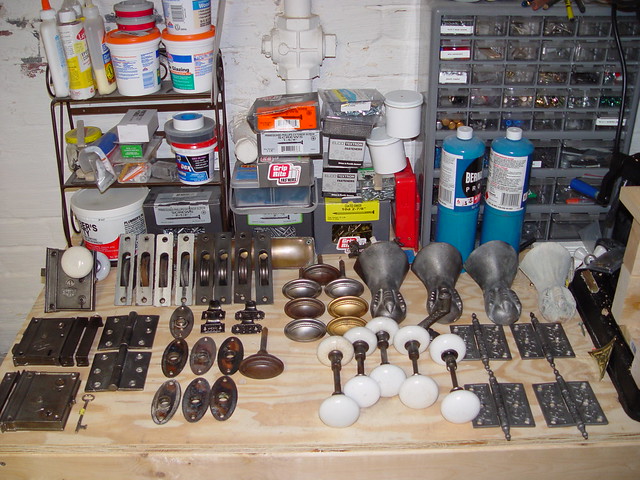
    <summary type="html"><![CDATA[<p>One of my absolute favorite aspects of our old home (and many old homes in general) is our house's period and restored architectural hardware. </p><p>
</p><div class="MediaContainer PhotoContainer"><a href="https://farm6.staticflickr.com/5109/5643991555_749197b2a7_z.jpg" rel="PhotoPopup" popupheight="480" popupwidth="640"><img alt="" src="https://farm6.staticflickr.com/5109/5643991555_749197b2a7.jpg" width="500" height="375" style="border-width: 0px; border-style: solid;"></a></div><p>Since moving into our home we've gone to great lengths to discover and restore period vintage hardware for our home. Whether that means scouring eBay or digging through the extras pile at a salvage yard, we've attempted to leave no knob unturned in our search.</p><p>Over the years on the blog we've covered our <a href="http://www.oldtownhome.com/2012/3/8/The-Anatomy-and-Restoration-of-a-Rim-Lock/">rim locks</a> at length, including their restoration. </p><p>
</p><div class="MediaContainer PhotoContainer"><a href="https://farm7.staticflickr.com/6106/6373342091_2007f42b7c_z.jpg" rel="PhotoPopup" popupheight="640" popupwidth="480"><img alt="" src="https://farm7.staticflickr.com/6106/6373342091_2007f42b7c.jpg" width="375" height="500" style="border-width: 0px; border-style: solid;"></a></div><p>We've mentioned our sash lifts, <a href="http://www.oldtownhome.com/2011/7/19/Toolbox-Tuesday-Got-Rust-or-Paint-Wire-Wheel-It-on-the-Bench-Grinder/">stripping their paint</a>, and how we've been tirelessly searching for just a few more matching lifts to complete the set. </p> <a href="https://www.oldtownhome.com/2014/8/20/Throw-it-Over-the-Transom-and-See-What-Happens/">more</a>]]></summary>
    <published>2014-08-20T10:29:00.000-04:00</published>
    <updated>2014-08-20T10:29:00.000-04:00</updated>
    <link rel="alternate" href="https://www.oldtownhome.com/2014/8/20/Throw-it-Over-the-Transom-and-See-What-Happens/" />
    <author>
      <name>Alex</name>
    </author>
    <content type="html"><![CDATA[<p>One of my absolute favorite aspects of our old home (and many old homes in general) is our house's period and restored architectural hardware. </p>
<p>
</p>
<div class="MediaContainer PhotoContainer"><a href="https://farm6.staticflickr.com/5109/5643991555_749197b2a7_z.jpg" rel="PhotoPopup" popupheight="480" popupwidth="640"><img alt="" src="https://farm6.staticflickr.com/5109/5643991555_749197b2a7.jpg" width="500" height="375" style="border-width: 0px; border-style: solid;" /></a></div>
<p>Since moving into our home we've gone to great lengths to discover and restore period vintage hardware for our home. Whether that means scouring eBay or digging through the extras pile at a salvage yard, we've attempted to leave no knob unturned in our search.</p>
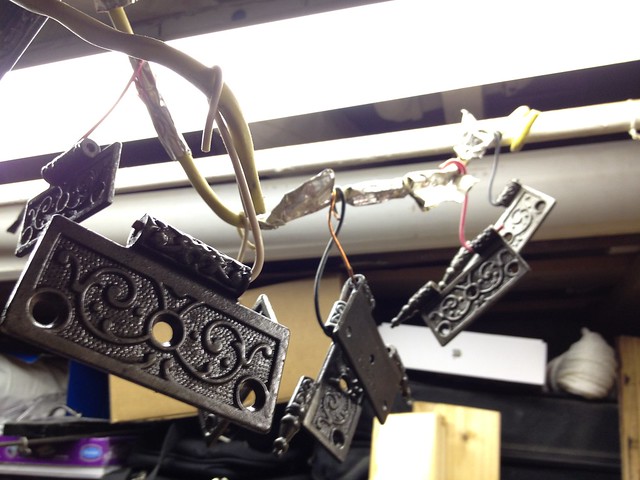
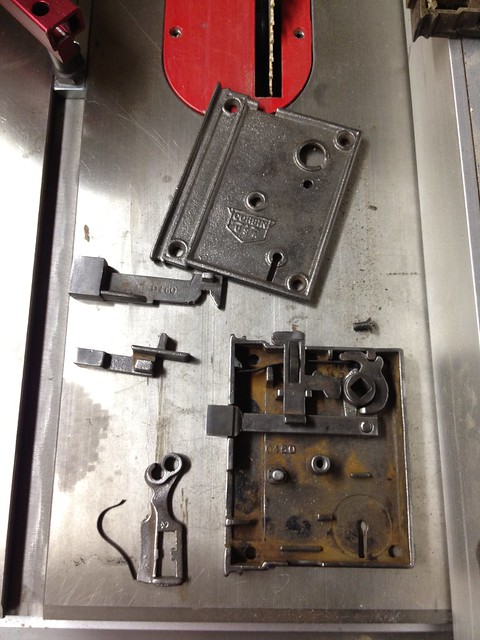
<p>Over the years on the blog we've covered our <a href="http://www.oldtownhome.com/2012/3/8/The-Anatomy-and-Restoration-of-a-Rim-Lock/">rim locks</a> at length, including their restoration. </p>
<p>
</p>
<div class="MediaContainer PhotoContainer"><a href="https://farm7.staticflickr.com/6106/6373342091_2007f42b7c_z.jpg" rel="PhotoPopup" popupheight="640" popupwidth="480"><img alt="" src="https://farm7.staticflickr.com/6106/6373342091_2007f42b7c.jpg" width="375" height="500" style="border-width: 0px; border-style: solid;" /></a></div>
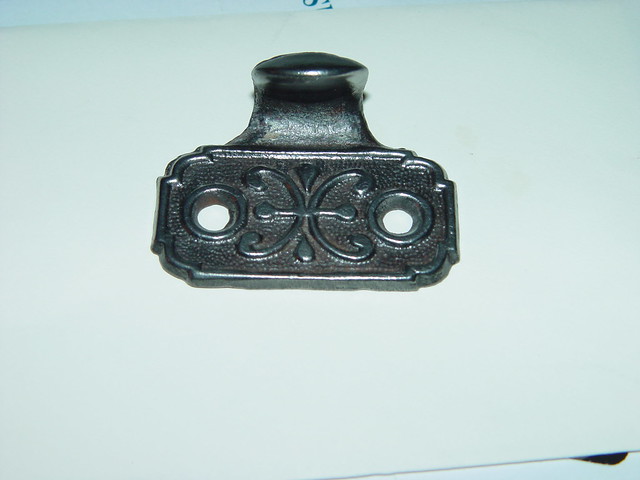
<p>We've mentioned our sash lifts, <a href="http://www.oldtownhome.com/2011/7/19/Toolbox-Tuesday-Got-Rust-or-Paint-Wire-Wheel-It-on-the-Bench-Grinder/">stripping their paint</a>, and how we've been tirelessly searching for just a few more matching lifts to complete the set. </p>
<p>
</p>
<div class="MediaContainer PhotoContainer"><a href="https://farm6.staticflickr.com/5306/5645783947_f3cb23048e_z.jpg" rel="PhotoPopup" popupheight="480" popupwidth="640"><img alt="" src="https://farm6.staticflickr.com/5306/5645783947_f3cb23048e.jpg" width="500" height="375" style="border-width: 0px; border-style: solid;" /></a></div>
<p>We've detailed the various hinges we're using on our salvaged and original doors, and the differences between the first floor and second floor hinges (decorative downstairs, simple up).</p>
<p>
</p>
<div class="MediaContainer PhotoContainer"><a href="https://farm7.staticflickr.com/6114/6346952943_021156d48b_z.jpg" rel="PhotoPopup" popupheight="480" popupwidth="640"><img alt="" src="https://farm7.staticflickr.com/6114/6346952943_021156d48b.jpg" width="500" height="375" style="border-width: 0px; border-style: solid;" /></a></div>
<p>And we've even showed off the cast iron slide bolt we installed on our vestibule doors and how it just happened to be very similar (in shape and size) to the one likely originally in this same place a century ago. </p>
<p>
</p>
<div class="MediaContainer PhotoContainer"><a href="https://farm7.staticflickr.com/6216/6373302481_9f2801e868_z.jpg" rel="PhotoPopup" popupheight="640" popupwidth="480"><img alt="" src="https://farm7.staticflickr.com/6216/6373302481_9f2801e868.jpg" width="375" height="500" style="border-width: 0px; border-style: solid;" /></a></div>
<p>But of all of the items we've discussed, and of all of the effort we've put into restoration of these antique architectural elements, my favorite, by far, is the work we've done to make our transom windows functional. </p>
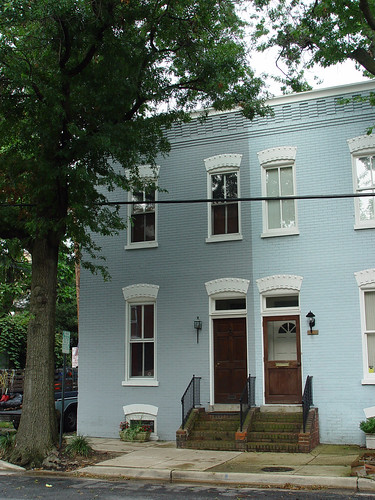
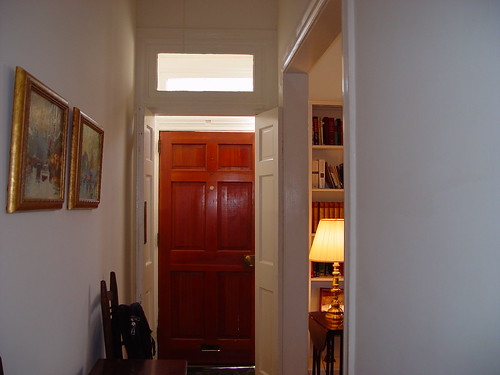
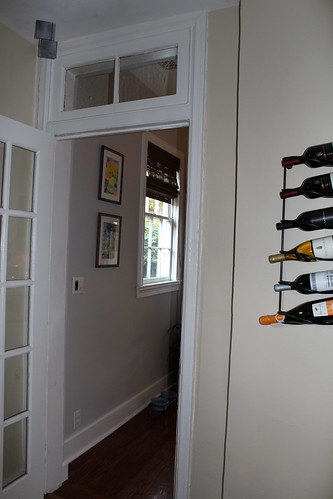
<p>When we moved into our home we had four fixed/painted shut transom windows.</p>
<ol>
    <li>The exterior fixed front transom window above our entry door.<br />
    <br />
    <div class="MediaContainer PhotoContainer"><a href="https://farm6.staticflickr.com/5185/5692700833_f3846ab705_z.jpg" rel="PhotoPopup" popupheight="640" popupwidth="480"><img alt="" src="https://farm6.staticflickr.com/5185/5692700833_f3846ab705.jpg" width="375" height="500" style="border-width: 0px; border-style: solid;" /></a></div>
    </li>
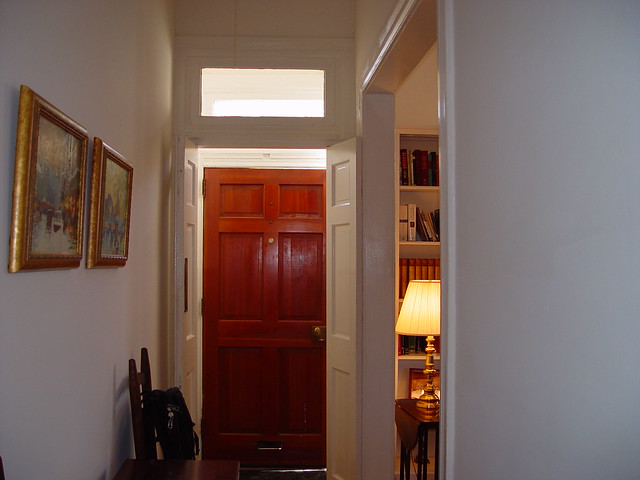
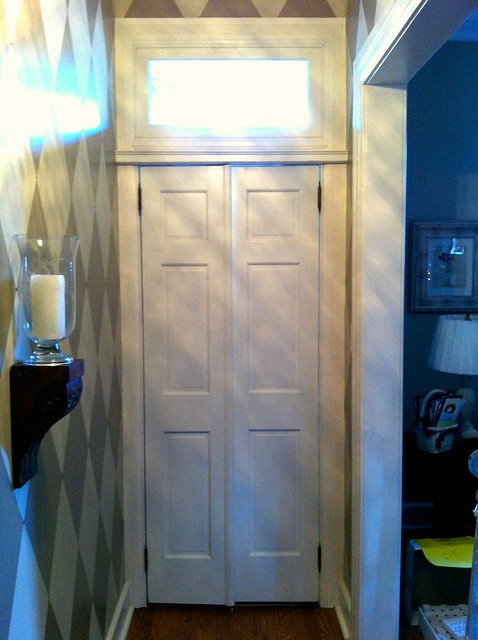
    <li>The interior fixed transom window above the front vestibule door (just two feet from the first).<br />
    <br />
    <div class="MediaContainer PhotoContainer"><a href="https://farm6.staticflickr.com/5261/5642078199_1c6b163233_z.jpg" rel="PhotoPopup" popupheight="480" popupwidth="640"><img alt="" src="https://farm6.staticflickr.com/5261/5642078199_1c6b163233.jpg" width="500" height="375" style="border-width: 0px; border-style: solid;" /></a></div>
    </li>
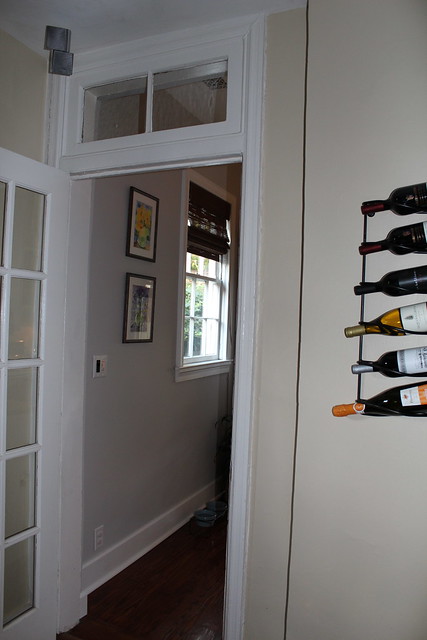
    <li>The interior fixed transom at the door from our kitchen into the family room, which was once the rear of our house until the kitchen addition was added in about 1900.<br />
    <br />
    <div class="MediaContainer PhotoContainer"><a href="https://farm8.staticflickr.com/7266/7780696774_766f837fc9_z.jpg" rel="PhotoPopup" popupheight="640" popupwidth="427"><img alt="" src="https://farm8.staticflickr.com/7266/7780696774_766f837fc9.jpg" width="333" height="500" style="border-width: 0px; border-style: solid;" /><br />
    &nbsp;</a></div>
    </li>
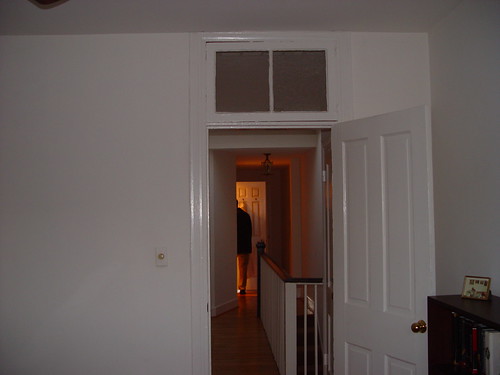
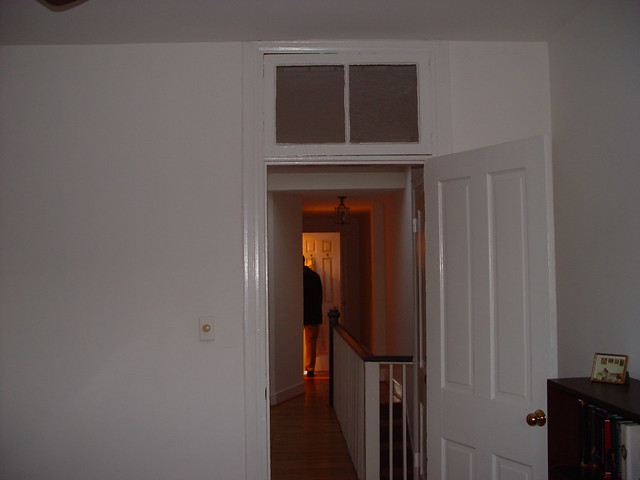
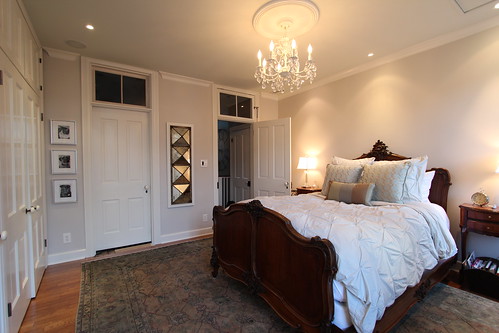
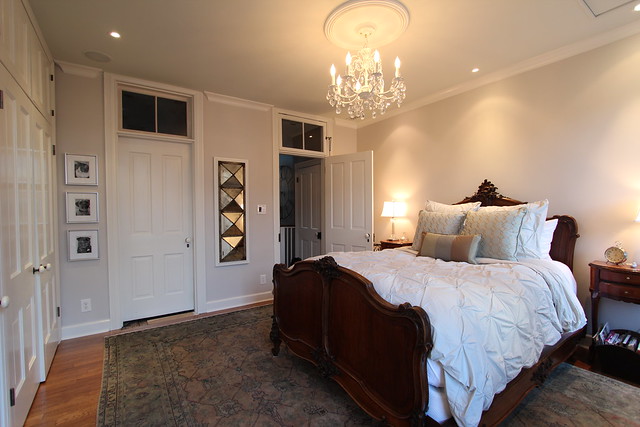
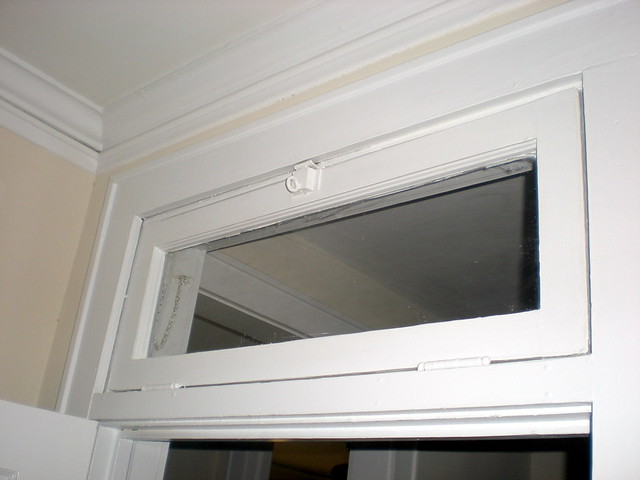
    <li>The interior master bedroom transom, painted shut, with hinges sloppily and incorrectly added to the side of the window.<br />
    <br />
    <div class="MediaContainer PhotoContainer"><a href="https://farm6.staticflickr.com/5025/5642656514_1cf7ba37ed_z.jpg" rel="PhotoPopup" popupheight="480" popupwidth="640"><img alt="" src="https://farm6.staticflickr.com/5025/5642656514_1cf7ba37ed.jpg" width="500" height="375" style="border-width: 0px; border-style: solid;" /><br />
    </a></div>
    </li>
</ol>
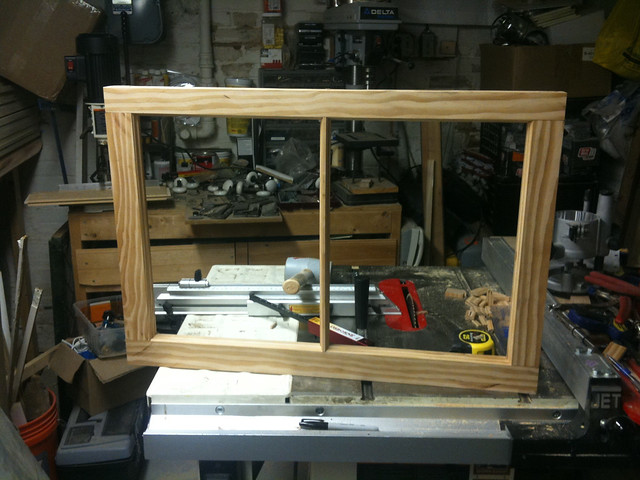
<p>Today we have six transom windows throughout the house. Yes, we've added two. At present, five are restored, four are functional, three have operational salvaged transom lifts, two of those lifts match exactly, and one was completely fabricated in our basement wood shop using salvaged glass. Tooting my own horn here, you'd be hard pressed to pick it out the new one among the others. :toot-toot:</p>
<p>The two we've added are:</p>
<ol>
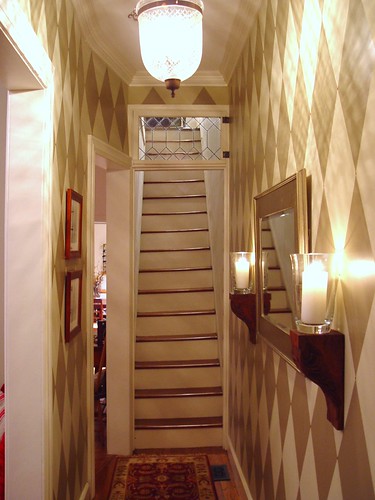
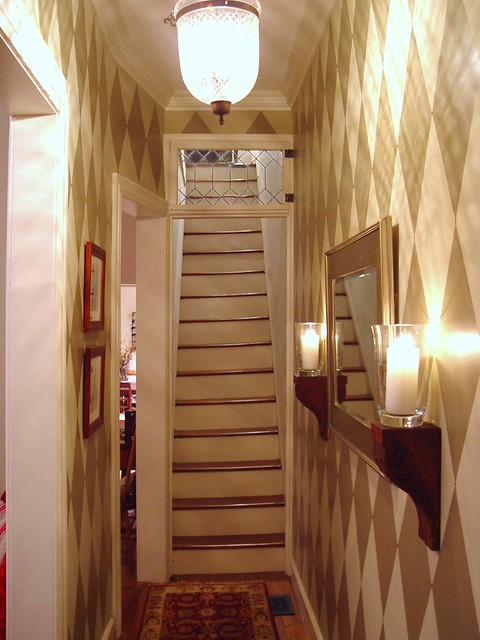
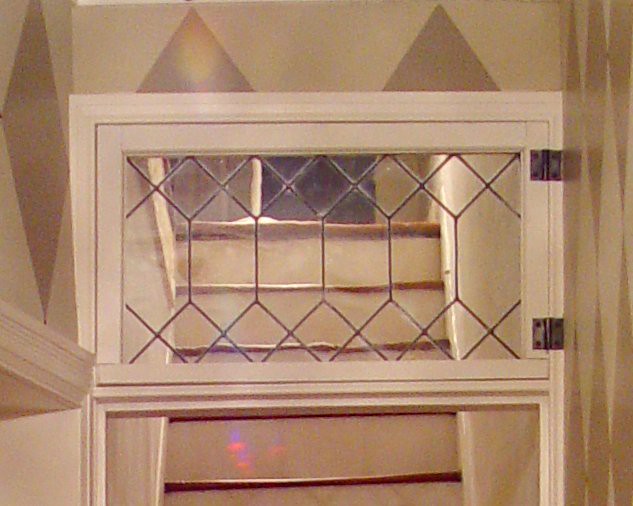
    <li>The decorative leaded transom above our stair doorway from our entry hall. Added to fill the large open space, and based on some evidence a transom once existed there. (Yes, it's mounted incorrectly with face mounted hinges on the side because I didn't understand our bedroom transom was not mounted correctly at the time. I'll be fixing that at some point.)<br />
    <br />
    <div class="MediaContainer PhotoContainer"><a href="https://farm7.staticflickr.com/6148/5969559643_fc7028446d_z.jpg" rel="PhotoPopup" popupheight="640" popupwidth="480"><img alt="" src="https://farm7.staticflickr.com/6148/5969559643_fc7028446d.jpg" width="375" height="500" style="border-width: 0px; border-style: solid;" /><br />
    &nbsp;</a></div>
    </li>
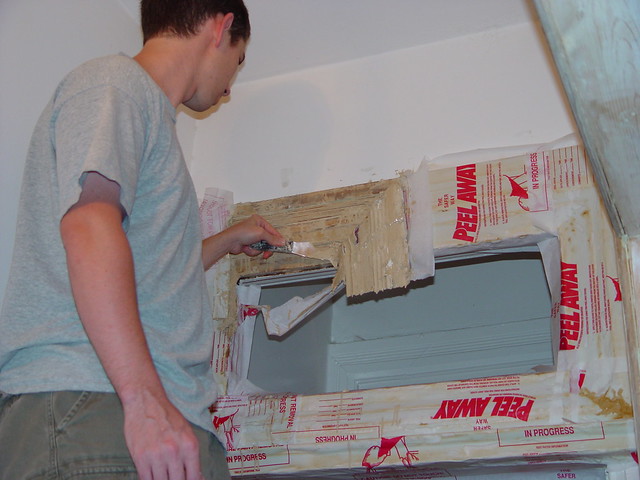
    <li>The transom window (and whole jamb assembly) above our master bathroom door at left. That's the completely new one.<br />
    <br />
    <div class="MediaContainer PhotoContainer"><a href="https://farm8.staticflickr.com/7033/6534233075_66a6ceb06d_z.jpg" rel="PhotoPopup" popupheight="427" popupwidth="640"><img alt="" src="https://farm8.staticflickr.com/7033/6534233075_66a6ceb06d.jpg" width="500" height="333" style="border-width: 0px; border-style: solid;" /></a></div>
    </li>
</ol>
<p>Transom windows, the small hinged window detail that sits above both interior and exterior doors in many old homes, are a great Victorian era utilitarian design element that end up adding a tremendous amount of character to a home. Though they've been around long before Queen Victoria, they gained popularity during the architectural phase that credits her name.</p>
<p>
</p>
<div class="MediaContainer PhotoContainer"><a href="https://farm3.staticflickr.com/2571/4168421150_28cf9c61fb_z.jpg" rel="PhotoPopup" popupheight="480" popupwidth="640"><img alt="" src="https://farm3.staticflickr.com/2571/4168421150_28cf9c61fb.jpg" width="500" height="375" style="border-width: 0px; border-style: solid;" /></a><br />
<em>Reproduction mortise and tenon transom we built for our home.</em></div>
<p>Originally implemented to allow additional light into the usually dark rooms, even when doors were shut, the windows that are functional (which allows them to open and close on hinges) were created to allow heated or cool air to flow between rooms more readily. </p>
<p>
</p>
<div class="MediaContainer PhotoContainer"><a href="https://farm3.staticflickr.com/2732/5859851932_5dff0dc4a2_z.jpg" rel="PhotoPopup" popupheight="478" popupwidth="640"><img alt="" src="https://farm3.staticflickr.com/2732/5859851932_5dff0dc4a2.jpg" width="500" height="374" style="border-width: 0px; border-style: solid;" /></a></div>
<p>Since their inception they've even become part of everyday sayings. Have you ever heard someone say "I'm going to send it over the transom and see what happens," when talking about an idea? This expression has roots in the writers realm, where a writer would throw a manuscript, article, or other work over the publisher's closed door and through the sometimes open transom window, in hopes the publisher would pick it up, read it, and be struck by the work's brilliance. In a way, a blog is actually one giant experiment in "over the transom" writing.</p>
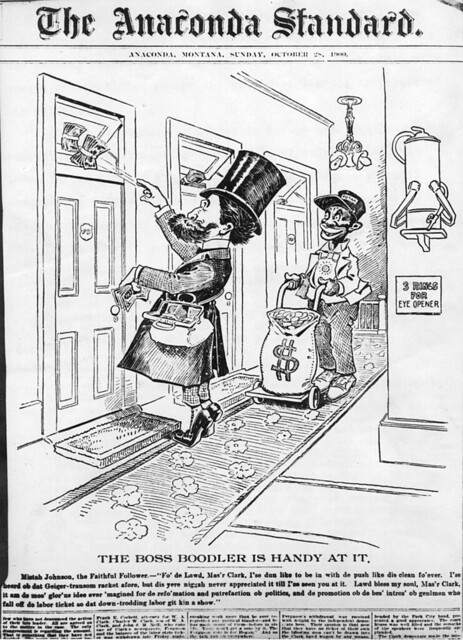
<p>It's been used in many ways over the years, such as in this political cartoon depicting bribery in a 1900 newspaper.</p>
<p>
</p>
<div class="MediaContainer PhotoContainer"><a href="https://farm6.staticflickr.com/5551/14980290145_75cf369a2d_z.jpg" rel="PhotoPopup" popupheight="640" popupwidth="463"><img alt="" src="https://farm6.staticflickr.com/5551/14980290145_75cf369a2d.jpg" width="362" height="500" style="border-width: 0px; border-style: solid;" /></a></div>
<p>But enough with the history lesson, let's talk about why we're discussing transoms today. </p>
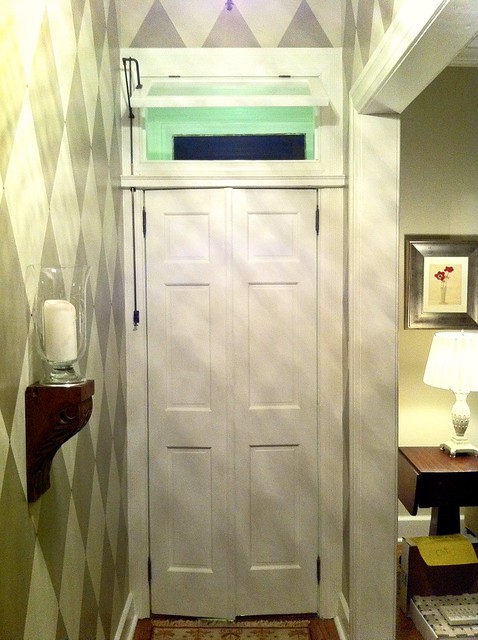
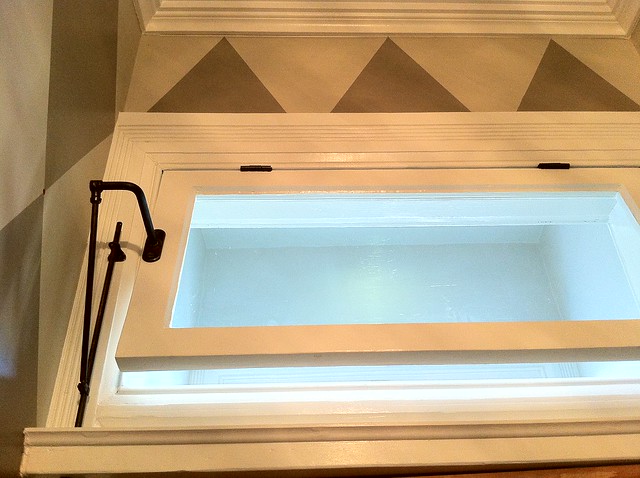
<p>After many years dreaming about this day (no, really, I've had dreams about it), the transom window above our master bathroom door is fully built, installed, painted, and 100% operational. And though I've talked about it once before, I want to cover just how one might go about installing a transom window lift in a bit more detail, as there seems to be a shocking lack of this type of information on the Internets. </p>
<p>
</p>
<div class="MediaContainer PhotoContainer"><a href="https://farm6.staticflickr.com/5262/5859833692_c8bc87e57d_z.jpg" rel="PhotoPopup" popupheight="166" popupwidth="640"><img alt="" src="https://farm6.staticflickr.com/5262/5859833692_c8bc87e57d.jpg" width="500" height="129" style="border-width: 0px; border-style: solid;" /></a></div>
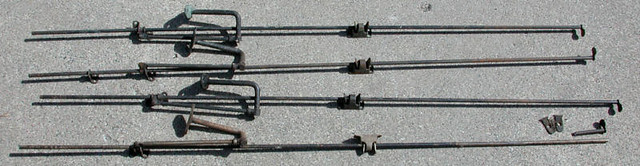
<p>Installing a transom lift is not incredibly difficult, but it's a bit tedious. The main things you need to know before putting this piece of salvaged goodness into place are the basic measurements for what you're trying to achieve. </p>
<p>In our case, our ceilings are 9' tall, door is about 7' tall, the transom is about 2' tall, and the lift is about 4' long.</p>
<p>A transom lift consists of several key elements. </p>
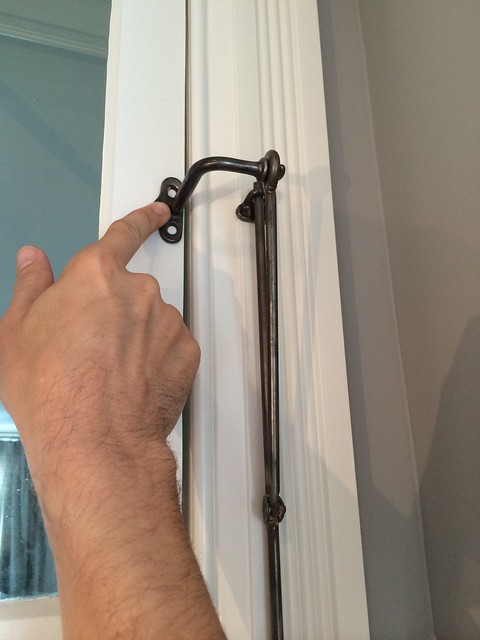
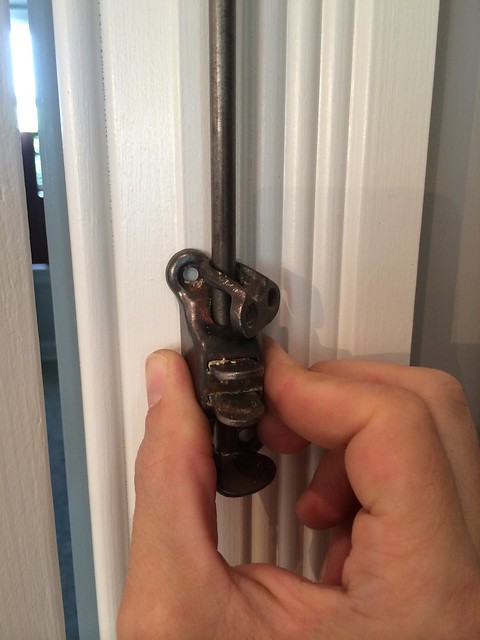
<p>1. The spring pinch clasp that sits near the bottom of the lift and allows the operator to set the open/closed position of the lift. This piece mounts to the wall and provides the lower support. </p>
<p>
</p>
<div class="MediaContainer PhotoContainer"><a href="https://farm6.staticflickr.com/5585/14976652031_8705aeac1a_z.jpg" rel="PhotoPopup" popupheight="640" popupwidth="480"><img alt="" src="https://farm6.staticflickr.com/5585/14976652031_8705aeac1a.jpg" width="375" height="500" style="border-width: 0px; border-style: solid;" /></a></div>
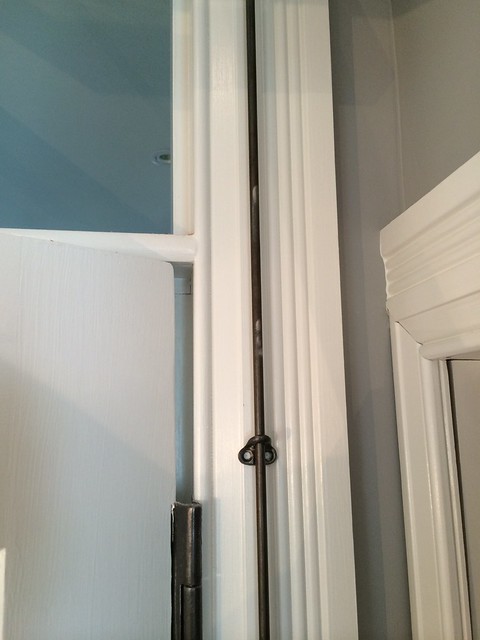
<p>2. The long rod that drives the whole thing extends from below the clasp to near the top of the transom. This rod is supported at several places, but is ultimately free moving. </p>
<p>3. Several supports that mount to the wall at the transom's midpoint and top connection and allow the rod to move up and down. These are often the pieces missing when buying salvaged transoms, so make sure all parts are there. </p>
<p>
</p>
<div class="MediaContainer PhotoContainer"><a href="https://farm4.staticflickr.com/3920/14793061179_efa64aa38b_z.jpg" rel="PhotoPopup" popupheight="640" popupwidth="480"><img alt="" src="https://farm4.staticflickr.com/3920/14793061179_efa64aa38b.jpg" width="375" height="500" style="border-width: 0px; border-style: solid;" /></a></div>
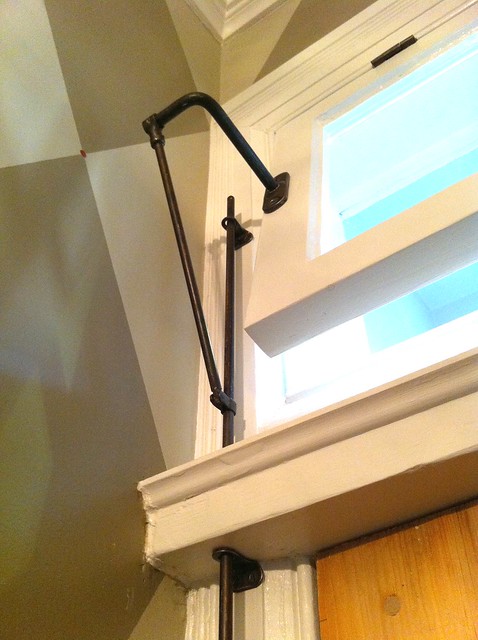
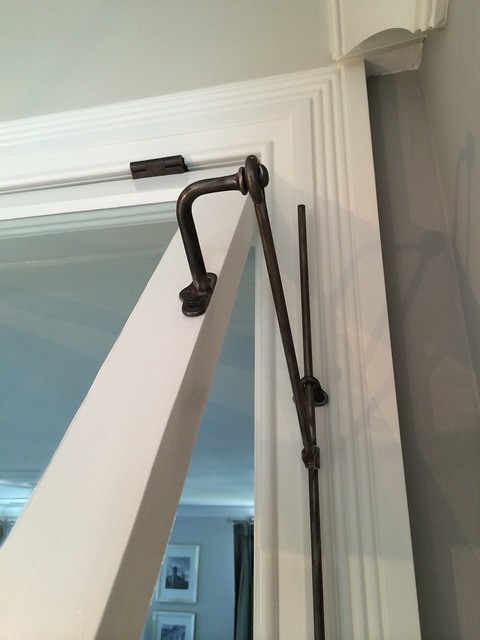
<p>4. The hinge assembly and lift mount bracket that attaches directly to the transom sash and is hinged against the transom rod. This hinge and the rod's upward motion is what actually opens the transom. </p>
<p>
</p>
<div class="MediaContainer PhotoContainer"><a href="https://farm4.staticflickr.com/3838/14979396622_43118644f9_z.jpg" rel="PhotoPopup" popupheight="640" popupwidth="480"><img alt="" src="https://farm4.staticflickr.com/3838/14979396622_43118644f9.jpg" width="375" height="500" style="border-width: 0px; border-style: solid;" /></a></div>
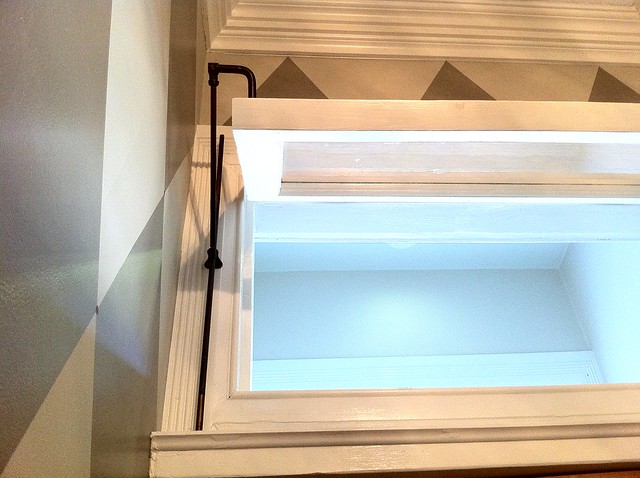
<p>In making our transom window operational, we want to achieve an install where we can open the window to about a 30 degree angle. This doesn't sound like much, but it's plenty to allow airflow without ending up with a weird hatch looking window, or one that's hard to get open or closed due to the weight of the window and its function. </p>
<p>I also consider the height of the window lift's operator (Wendy or me), and what a comfortable mounting height is to allow a person of average height to easily slide the window open. </p>
<p>All told, we chose a mount the clasp of our transom at a height of 50" above the floor. This is roughly the same height as a light switch, so it tends to work well. </p>
<p>If you're trying to mount a lift and need to pick a mounting height that works for your room that doesn't match our room's measurements, pinch the clasp and move the rod completely into the "up" position. This will make sure it's fully extended and you can determine where the upper extent of the rod reaches when in this position. This is important to ensure the rod won't run into the ceiling when fully up.</p>
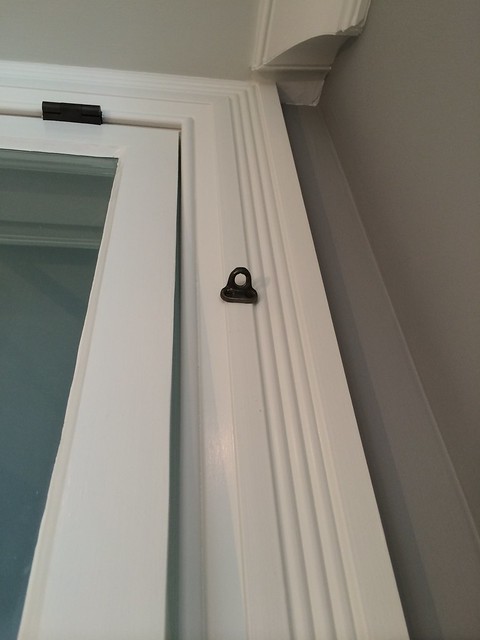
<p>Once you know where the clasp will go on your moulding, hold the whole assembly in place and mark your screw locations. While continuing to hold it all in place, climb onto a stool or ladder and place the upper support bracket about 1" above the lift's hinge. Then mark those screw locations. Remove and drill your pilot holes based on the marks.</p>
<p>
</p>
<div class="MediaContainer PhotoContainer"><a href="https://farm4.staticflickr.com/3897/14979745525_ed8891a917_z.jpg" rel="PhotoPopup" popupheight="640" popupwidth="480"><img alt="" src="https://farm4.staticflickr.com/3897/14979745525_ed8891a917.jpg" width="375" height="500" style="border-width: 0px; border-style: solid;" /></a></div>
<p>This upper support is one of the rod's guides and needs to be high enough not to interfere with the lifting of the transom rod, but low enough to keep the rod in place when it's totally lowered. </p>
<p>
</p>
<div class="MediaContainer PhotoContainer"><a href="https://farm6.staticflickr.com/5568/14976655031_64a593ee79_z.jpg" rel="PhotoPopup" popupheight="640" popupwidth="480"><img alt="" src="https://farm6.staticflickr.com/5568/14976655031_64a593ee79.jpg" width="375" height="500" style="border-width: 0px; border-style: solid;" /></a></div>
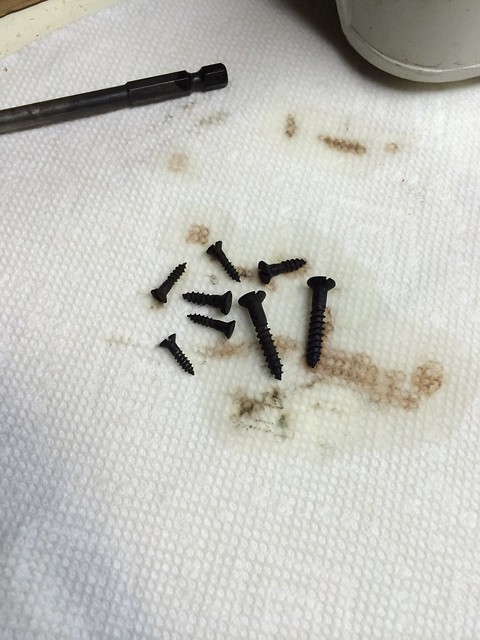
<p>We're using a combination of #4 (for the supports), #6 (for the clasp), and #8 (for the bracket) screws, so pilot hole sizes vary. We pre-antiqued our screws gun blue, making them appear aged and black to fit better with the hardware. You can ready more about that process on our <a href="http://www.oldtownhome.com/2012/2/24/How-To-Easily-Antique-Screws/">how to antique screws</a> post. I know, gripping stuff.</p>
<p>
</p>
<div class="MediaContainer PhotoContainer"><a href="https://farm6.staticflickr.com/5592/14979389182_6c3b3862f1_z.jpg" rel="PhotoPopup" popupheight="640" popupwidth="480"><img alt="" src="https://farm6.staticflickr.com/5592/14979389182_6c3b3862f1.jpg" width="375" height="500" style="border-width: 0px; border-style: solid;" /></a></div>
<p>Placing everything is pretty simple. Just secure the clasp and supports in your pilot holes and you're ready to move on. The middle support piece is still not attached at this point. </p>
<p>Next, pinch the clasp and lower the rod so that the hinge assembly, when collapsed against the wall, puts the top of the mount bracket near the upper support piece, and the upper section of the rod is still within that same support. This gives you the position of the rod when the transom is fully closed.</p>
<p>Climb back up onto the stool/ladder and position the lift mounting bracket against the sash to determine and mark the screw hole locations for the mounting bracket.</p>
<p>
</p>
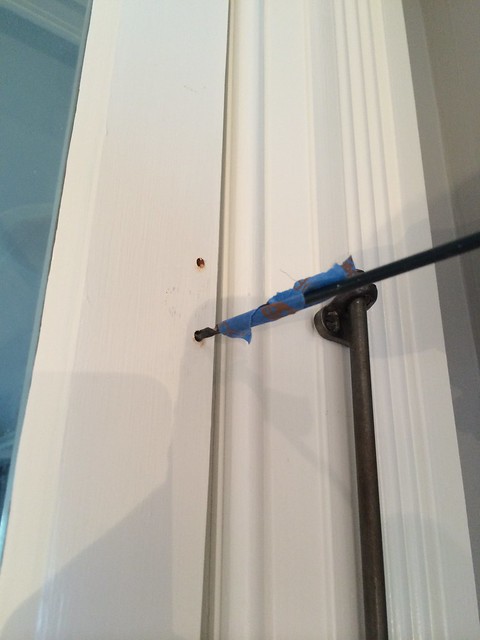
<div class="MediaContainer PhotoContainer"><a href="https://farm6.staticflickr.com/5586/14793064159_77cdeda676_z.jpg" rel="PhotoPopup" popupheight="640" popupwidth="480"><img alt="" src="https://farm6.staticflickr.com/5586/14793064159_77cdeda676.jpg" width="375" height="500" style="border-width: 0px; border-style: solid;" /></a></div>
<p>When it comes time to drill the screw holes for the mounting bracket, it's best to put a little bit of tape on your drill bit to mark the depth you want to drill based on your screw length. I like to do this whenever I'm drilling a pilot hole on something that I could accidentally punch through the other side on, ruining my day and possibly my life.</p>
<p>
</p>
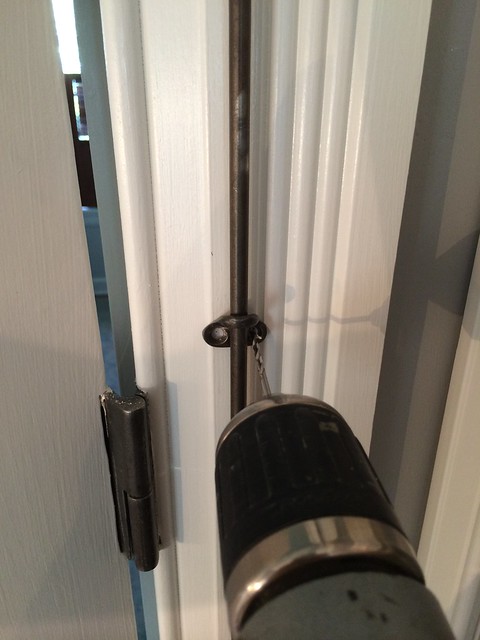
<div class="MediaContainer PhotoContainer"><a href="https://farm4.staticflickr.com/3859/14979397982_6ff83b540d_z.jpg" rel="PhotoPopup" popupheight="640" popupwidth="480"><img alt="" src="https://farm4.staticflickr.com/3859/14979397982_6ff83b540d.jpg" width="375" height="500" style="border-width: 0px; border-style: solid;" /></a></div>
<p>Once your pilot holes are in place, simply drive your screws to secure the mount.</p>
<p>The final step is simple. Position your middle support bracket where it will not impede the function of the lift, drill pilot holes, and attach the final support with your screws...</p>
<p>
</p>
<div class="MediaContainer PhotoContainer"><a href="https://farm6.staticflickr.com/5556/14793137358_98d55c7639_z.jpg" rel="PhotoPopup" popupheight="640" popupwidth="480"><img alt="" src="https://farm6.staticflickr.com/5556/14793137358_98d55c7639.jpg" width="375" height="500" style="border-width: 0px; border-style: solid;" /></a></div>
<p>...then take a step back to admire your fully functional transom window lift.&nbsp;</p>
<p>
</p>
<div class="MediaContainer PhotoContainer"><a href="https://farm6.staticflickr.com/5575/14976647181_a46a1c4cd9_z.jpg" rel="PhotoPopup" popupheight="640" popupwidth="480"><img alt="" src="https://farm6.staticflickr.com/5575/14976647181_a46a1c4cd9.jpg" width="375" height="500" style="border-width: 0px; border-style: solid;" /></a></div>
<p>I believe the transom lift hardware is actually one of the more rare items in today's old homes, as they're fairly delicate and many original lifts have been damaged and removed over the years. I've only seen a handful in all of the old homes and buildings we've been through, and most of those are completely painted over and barely or non functional.</p>
<p>I'm very proud to have not only made our transom windows functional, but to have also built such an accurate reproduction of our other transom window that future owners of our home may mistake it for an original elements...at least until they read our blog. ;-)</p><p><a href="https://www.oldtownhome.com/2014/8/20/Throw-it-Over-the-Transom-and-See-What-Happens/">Read Full Post</a></p>]]></content>
    <category term="Hardware" />
    <category term="Header Image" />
    <category term="Master Bathroom" />
    <category term="Transoms" />
    <PostImage>https://farm4.staticflickr.com/3880/14980360485_e4df8d1bf9.jpg</PostImage>
    <media:thumbnail url="https://farm4.staticflickr.com/3880/14980360485_e4df8d1bf9_t.jpg" />
    <ExtensionElements>
      <Item>PostImage</Item>
      <Item>media:thumbnail</Item>
    </ExtensionElements>
  </entry>
  <entry>
    <guid>0c43e3e2-449c-4db2-bc02-e9b747eea4af</guid>
    <id>https://www.oldtownhome.com/2011/12/5/And-the-Winner-of-the-Great-House-Numbers-Debate-is/</id>
    <title>And the Winner of the Great House Numbers Debate is...</title>
    <summary type="html"><![CDATA[<p>I'm so happy to report that we've finally come to a decision in the <a href="http://www.oldtownhome.com/2011/10/13/The-Great-House-Numbers-Debate/index.aspx">great house numbers debate</a>&nbsp;of 2011. As you may recall, Alex and I have been on the fence when it comes to what we wanted to do with the transom window over our front door. And with all the work we've been doing this last year to <a href="http://www.oldtownhome.com/vestibule/index.aspx">reconfigure and renovate our vestibule</a>, the time has come for us to pull the trigger.</p>
<p>The options we debated between were:</p>
<p>
</p>
<ol>
    <li>Numbers on a plate or plaque directly on the house.</li>
    <li>Numbers on the door.</li>
    <li>Numbers in the transom.</li>
    <li>Other (like painted on the sidewalk, graffiti on the stairs, or some other random display that may work in theory but would never work in reality).</li>
</ol>
<p>After many thoughtful, insightful, and helpful comments from all of our readers, and after much deliberation the winner is...(drum roll please)...
</p>
<p><span class="Apple-tab-span" style="white-space: pre;">	</span>3. Numbers in the transom with original glass!</p>
<p>It was a tough decision, and not one made lightly, largely due to the fact that we had purchased a leaded glass window for the space nearly nine years ago. Not only do I love the leaded glass, but I consider it an investment of both money and time. Time you might wonder? Well, the leaded glass, like many other things in our house, has been moved from one precarious location to another in our basement hellhole, and I consider it no small feat that it's survived the last nine years. I'm sure it will keep moving over the next several years and will ultimately be broken only when we finally figure out a place where we want to install it. &nbsp;</p>
<p>But alas, I finally caved to Alex's pressure to pursue the numbers in the transom option, in part because I think it will look really classic, in part because I dreaded the thought of trying to keep the leaded glass clean, in part because most of our readers suggested this route, and in part because I didn't particularly love any of the other house number options. Lots of parts went into this decision, that's for sure.</p>
<p>We had a couple of options on how to proceed with these numbers. The classic approach was to apply gold leaf and hand paint the numbers and their black shadow/outline on the window ourselves. You might be able to guess, but Alex was pushing for this option. Though I have no doubt we could tackle this, there are just too many other projects going on right now, so I had to veto his gumption as I had found a nearly as authentic option that was far easier to implement.</p>
<p>We opted to work with a Washington, DC-based company called <a href="http://www.housenumberlab.com/" target="_blank">The House Number Lab</a>. They offer a large assortment of number styles as well as materials to choose from, each in historically accurate and completely custom fonts and sizes that are tailored to our specific install. After careful consideration, and some internal debate, we settled on a 22 carat matte gold in "The Grant B" style font with a heavy drop shadow to the left in black. We think it's a classic font that will work well with the style of our home, but we went with the "B" option which introduces a small extra flourish on the numbers for a little extra oomph.&nbsp;Who knew there would be so many options?&nbsp;</p>
<p></p> <a href="https://www.oldtownhome.com/2011/12/5/And-the-Winner-of-the-Great-House-Numbers-Debate-is/">more</a>]]></summary>
    <published>2011-12-05T09:12:00.000-05:00</published>
    <updated>2011-12-05T09:12:00.000-05:00</updated>
    <link rel="alternate" href="https://www.oldtownhome.com/2011/12/5/And-the-Winner-of-the-Great-House-Numbers-Debate-is/" />
    <author>
      <name>Wendy</name>
    </author>
    <content type="html"><![CDATA[<p>I'm so happy to report that we've finally come to a decision in the <a href="http://www.oldtownhome.com/2011/10/13/The-Great-House-Numbers-Debate/index.aspx">great house numbers debate</a>&nbsp;of 2011. As you may recall, Alex and I have been on the fence when it comes to what we wanted to do with the transom window over our front door. And with all the work we've been doing this last year to <a href="http://www.oldtownhome.com/vestibule/index.aspx">reconfigure and renovate our vestibule</a>, the time has come for us to pull the trigger.</p>
<p>The options we debated between were:</p>
<p>
</p>
<ol>
    <li>Numbers on a plate or plaque directly on the house.</li>
    <li>Numbers on the door.</li>
    <li>Numbers in the transom.</li>
    <li>Other (like painted on the sidewalk, graffiti on the stairs, or some other random display that may work in theory but would never work in reality).</li>
</ol>
<p>After many thoughtful, insightful, and helpful comments from all of our readers, and after much deliberation the winner is...(drum roll please)...
</p>
<p><span class="Apple-tab-span" style="white-space: pre;">	</span>3. Numbers in the transom with original glass!</p>
<p>It was a tough decision, and not one made lightly, largely due to the fact that we had purchased a leaded glass window for the space nearly nine years ago. Not only do I love the leaded glass, but I consider it an investment of both money and time. Time you might wonder? Well, the leaded glass, like many other things in our house, has been moved from one precarious location to another in our basement hellhole, and I consider it no small feat that it's survived the last nine years. I'm sure it will keep moving over the next several years and will ultimately be broken only when we finally figure out a place where we want to install it. &nbsp;</p>
<p>But alas, I finally caved to Alex's pressure to pursue the numbers in the transom option, in part because I think it will look really classic, in part because I dreaded the thought of trying to keep the leaded glass clean, in part because most of our readers suggested this route, and in part because I didn't particularly love any of the other house number options. Lots of parts went into this decision, that's for sure.</p>
<p>We had a couple of options on how to proceed with these numbers. The classic approach was to apply gold leaf and hand paint the numbers and their black shadow/outline on the window ourselves. You might be able to guess, but Alex was pushing for this option. Though I have no doubt we could tackle this, there are just too many other projects going on right now, so I had to veto his gumption as I had found a nearly as authentic option that was far easier to implement.</p>
<p>We opted to work with a Washington, DC-based company called <a href="http://www.housenumberlab.com/" target="_blank">The House Number Lab</a>. They offer a large assortment of number styles as well as materials to choose from, each in historically accurate and completely custom fonts and sizes that are tailored to our specific install. After careful consideration, and some internal debate, we settled on a 22 carat matte gold in "The Grant B" style font with a heavy drop shadow to the left in black. We think it's a classic font that will work well with the style of our home, but we went with the "B" option which introduces a small extra flourish on the numbers for a little extra oomph.&nbsp;Who knew there would be so many options?&nbsp;</p>
<p></p>
<p>Honestly though we had a tougher time choosing the material than the font. It just boils down to the fact that we're just not big fans of gold. If you look around our house (or at us), you'll notice that our wedding rings, wedding china, picture frames, mirrors, and accessories all are silver. Chandeliers that once were brass or gold, I've long since spray painted another color. So it was tough for us to go against our silver tendencies and choose the more classic, and more historically accurate gold tone. But as a "meet you in the middle" decision, we went with the matte over the burnished gold, for a more muted hue. &nbsp;</p>
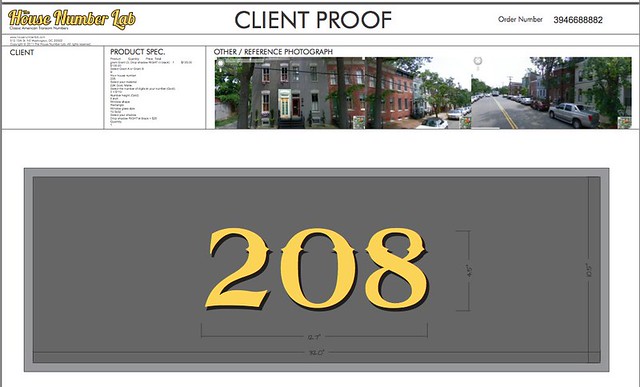
<p>Glenn, owner of The House Numbers Lab, was great to work with. We opted to see proofs before having the numbers made -- an option that adds time to the order but is totally worth it in my opinion. Initially we placed the order for 5" high numbers, but after seeing the proof, and hanging the to-scale print out in our transom, I felt it looked just a little too imposing. After sending Glenn an email, he quickly sent us back 4" and 4.5" versions to take a look at. The small adjustment made all the difference, and we knew the 4" was just right.&nbsp;</p>
<p>
</p>
<div class="MediaContainer PhotoContainer"><a href="http://farm8.staticflickr.com/7148/6457808751_7245258758_z.jpg" rel="PhotoPopup" popupheight="387" popupwidth="640"><img alt="" src="https://farm8.staticflickr.com/7148/6457808751_7245258758.jpg" width="500" height="303" style="border-width: 0px;border-style: solid;"></a></div>
<p>After a several weeks-long wait for our order (due to an expected delay by the gold supplier), our numbers arrived the middle of last week in a neatly packaged protective box. We were excited to get them up on the window as it marked a significant step toward the completion of our <a href="http://www.oldtownhome.com/curb-appeal/index.aspx">Curb Appeal 2.0</a>, but with the weather cooling and the sun setting so early, we had to wait for a good warm weather day to apply them above 50 degrees.&nbsp;</p>
<p>
</p>
<div class="MediaContainer PhotoContainer"><a href="http://farm8.staticflickr.com/7144/6457546365_2220638dd6_z.jpg" rel="PhotoPopup" popupheight="480" popupwidth="640"><img alt="" src="https://farm8.staticflickr.com/7144/6457546365_2220638dd6.jpg" width="500" height="375" style="border-width: 0px;border-style: solid;"></a></div>
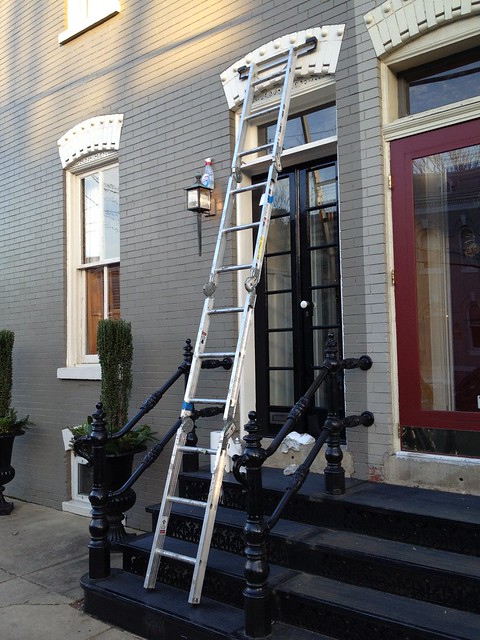
<p>Yesterday was a downright balmy December day with highs approaching 60 degrees, so we decided to pull the trigger and go for it.&nbsp;The House Numbers Lab website includes detailed instructions on how to best install, and in addition to the number decals, the package comes with a plastic&nbsp;squeegee to smooth the numbers during install and a dry erase marker to properly mark the center of the window. We just needed to grab some supplies to clean the window and a pair of scissors, tape, a tape measure, and the ladder to aid in the install.</p>
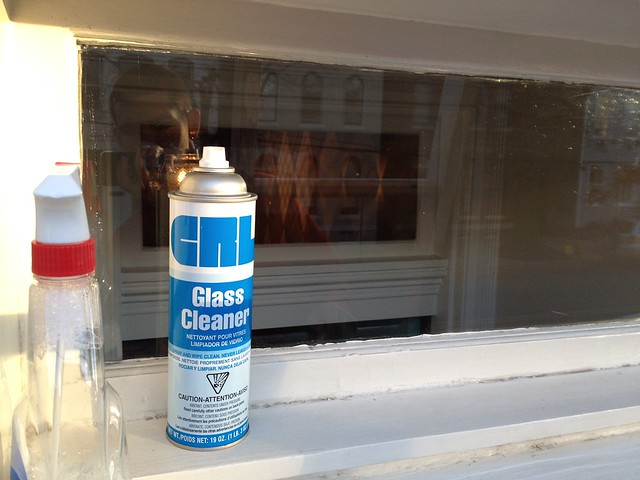
<p>Alex kicked off the project by setting up the ladder to clean the windows, inside and out. The glass was a mess because of the road dirt that typically collects outside, so I'm always happy when a project calls for cleaning the transom window.&nbsp;</p>
<p>
</p>
<div class="MediaContainer PhotoContainer"><a href="http://farm8.staticflickr.com/7009/6456397121_8f74c3c883_z.jpg" rel="PhotoPopup" popupheight="640" popupwidth="480"><img alt="" src="https://farm8.staticflickr.com/7009/6456397121_8f74c3c883.jpg" width="375" height="500" style="border-width: 0px;border-style: solid;"></a></div>
<p>He used a regular window cleaner followed by an alcohol based glass cleaner that we received years ago when installing our show glass doors. This is meant to leave an ultra clean surface that is perfect for the&nbsp;adherence&nbsp;of sticky substances to a clean window.</p>
<p>
</p>
<div class="MediaContainer PhotoContainer"><a href="http://farm8.staticflickr.com/7151/6456389209_966ebd8264_z.jpg" rel="PhotoPopup" popupheight="480" popupwidth="640"><img alt="" src="https://farm8.staticflickr.com/7151/6456389209_966ebd8264.jpg" width="500" height="375" style="border-width: 0px;border-style: solid;"></a></div>
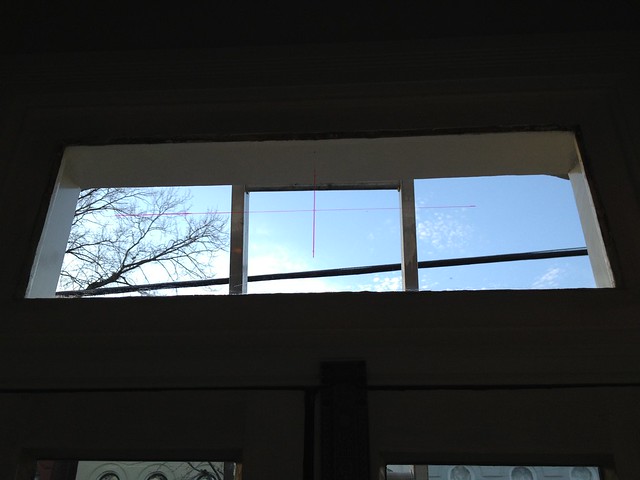
<p>Once everything was clean, he measured the absolute center point of the transom glass and made a cross using the dry erase marker on the outside of the glass to give the numbers a guide for install.</p>
<p>
</p>
<div class="MediaContainer PhotoContainer"><a href="http://farm8.staticflickr.com/7141/6456395887_e2d8a898f6_z.jpg" rel="PhotoPopup" popupheight="480" popupwidth="640"><img alt="" src="https://farm8.staticflickr.com/7141/6456395887_e2d8a898f6.jpg" width="500" height="375" style="border-width: 0px;border-style: solid;"></a></div>
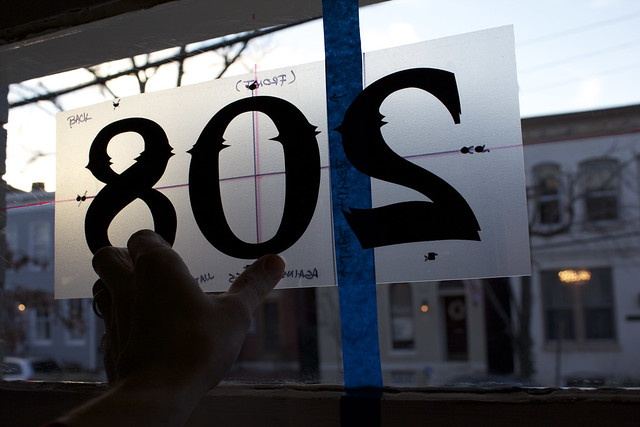
<p>The next step was to tape the numbers to the inside of the window and take a step back to be sure they were level, centered, and looked the way we wanted them too. This is an important step because there is no turning back once they are up on the glass.&nbsp;</p>
<p>
</p>
<div class="MediaContainer PhotoContainer"><a href="http://farm8.staticflickr.com/7151/6456897021_112ac65c41_z.jpg" rel="PhotoPopup" popupheight="427" popupwidth="640"><img alt="" src="https://farm8.staticflickr.com/7151/6456897021_112ac65c41.jpg" width="500" height="333" style="border-width: 0px;border-style: solid;"></a></div>
<p>We decided that they needed to come up a little bit on the right since the window is a little out of level. So we made that slight adjustment and Alex got to work sticking them onto the glass.&nbsp;</p>
<p>Following the instructions closely, Alex peeled, stuck, squeegeed, and smoothed until the numbers were fully in place.</p>
<p>
</p>
<div class="MediaContainer PhotoContainer"><a href="http://farm8.staticflickr.com/7161/6457049439_04fe1ee3fd_z.jpg" rel="PhotoPopup" popupheight="640" popupwidth="427"><img alt="" src="https://farm8.staticflickr.com/7161/6457049439_04fe1ee3fd.jpg" width="333" height="500" style="border-width: 0px;border-style: solid;"></a></div>
<p>He then carefully (and I mean carefully -- it took him forever) peeled the backing off of the numbers. I think we were both getting excited, but he took his time to be sure the numbers didn't peel off of the house.</p>
<p>
</p>
<div class="MediaContainer PhotoContainer"><a href="http://farm8.staticflickr.com/7018/6457086257_bbe9728ce6_z.jpg" rel="PhotoPopup" popupheight="427" popupwidth="640"><img alt="" src="https://farm8.staticflickr.com/7018/6457086257_bbe9728ce6.jpg" width="500" height="333" style="border-width: 0px;border-style: solid;"></a></div>
<p>A few minutes later we had the numbers fully installed. The final step was to wipe off the red cross on the outside of the window and remove the extra dots from the interior.</p>
<p>
</p>
<div class="MediaContainer PhotoContainer"><a href="http://farm8.staticflickr.com/7146/6457091259_3d5eea9fed_z.jpg" rel="PhotoPopup" popupheight="427" popupwidth="640"><img alt="" src="https://farm8.staticflickr.com/7146/6457091259_3d5eea9fed.jpg" width="500" height="333" style="border-width: 0px;border-style: solid;"></a></div>
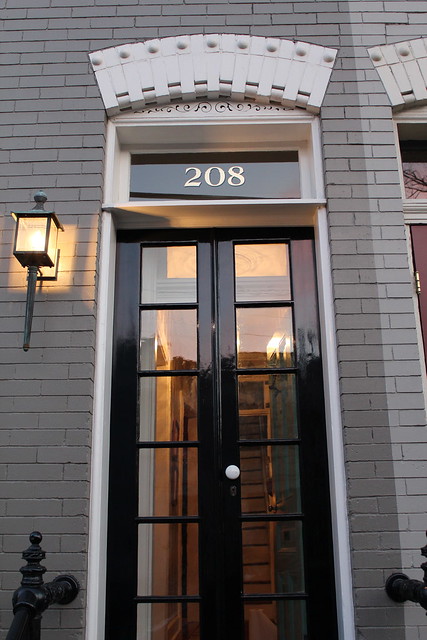
<p>The final and fully installed numbers turned out really nice! It was wonderful, it didn't require either of us spending hours with gold leaf, stencils, and free hand painting over the course of several days, though I'm sure that would have been very <em>fun</em>. (Sarcasm fully intended.)&nbsp;</p>
<p>
</p>
<div class="MediaContainer PhotoContainer"><a href="http://farm8.staticflickr.com/7160/6457109145_66d87a2cce_z.jpg" rel="PhotoPopup" popupheight="640" popupwidth="427"><img alt="" src="https://farm8.staticflickr.com/7160/6457109145_66d87a2cce.jpg" width="333" height="500" style="border-width: 0px;border-style: solid;"></a></div>
<p>And for those of you following the front vestibule progress and our <a href="http://www.oldtownhome.com/2011/11/22/Getting-a-Handle-on-the-French-Door-Projectand-We-Want-Your-Opinion/index.aspx">debate over the color of the door knob</a>, we've pulled the trigger and ordered a new (well, old actually) knob in black. It's on its way.&nbsp;</p>
<p>What do you think? Did we make the right choice? Do you like the gold we chose? I'd say we're both really happy with our selection. Our house numbers really fit in with the rest of the area and the look is very historically accurate to the period of our home. I think we can call this one mission accomplished.</p>
<div id="radePasteHelper" style="border:0px solid red;position: absolute; left: -10000px; top: 0px; width: 1px; height: 1px; overflow-x: hidden; overflow-y: hidden;">
<li style="list-style-image: none; font-size: 14px; line-height: 23px; background-color: #fafaf8;">Numbers on a plate or plaque directly on the house.</li>
<li style="list-style-image: none; font-size: 14px; line-height: 23px; background-color: #fafaf8;">Numbers on the door.</li>
<li style="list-style-image: none; font-size: 14px; line-height: 23px; background-color: #fafaf8;">Numbers in the transom.</li>
<li style="list-style-image: none; font-size: 14px; line-height: 23px; background-color: #fafaf8;">Other (like painted on the sidewalk, graffiti on the stairs, or some other random display that may work in theory but would never work in reality).</li>
</div><p><a href="https://www.oldtownhome.com/2011/12/5/And-the-Winner-of-the-Great-House-Numbers-Debate-is/">Read Full Post</a></p>]]></content>
    <category term="Curb Appeal" />
    <category term="Entryway" />
    <category term="Header Image" />
    <category term="Transoms" />
    <category term="Vestibule" />
    <PostImage>http://farm8.staticflickr.com/7151/6457744875_27b6859270_z.jpg</PostImage>
    <media:thumbnail url="https://farm8.staticflickr.com/7151/6457744875_27b6859270_t.jpg" />
    <ExtensionElements>
      <Item>PostImage</Item>
      <Item>media:thumbnail</Item>
    </ExtensionElements>
  </entry>
  <entry>
    <guid>e3006f17-36af-4968-a23e-4fa1bb1a1a39</guid>
    <id>https://www.oldtownhome.com/2011/6/22/Transoms-A-Window-of-Possibilities/</id>
    <title>Transoms: A Window of Possibilities</title>
    <summary type="html"><![CDATA[<p>Like many older homes, one of the key period pieces in our home is the transom windows that still exist over most of the house's doorways. Strictly a utilitarian feature of historic architecture, transom windows were used to both allow additional light into or out of a room, and to allow easier passage of heat or cool air to flow between rooms. Though offering utility in their implementation, their classic looks are a signature element of our home that we've painstakingly cared for and restored.</p>
<p>Throughout the renovation of our entry hallway and vestibule, we've been working to bring the charm and&nbsp;historic&nbsp;accuracy back to our entryway, including a full restoration of the transom above the interior front door. We're lucky enough to have the original and unbroken wavy glass in this transom window, a feature that is often hit or miss throughout older homes. When the sunlight comes in through this window, the light is slightly distorted by the uneven glass and looks quite nice on the walls or floor. However, this transom was not an operable transom window, meaning it did not open to allow the passage of air.</p>
<div class="MediaContainer PhotoContainer"><a href="http://farm6.static.flickr.com/5196/5859777916_bf770a0097_z.jpg" rel="PhotoPopup" popupwidth="478" popupheight="640"><img alt="" width="374" height="500" style="border:0px solid; border-image: initial;" src="https://farm6.static.flickr.com/5196/5859777916_bf770a0097.jpg"></a></div>
<p>Typically, transom windows were configured in a way that would allow a person to open them when they wanted to let heat flow between rooms, or to allow the creation of a draft to cool the home. The mechanisms to allow opening of transoms were fairly vast in their construction and styles. There were bottom hinged transoms with latches and chains that had a long pole to pull the latch open, side hinged transoms that opened like doors, and top hinged transoms with fixed lifts that could be hand operated.</p>
<div class="MediaContainer PhotoContainer"><a href="http://farm6.static.flickr.com/5277/5859246463_2aab73ea0a_z.jpg" rel="PhotoPopup" popupwidth="640" popupheight="480"><img alt="" width="240" height="180" style="border:0px solid; border-image: initial;" src="https://farm6.static.flickr.com/5277/5859246463_2aab73ea0a_m.jpg"></a> <a href="http://farm6.static.flickr.com/5032/5859810088_bb53dca602_z.jpg" rel="PhotoPopup" popupwidth="633" popupheight="506"><img alt="" width="240" height="192" style="border:0px solid; border-image: initial;" src="https://farm6.static.flickr.com/5032/5859810088_bb53dca602_m.jpg"></a></div>
<p>However, the transom above our front door was a "fixed" transom, and did not open in any way. Below is a photo of our window from early on in our renovation process, with all of its bumpy paint intact.</p>
<p></p></img></img></img> <a href="https://www.oldtownhome.com/2011/6/22/Transoms-A-Window-of-Possibilities/">more</a>]]></summary>
    <published>2011-06-22T10:15:00.000-04:00</published>
    <updated>2011-06-22T10:15:00.000-04:00</updated>
    <link rel="alternate" href="https://www.oldtownhome.com/2011/6/22/Transoms-A-Window-of-Possibilities/" />
    <author>
      <name>Alex</name>
    </author>
    <content type="html"><![CDATA[<p>Like many older homes, one of the key period pieces in our home is the transom windows that still exist over most of the house's doorways. Strictly a utilitarian feature of historic architecture, transom windows were used to both allow additional light into or out of a room, and to allow easier passage of heat or cool air to flow between rooms. Though offering utility in their implementation, their classic looks are a signature element of our home that we've painstakingly cared for and restored.</p>
<p>Throughout the renovation of our entry hallway and vestibule, we've been working to bring the charm and&nbsp;historic&nbsp;accuracy back to our entryway, including a full restoration of the transom above the interior front door. We're lucky enough to have the original and unbroken wavy glass in this transom window, a feature that is often hit or miss throughout older homes. When the sunlight comes in through this window, the light is slightly distorted by the uneven glass and looks quite nice on the walls or floor. However, this transom was not an operable transom window, meaning it did not open to allow the passage of air.</p>
<div class="MediaContainer PhotoContainer"><a href="http://farm6.static.flickr.com/5196/5859777916_bf770a0097_z.jpg" rel="PhotoPopup" popupwidth="478" popupheight="640"><img alt="" width="374" height="500" style="border:0px solid; border-image: initial;" src="https://farm6.static.flickr.com/5196/5859777916_bf770a0097.jpg"></a></div>
<p>Typically, transom windows were configured in a way that would allow a person to open them when they wanted to let heat flow between rooms, or to allow the creation of a draft to cool the home. The mechanisms to allow opening of transoms were fairly vast in their construction and styles. There were bottom hinged transoms with latches and chains that had a long pole to pull the latch open, side hinged transoms that opened like doors, and top hinged transoms with fixed lifts that could be hand operated.</p>
<div class="MediaContainer PhotoContainer"><a href="http://farm6.static.flickr.com/5277/5859246463_2aab73ea0a_z.jpg" rel="PhotoPopup" popupwidth="640" popupheight="480"><img alt="" width="240" height="180" style="border:0px solid; border-image: initial;" src="https://farm6.static.flickr.com/5277/5859246463_2aab73ea0a_m.jpg"></a> <a href="http://farm6.static.flickr.com/5032/5859810088_bb53dca602_z.jpg" rel="PhotoPopup" popupwidth="633" popupheight="506"><img alt="" width="240" height="192" style="border:0px solid; border-image: initial;" src="https://farm6.static.flickr.com/5032/5859810088_bb53dca602_m.jpg"></a></div>
<p>However, the transom above our front door was a "fixed" transom, and did not open in any way. Below is a photo of our window from early on in our renovation process, with all of its bumpy paint intact.</p>
<p></p>
<div class="MediaContainer PhotoContainer"><a href="http://farm6.static.flickr.com/5261/5643626657_a00c8d273b_z.jpg" rel="PhotoPopup" popupwidth="640" popupheight="480"><img alt="" width="500" height="375" style="border:0px solid; border-image: initial;" src="https://farm6.static.flickr.com/5261/5643626657_a00c8d273b.jpg"></a></div>
<p>Originally, we thought that it had simply been painted shut, but after stripping the paint from the window and molding, we could see that it was held in place by two very old cut nails and there were no obvious signs of hinges or transom window hardware. Since our home was a simple and modest home, we believe that the window never actually opened and was left in a fixed position to save the builder some money (trust me, this isn't the only place in our home the builder cut some corners to save money).</p>
<div class="MediaContainer PhotoContainer"><a href="http://farm6.static.flickr.com/5230/5643643551_5c8efa1a63_z.jpg" rel="PhotoPopup" popupwidth="640" popupheight="480"><img alt="" width="500" height="375" style="border:0px solid; border-image: initial;" src="https://farm6.static.flickr.com/5230/5643643551_5c8efa1a63.jpg"></a></div>
<p>We decided that, though the window never opened in the past, that was no reason not to make an operable transom now. But the only way I would do this was to make it look like it has always been functional.&nbsp;</p>
<p>The first item we had to tackle in this project was the sourcing of the transom window hardware. There are many reproduction items available from various manufacturers. Each one is usually in a polished brass finish, runs about $200-$300, and simply wouldn't look right with the decor and style of our home. Besides, I don't like to use reproduction hardware in our house when there is typically a way to find authentic hardware with just&nbsp;a little patience. After striking out at some salvage yards, either due to the asking price or the condition of the transom lifts, I went to my favorite secondary source for antique hardware: eBay.</p>
<p>With a search for "transom window lift," "transom window rod," or "transom window hardware," you can usually find a decent amount of inventory. I was able to get a single full set of hardware with all brackets in great shape for about $40 with shipping. The hardware we bought is the same style as the four rods in the following photo.</p>
<div class="MediaContainer PhotoContainer"><a href="http://farm6.static.flickr.com/5262/5859833692_c8bc87e57d_z.jpg" rel="PhotoPopup" popupwidth="640" popupheight="166"><img alt="" width="500" height="129" style="border:0px solid; border-image: initial;" src="https://farm6.static.flickr.com/5262/5859833692_c8bc87e57d.jpg"></a></div>
<p>Next, I found a simple set of 2" x 2" cast iron butt hinges that we would affix to the top of the window.</p>
<p>Once the hardware was in hand, I carefully removed the transom from its position above the door. I felt a little bad since it has been in its location for 125 years, but felt good that we were adding a piece of period function. Once I removed the window, it was obvious that it had never opened, the wood beside the window had never actually been painted.&nbsp;</p>
<p>Using a chisel, I mortised the hinges hinges into the top of the transom and mounted it within the transom opening. It isn't the easiest thing in the world, but with Wendy's help I was able to hang the window in place without dropping or breaking it, my biggest fear when working with old and original glass.</p>
<div class="MediaContainer PhotoContainer"><a href="http://farm3.static.flickr.com/2689/5859306833_299467d1d0_z.jpg" rel="PhotoPopup" popupwidth="640" popupheight="478"><img alt="" width="500" height="374" style="border:0px solid; border-image: initial;" src="https://farm3.static.flickr.com/2689/5859306833_299467d1d0.jpg"></a></div>
<p>Once the hinges were in place, I started to work on mounting the transom lift hardware. It is pretty straight forward, you just need to make sure the hardware moves enough to open your window far enough to give it the function it needs. I tend to mount the lift about midway up the side of the window. This will usually give it enough lift. I did need to drill a hold through the ledge below the window. That ledge was put in place well after the house was built, but I didn't want to remove it since the door we had purchased was sized properly based on the existing opening. Oh well...</p>
<p>The actual attachment of the lift is done with a handful of small screws. I added a squirt or two of WD40 to get the mechanism working squeak free, and we had an operable transom window.</p>
<div class="MediaContainer PhotoContainer"><a href="http://farm4.static.flickr.com/3205/5859314801_0b0a275a08_z.jpg" rel="PhotoPopup" popupwidth="478" popupheight="640"><img alt="" width="374" height="500" style="border:0px solid; border-image: initial;" src="https://farm4.static.flickr.com/3205/5859314801_0b0a275a08.jpg"></a></div>
<p>We added some function to our home that was always intended but was previously left out, and I'm quite happy about that.</p>
<p>
</p>
<div class="MediaContainer PhotoContainer"><a href="http://farm6.static.flickr.com/5069/5859889728_2b08c16fde_z.jpg" rel="PhotoPopup" popupwidth="478" popupheight="640"><img alt="" width="374" height="500" style="border:0px solid; border-image: initial;" src="https://farm6.static.flickr.com/5069/5859889728_2b08c16fde.jpg"></a></div>
<p>Fully open, the transom allows a decent amount of airflow. Once we have our new vestibule configuration, we'll be able to open the outer front doors, keep the inner door closed, and open the transom to get a nice cross breeze going through the house.</p>
<div class="MediaContainer PhotoContainer"><a href="http://farm6.static.flickr.com/5027/5859874228_927161c101_z.jpg" rel="PhotoPopup" popupwidth="640" popupheight="478"><img alt="" width="500" height="374" style="border:0px solid; border-image: initial;" src="https://farm6.static.flickr.com/5027/5859874228_927161c101.jpg"></a></div>
<p>With this project done on our vestibule overhaul, let's take a look at what we have left to tackle.</p>
<p><span style="line-height: 23px; border-collapse: collapse; font-size: 14px;"></span></p>
<ol>
    <li style="padding-bottom: 0px; padding-left: 0px; padding-right: 0px; list-style-image: none; padding-top: 2px;"><span style="text-decoration: line-through;"><a href="http://www.oldtownhome.com/2011/6/13/Entry-Vestibule-The-Smallest-Room-in-the-House/index.aspx">Renovate the space, walls, ceiling, molding, strip, patch, paint</a></span> </li>
    <li style="padding-bottom: 0px; padding-left: 0px; padding-right: 0px; list-style-image: none; padding-top: 2px;"><span style="text-decoration: line-through;"><a href="http://www.oldtownhome.com/2011/6/15/Vestibule-Renovation-Part-2-Installing-the-Tile-In-Our-Tiny-Room/index.aspx">Install new tile floor</a> </span></li>
    <li style="padding-bottom: 0px; padding-left: 0px; padding-right: 0px; list-style-image: none; padding-top: 2px;">Purchase antique mail slot </li>
    <li style="padding-bottom: 0px; padding-left: 0px; padding-right: 0px; list-style-image: none; padding-top: 2px;">Replace&nbsp;interior doors&nbsp;with stripped and fitted salvaged door&nbsp; </li>
    <li style="padding-bottom: 0px; padding-left: 0px; padding-right: 0px; list-style-image: none; padding-top: 2px;">Replace&nbsp;exterior door with salvaged door after stripping and replacing glass panes </li>
    <li style="padding-bottom: 0px; padding-left: 0px; padding-right: 0px; list-style-image: none; padding-top: 2px;"><span style="text-decoration: line-through;">Make&nbsp;interior transom window operational </span></li>
    <li style="padding-bottom: 0px; padding-left: 0px; padding-right: 0px; list-style-image: none; padding-top: 2px;">Replace&nbsp;exterior transom window with either leaded glass or painted house numbers (we're not sure on this step yet)</li>
</ol>
<p>We're well on our way with this project and can't wait to finish it up.</p>
<p>Have you ever made a transom window that was painted shut operational again? Maybe added some function to your old home that didn't previously exist? Let us know the outcome and what you worked on.</p><p><a href="https://www.oldtownhome.com/2011/6/22/Transoms-A-Window-of-Possibilities/">Read Full Post</a></p>]]></content>
    <category term="eBay" />
    <category term="Entryway" />
    <category term="Header Image" />
    <category term="Projects:Home Improvement" />
    <category term="Salvage" />
    <category term="Transoms" />
    <category term="Vestibule" />
    <PostImage>http://farm6.static.flickr.com/5158/5860273060_f171cb08a7.jpg</PostImage>
    <media:thumbnail url="https://farm6.static.flickr.com/5158/5860273060_f171cb08a7_t.jpg" />
    <ExtensionElements>
      <Item>PostImage</Item>
      <Item>media:thumbnail</Item>
    </ExtensionElements>
  </entry>
</feed>