<?xml version="1.0" encoding="utf-8"?>
<feed xmlns="http://www.w3.org/2005/Atom" xmlns:media="http://search.yahoo.com/mrss/">
  <title>Old Town Home Category: 'How To'</title>
  <updated>2017-12-04T13:42:00.000-05:00</updated>
  <id>http://www.oldtownhome.com/how-to/index.atom</id>
  <link rel="alternate" href="http://www.oldtownhome.com/how-to/index.atom" />
  <author>
    <name>Alex and Wendy</name>
    <uri>http://www.oldtownhome.com/</uri>
    <email>wendy@oldtownhome.com</email>
  </author>
  <entry>
    <guid>e8a59de0-a877-41a6-a1f8-aec05e7c220d</guid>
    <id>https://www.oldtownhome.com/2017/12/4/How-To-Install-a-Salvaged-Door-with-Antique-Hinges/</id>
    <title>How To Install a Salvaged Door with Antique Hinges</title>
    <summary type="html"><![CDATA[<p>We love architectural salvage! But sometimes making something old fit in something new can be a challenge.&nbsp;</p><p>Over the years we've worked to install various old architectural salvage items in our home. From transom windows to doors and hinges to locks, using old materials in your renovation not only adds character you just can't get from new products, it can also make a renovation look appropriate in an old home, like it's always been that way.&nbsp;</p><p>For example, our entry hall before and after, with reproduction mouldings, a salvaged leaded glass transom with antique hardware, and minor reconfiguration.</p><p>
</p><p class="MediaContainer PhotoContainer"><a href="https://farm5.staticflickr.com/4548/38816782701_458e4b1a28_z.jpg" rel="PhotoPopup" popupheight="427" popupwidth="640"><img alt="" src="https://farm5.staticflickr.com/4548/38816782701_458e4b1a28.jpg" width="500" height="333" style="border-width: 0px; border-style: solid;"></a></p><p class="MediaContainer PhotoContainer"><em>Before and After of our entry hallway with salvaged leaded glass transom</em></p> <a href="https://www.oldtownhome.com/2017/12/4/How-To-Install-a-Salvaged-Door-with-Antique-Hinges/">more</a>]]></summary>
    <published>2017-12-04T13:42:00.000-05:00</published>
    <updated>2017-12-04T13:42:00.000-05:00</updated>
    <link rel="alternate" href="https://www.oldtownhome.com/2017/12/4/How-To-Install-a-Salvaged-Door-with-Antique-Hinges/" />
    <author>
      <name>Alex</name>
    </author>
    <content type="html"><![CDATA[<p>We love architectural salvage! But sometimes making something old fit in something new can be a challenge.&nbsp;</p>
<p>Over the years we've worked to install various old architectural salvage items in our home. From transom windows to doors and hinges to locks, using old materials in your renovation not only adds character you just can't get from new products, it can also make a renovation look appropriate in an old home, like it's always been that way.&nbsp;</p>
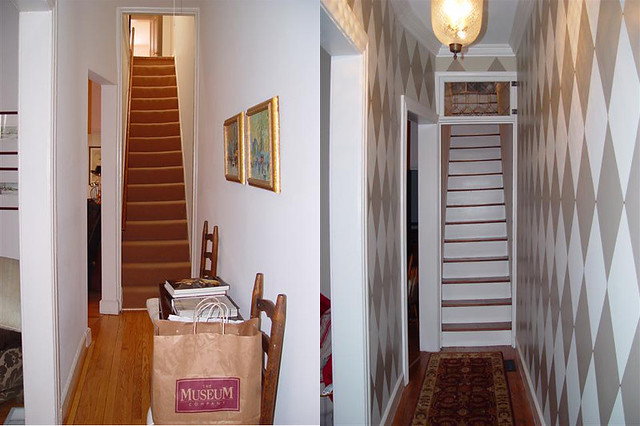
<p>For example, our entry hall before and after, with reproduction mouldings, a salvaged leaded glass transom with antique hardware, and minor reconfiguration.</p>
<p>
</p>
<p class="MediaContainer PhotoContainer"><a href="https://farm5.staticflickr.com/4548/38816782701_458e4b1a28_z.jpg" rel="PhotoPopup" popupheight="427" popupwidth="640"><img alt="" src="https://farm5.staticflickr.com/4548/38816782701_458e4b1a28.jpg" width="500" height="333" style="border-width: 0px; border-style: solid;" /></a></p>
<p class="MediaContainer PhotoContainer"><em>Before and After of our entry hallway with salvaged leaded glass transom</em></p>
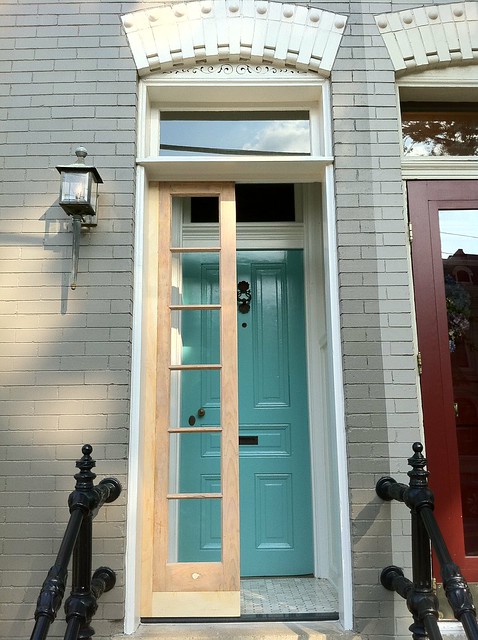
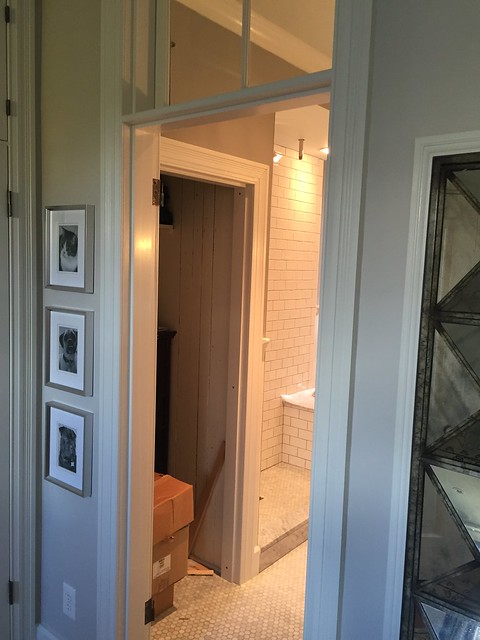
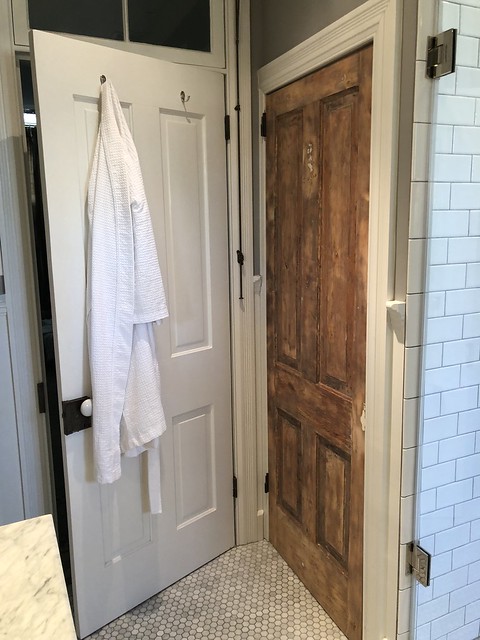
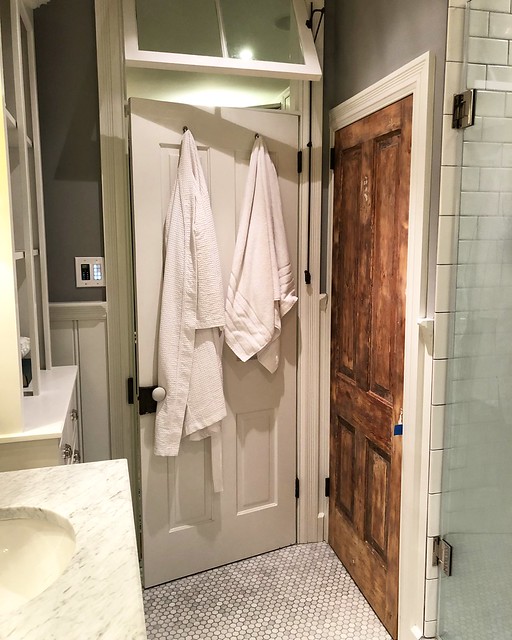
<p>Or our master bathroom door with custom reproduction door jamb, salvaged door, custom reproduction transom window with wavy glass, and salvaged hinges, door lock, and transom lift mechanism.</p>
<p>
</p>
<div class="MediaContainer PhotoContainer"><a href="https://farm6.staticflickr.com/5575/14976647181_a46a1c4cd9_z.jpg" rel="PhotoPopup" popupheight="640" popupwidth="480"><img alt="" src="https://farm6.staticflickr.com/5575/14976647181_a46a1c4cd9.jpg" width="375" height="500" style="border-width: 0px; border-style: solid;" /></a></div>
<p>But one of the most significant challenges we've faced in our home is the seemingly simple task of making an old salvaged door work in a jamb for which it wasn't built. However, we've accomplished this very job in scenarios where the door was too large, too small, out of square, or badly damaged. It wasn't without struggle, and we've gotten much better at it over the years. I'm sure there are tons of tips and tricks out there to make this process much easier, but the following is our process, advice, and useful guidance that has worked well for us in our experiences as we've honed our skills.</p>
<p>
</p>
<div class="MediaContainer PhotoContainer"><a href="https://farm7.staticflickr.com/6206/6134838451_33a1550ac7_z.jpg" rel="PhotoPopup" popupheight="640" popupwidth="478"><img alt="" src="https://farm7.staticflickr.com/6206/6134838451_33a1550ac7.jpg" width="374" height="500" style="border-width: 0px; border-style: solid;" /></a></div>
<p>Our master bathroom has a small closet nestled between the doorway to the room and the shower. This closet is both extra storage and houses many of my clothes.&nbsp;</p>
<p>
</p>
<div class="MediaContainer PhotoContainer"><a href="https://farm4.staticflickr.com/3949/15146304673_93ce356273_z.jpg" rel="PhotoPopup" popupheight="640" popupwidth="480"><img alt="" src="https://farm4.staticflickr.com/3949/15146304673_93ce356273.jpg" width="375" height="500" style="border-width: 0px; border-style: solid;" /></a></div>
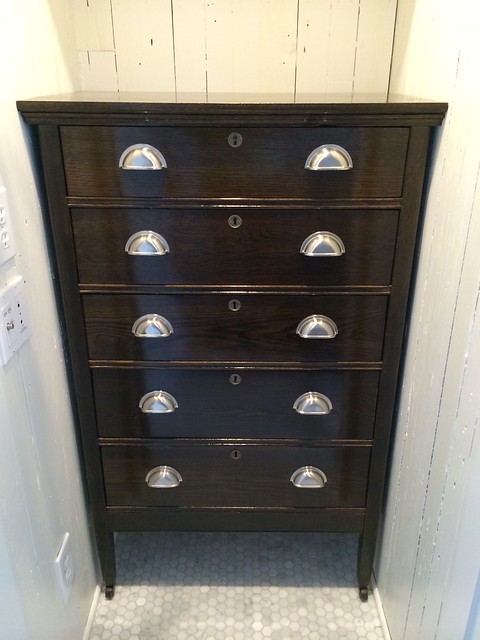
<p>Its walls are made up of original pine flooring and it sports an antique oak dresser that's essentially built right into the opening. It's not coming out any time soon, but we've build the door jamb and casings so they can be removable in the event someone wants to take the dresser out without destroying it.</p>
<p>
</p>
<div class="MediaContainer PhotoContainer"><a href="https://farm4.staticflickr.com/3881/15001463805_86c82238df_z.jpg" rel="PhotoPopup" popupheight="640" popupwidth="480"><img alt="" src="https://farm4.staticflickr.com/3881/15001463805_86c82238df.jpg" width="375" height="500" style="border-width: 0px; border-style: solid;" /></a></div>
<p>This tight space is also home to a pretty great plaster rhino that I tend to use as a hat rack of sorts.</p>
<p>
</p>
<div class="MediaContainer PhotoContainer"><a href="https://farm5.staticflickr.com/4537/38118736234_a0e61c0d5c_z.jpg" rel="PhotoPopup" popupheight="640" popupwidth="480"><img alt="" src="https://farm5.staticflickr.com/4537/38118736234_a0e61c0d5c.jpg" width="375" height="500" style="border-width: 0px; border-style: solid;" /></a></div>
<p>The door jamb in this closet is a custom jamb built from 4/5 poplar and meant to be a similar size and look to the original jambs in our 1886 house. This means that the opening is completely custom, which certainly makes mounting a door somewhat of a challenge.&nbsp;</p>
<p>One other wrinkle here is that I wanted the light in the closet to turn on when the door was opened, and off when it was closed. As a result we mounted a contact closure switch in the jamb to work in conjunction with the light switch on the wall.</p>
<h2>Prerequisites</h2>
<p>When I'm working to mount a salvaged door there are a few prerequisites I like to check before we get started.&nbsp;</p>
<h3>Prereq 1 - Jamb</h3>
<p>The jamb and door opening are critical when working with salvaged doors. The ideal scenario is to have an opening that is square, plumb, and level. Sometimes this is not possible, sometimes it is. Regardless, you need understand if the opening is out of square, has a wonky angle somewhere, or has some other issue to be aware of (like if the floor is going to be an obstruction as the door is opened). This will all impact how you ultimately trim your door to fit.</p>
<p>
</p>
<div class="MediaContainer PhotoContainer"><a href="https://farm5.staticflickr.com/4578/27058518639_0b964ceef1_z.jpg" rel="PhotoPopup" popupheight="640" popupwidth="480"><img alt="" src="https://farm5.staticflickr.com/4578/27058518639_0b964ceef1.jpg" width="375" height="500" style="border-width: 0px; border-style: solid;" /></a></div>
<p>Once you have a good idea on the jamb, it's time to move on to the next item.</p>
<h3>Prereq 2 - The Door</h3>
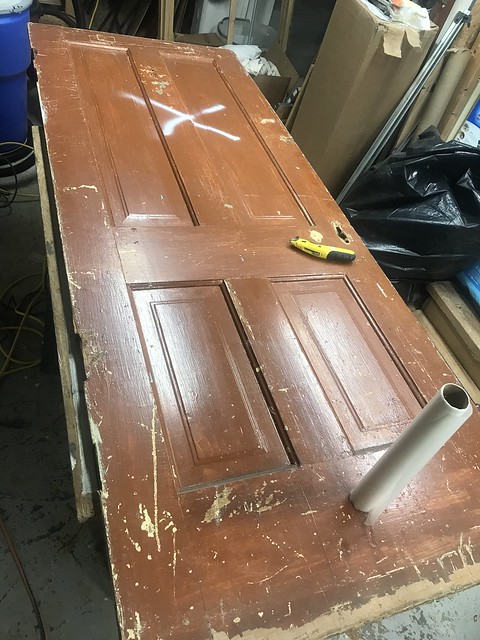
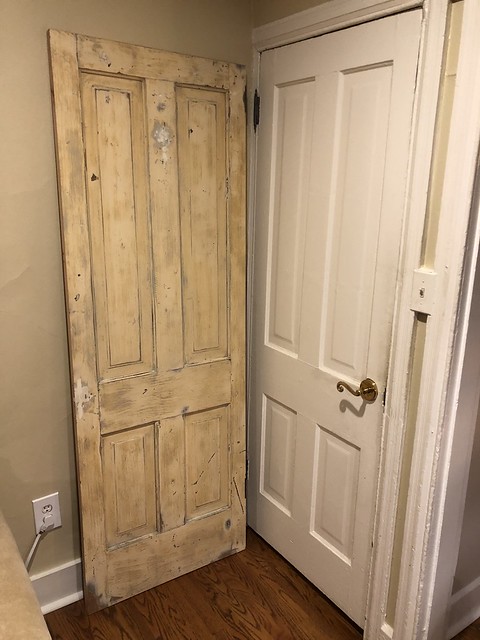
<p>First, the door. Our primary goal is always to find a door with the right look and profiles to match the other doors or general style of our house. For us we have two styles of interior doors, both of which are four panel raised panel doors. One style has a single bevel on the panel and is for the bedrooms. The other is a double bevel panel and is primarily used for smaller rooms and closets. We were lucky enough several years ago to find a large set of doors that were nearly an identical match to our closet doors. We bought six of these doors many years ago (f<a href="https://www.oldtownhome.com/2013/1/22/Master-Bedroom-Building-Our-Dream-Closet-Part-1/">ive were used for our bedroom closets</a>) and one has been patiently waiting in our basement to eventually be our bathroom's closet door.</p>
<p>
</p>
<div class="MediaContainer PhotoContainer"><a href="https://farm5.staticflickr.com/4448/23878431728_bd56af1aec_z.jpg" rel="PhotoPopup" popupheight="640" popupwidth="480"><img alt="" src="https://farm5.staticflickr.com/4448/23878431728_bd56af1aec.jpg" width="375" height="500" style="border-width: 0px; border-style: solid;" /></a></div>
<p>From this point forward I plan to only ever work with doors that will either fit the current opening, or are larger than the current opening. It's pretty easy to cut doors down to size, but it's a whole other thing to make them larger. We did this very thing on several of our interior doors as well as our new front door and French doors, and it was an undertaking that I'd like to avoid in the future.</p>
<p>
</p>
<div class="MediaContainer PhotoContainer"><a href="https://farm7.staticflickr.com/6150/5997625687_b53b391dd2_z.jpg" rel="PhotoPopup" popupheight="480" popupwidth="640"><img alt="" src="https://farm7.staticflickr.com/6150/5997625687_b53b391dd2.jpg" width="500" height="375" style="border-width: 0px; border-style: solid;" /></a></div>
<p>The other thing that's important to consider about your door is warping. Quite often salvaged doors have some level of warp to them. In many scenarios, this is not a problem as it is minor and will be disguised by the door's opening. But if you're doing a double door (like our closet for example), and the two doors warp away from each other, the problem will be very noticeable and they'll never look like they are completely closed. You need to determine your tolerance for warping in your situation and take a square and straight edge with you to the salvage yard.</p>
<p class="MediaContainer PhotoContainer"><a href="https://farm5.staticflickr.com/4531/26901705599_c618494292_z.jpg" rel="PhotoPopup" popupheight="640" popupwidth="480"><img alt="" src="https://farm5.staticflickr.com/4531/26901705599_c618494292.jpg" width="375" height="500" style="border-width: 0px; border-style: solid;" /></a></p>
<p class="MediaContainer PhotoContainer"><em>The door on the right is the final remaining original unstripped door with 1980s hardware in the house. The door on the left is our matched salvaged door.</em></p>
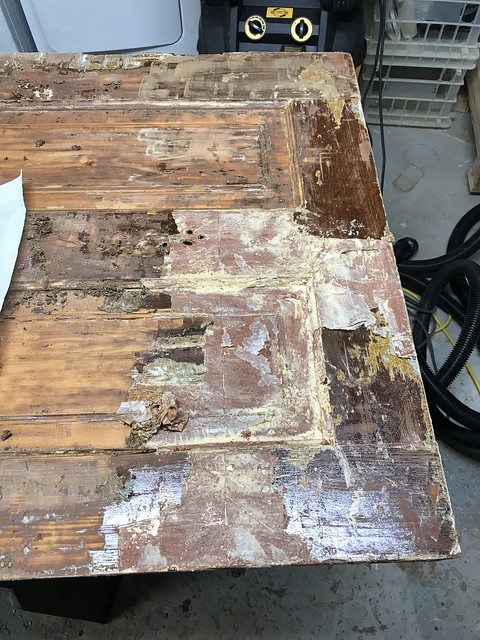
<p>Once the door is selected, I like to start the process by doing any paint stripping and repair before I get to mounting it in its opening. It certainly means more work up front, but it helps ensure that the work you do to square and mount the door isn't impacted by any repairs you need to make later.</p>
<p>
</p>
<div class="MediaContainer PhotoContainer"><a href="https://farm5.staticflickr.com/4474/37717127412_abcef21c65_z.jpg" rel="PhotoPopup" popupheight="640" popupwidth="480"><img alt="" src="https://farm5.staticflickr.com/4474/37717127412_abcef21c65.jpg" width="375" height="500" style="border-width: 0px; border-style: solid;" /></a></div>
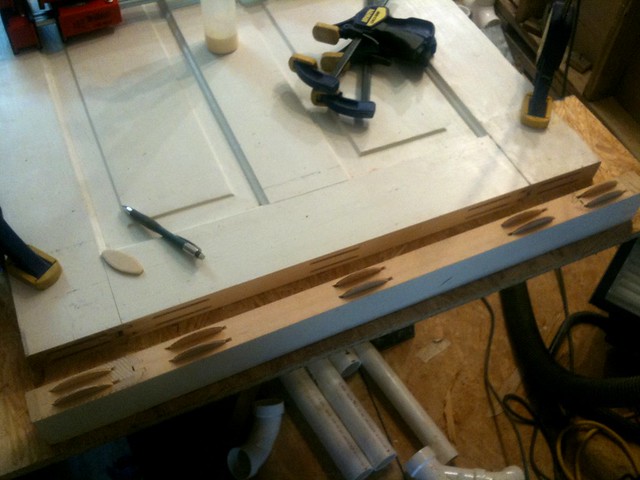
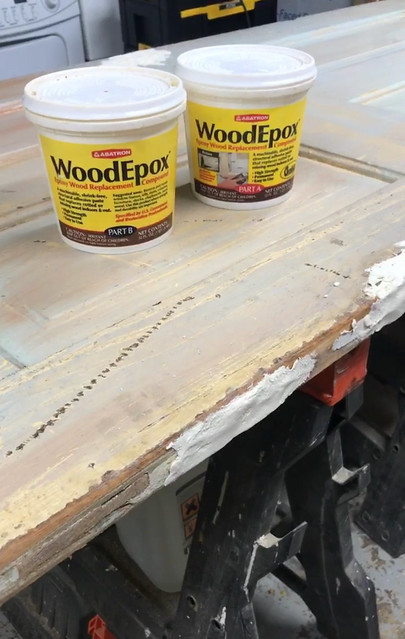
<p>After stripping if the door is loose or has any missing parts or major issues, I'll re-glue, apply epoxy, and do my initial sanding to get everything ready for mounting. This includes filling any old hinge mortises with epoxy to give myself a clean slate to work from. I'd rather do this than try to deal with trying to make old hinge mortises match up in the door jamb.&nbsp;(But keep in mind, if you're trimming large pieces of the sides off, there's no need to epoxy the old hinge mortises since you'll just cut it all off. I've made this stupid move several times.)&nbsp;</p>
<p>
</p>
<div class="MediaContainer PhotoContainer"><a href="https://farm5.staticflickr.com/4520/38835092841_3484d00a1c_z.jpg" rel="PhotoPopup" popupheight="640" popupwidth="405"><img alt="" src="https://farm5.staticflickr.com/4520/38835092841_3484d00a1c.jpg" width="316" height="500" style="border-width: 0px; border-style: solid;" /></a></div>
<p>When the door is all set and any epoxy is sanded, we're ready for the next item.</p>
<h3>Prereq 3 - Hardware</h3>
<p>You'll want to figure out the hardware you're using early in the process. Figuring out the hinges you want to use is the most important piece, but the lockset and anything else is important as well. We're using antique cast iron hinges and surface mount rim locks on all of our doors, so consistency has certainly helped us hone our process.</p>
<p>
</p>
<div class="MediaContainer PhotoContainer"><a href="https://farm5.staticflickr.com/4555/38787465922_4c5ff01d47_z.jpg" rel="PhotoPopup" popupheight="480" popupwidth="640"><img alt="" src="https://farm5.staticflickr.com/4555/38787465922_4c5ff01d47.jpg" width="500" height="375" style="border-width: 0px; border-style: solid;" /></a></div>
<p>If you're doing your whole house, even over a long period of time, take some time up front to come up with the plan you want to follow for all of your house's hardware. While salvaged hardware may be a bit harder to source and work with, the end result of using only salvaged hardware is really the icing on the cake of an old house renovation.</p>
<p>But one thing you must do, please use plain old slot head screws. And where appropriate, <a href="https://www.oldtownhome.com/2012/2/24/How-To-Easily-Antique-Screws/">antique those screws to look old</a>, not all shiny and new.</p>
<h3>Prereq 4 - Tools</h3>
<p>The following tools are the tools that we've found work best and are invaluable for this process, beyond the standards of tape measure, pencil, etc.&nbsp;</p>
<p>
</p>
<div class="MediaContainer PhotoContainer"><a href="https://farm5.staticflickr.com/4528/27039233019_cd48f3a1f9_z.jpg" rel="PhotoPopup" popupheight="479" popupwidth="640"><img alt="" src="https://farm5.staticflickr.com/4528/27039233019_cd48f3a1f9.jpg" width="500" height="375" style="border-width: 0px; border-style: solid;" /></a></div>
<p>I'm also outlining the specific model of tool we're using for each.</p>
<ol>
    <li>Laser Distance Measurer - <a target="_blank" href="https://www.amazon.com/gp/product/B072NF73DS/ref=as_li_tl?ie=UTF8&amp;camp=1789&amp;creative=9325&amp;creativeASIN=B072NF73DS&amp;linkCode=as2&amp;tag=oltoho-20&amp;linkId=0a3f500d3a4c6bcad798f877f3b720ff">DeWALT Pocket Laser Distance Measurer</a><img alt="" src="//ir-na.amazon-adsystem.com/e/ir?t=oltoho-20&amp;l=am2&amp;o=1&amp;a=B072NF73DS" width="1" height="1" style="border: none !important; margin: 0px !important;" /></li>
    <li>Hinge Mortising Jig - <a target="_blank" href="https://www.amazon.com/gp/product/B00004TI3O/ref=as_li_tl?ie=UTF8&amp;camp=1789&amp;creative=9325&amp;creativeASIN=B00004TI3O&amp;linkCode=as2&amp;tag=oltoho-20&amp;linkId=a5d5c314c406298f0eda62e6a17edb71">Porter-Cable Hinge Template</a><img alt="" src="//ir-na.amazon-adsystem.com/e/ir?t=oltoho-20&amp;l=am2&amp;o=1&amp;a=B00004TI3O" width="1" height="1" style="border: none !important; margin: 0px !important;" /></li>
    <li>Router - <a target="_blank" href="https://www.amazon.com/gp/product/B074C31YML/ref=as_li_tl?ie=UTF8&amp;camp=1789&amp;creative=9325&amp;creativeASIN=B074C31YML&amp;linkCode=as2&amp;tag=oltoho-20&amp;linkId=9d7bcc0a0d83630e725d5f52b01ee9a6">Makita Cordless Compact Router</a><img alt="" src="//ir-na.amazon-adsystem.com/e/ir?t=oltoho-20&amp;l=am2&amp;o=1&amp;a=B074C31YML" width="1" height="1" style="border: none !important; margin: 0px !important;" /></li>
    <li>Track Saw - <a target="_blank" href="https://www.amazon.com/gp/product/B01LG5X8Z6/ref=as_li_tl?ie=UTF8&amp;camp=1789&amp;creative=9325&amp;creativeASIN=B01LG5X8Z6&amp;linkCode=as2&amp;tag=oltoho-20&amp;linkId=420e9ac2109ee29188b02cd9a3c24685">Festool Cordless Track Saw</a><img alt="" src="//ir-na.amazon-adsystem.com/e/ir?t=oltoho-20&amp;l=am2&amp;o=1&amp;a=B01LG5X8Z6" width="1" height="1" style="border: none !important; margin: 0px !important;" /></li>
    <li>Chisels - <a target="_blank" href="https://www.amazon.com/gp/product/B0051PCQ7Y/ref=as_li_tl?ie=UTF8&amp;camp=1789&amp;creative=9325&amp;creativeASIN=B0051PCQ7Y&amp;linkCode=as2&amp;tag=oltoho-20&amp;linkId=7213884a3b9c6b0b81a35a87ea829161">Stanley 750 Series Chisel Set</a><img alt="" src="//ir-na.amazon-adsystem.com/e/ir?t=oltoho-20&amp;l=am2&amp;o=1&amp;a=B0051PCQ7Y" width="1" height="1" style="border: none !important; margin: 0px !important;" /></li>
    <li>Hand Plane - <a target="_blank" href="https://www.amazon.com/gp/product/B0000223QX/ref=as_li_tl?ie=UTF8&amp;camp=1789&amp;creative=9325&amp;creativeASIN=B0000223QX&amp;linkCode=as2&amp;tag=oltoho-20&amp;linkId=4682fd3019305c6bba14d5bfa821eeb5">Stanley Low Angle Plane</a><img alt="" src="//ir-na.amazon-adsystem.com/e/ir?t=oltoho-20&amp;l=am2&amp;o=1&amp;a=B0000223QX" width="1" height="1" style="border: none !important; margin: 0px !important;" /></li>
</ol>
<p><strong>Okay, lets get started!</strong></p>
<h2>Step 1 - Jamb Hinge Mortising</h2>
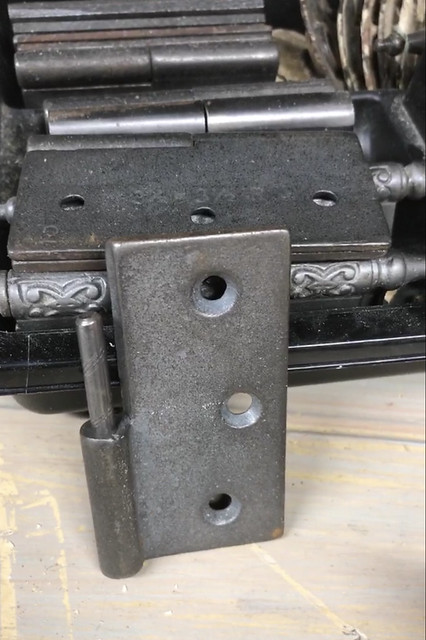
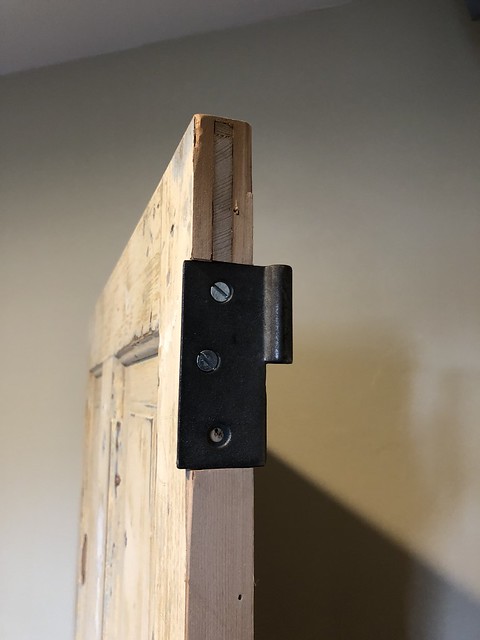
<p>Once our door is ready to go I'm going to actually turn my attention to the hinge jamb mortising. In our case we are using 3-1/2"x3-1/2" antique cast iron lift off hinges for our doors throughout our second floor. We're using decorative salvaged removable pin hinges on the first floor, but these old lift-off hinges upstairs are great. They are moderately forgiving when it comes to alignment, can be mounted easily by one person, and have a great old look to them.</p>
<p>
</p>
<div class="MediaContainer PhotoContainer"><a href="https://farm5.staticflickr.com/4516/23910026947_7fd53b10df_z.jpg" rel="PhotoPopup" popupheight="640" popupwidth="426"><img alt="" src="https://farm5.staticflickr.com/4516/23910026947_7fd53b10df.jpg" width="333" height="500" style="border-width: 0px; border-style: solid;" /></a></div>
<p>Since the door had its prior hinge mortises filled with epoxy, we can mount our hinges pretty much wherever we need them to sit in the jamb. To do this I simply held the hinges in place and gave myself some pencil marks where the hinge mortises need to sit.&nbsp;</p>
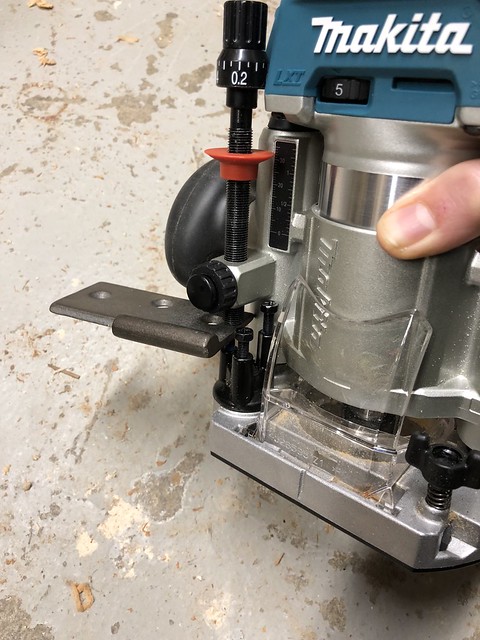
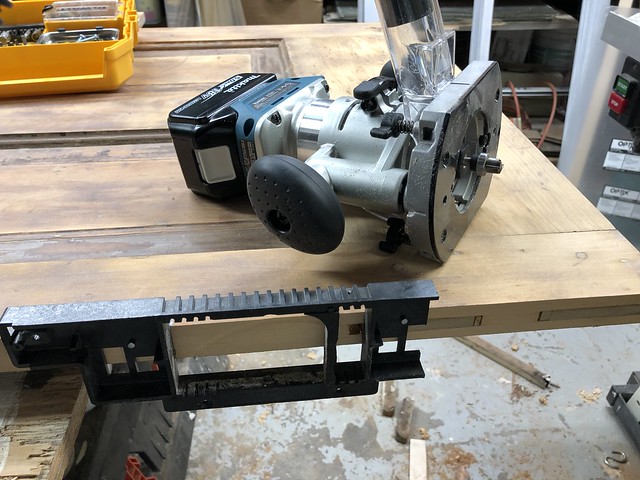
<p>Using a standard mortising template and router with collared bit I cut out the mortises for the hinges. In this case we are doing this in a finished space, and are using the new Makita cordless router with the plunge base and dust extraction attachment. This really helped to keep the mess down on what is typically a pretty dusty process. The mortising template expects a modern jamb and door, so I've had to modify it a bit to work for our needs. I cut off the end then drove a few nails through the middle of it to hold it in place.</p>
<p>
</p>
<div class="MediaContainer PhotoContainer"><a href="https://farm5.staticflickr.com/4490/37862060702_ce86353dcd_z.jpg" rel="PhotoPopup" popupheight="640" popupwidth="480"><img alt="" src="https://farm5.staticflickr.com/4490/37862060702_ce86353dcd.jpg" width="375" height="500" style="border-width: 0px; border-style: solid;" /></a></div>
<p>Setting the correct depth on the router is key here. I find using a plunge base tends to really help this situation. I can essentially zero out the setting so that the router bit is flush with the jamb, then I pull the stop on the plunge base up a little and actually use one side of the hinge to set a gap between the stop of the router and the base. Then, removing the hinge you can let the bit plunge all of the way down to the stop and you've got yourself a perfect depth. This is important with old hinges since they are always just a little variable on size. And on the lift-off hinges we're using, the thickness is tapered from the front to back, so we set our depth to by the midway point of the hinge.</p>
<p>
</p>
<div class="MediaContainer PhotoContainer"><a href="https://farm5.staticflickr.com/4524/23970624697_b02531daa2_z.jpg" rel="PhotoPopup" popupheight="640" popupwidth="480"><img alt="" src="https://farm5.staticflickr.com/4524/23970624697_b02531daa2.jpg" width="375" height="500" style="border-width: 0px; border-style: solid;" /></a></div>
<p>If you're using old hinges (or any hinges) with square corners, you're going to need to make the rounded corners of your mortises square. There are several tools that promise to do this quickly and easily, but I find using a good and sharp chisel is all you really need. Mark the edges of the corner with the chisel, then begin working the material until it's a nice and flat corner. I also try to remove a little more material with the chisel in order to accommodate the slightly graduated thickness of the hinge.</p>
<p>
</p>
<div class="MediaContainer PhotoContainer"><a href="https://farm5.staticflickr.com/4478/37183309644_dda0625794_z.jpg" rel="PhotoPopup" popupheight="640" popupwidth="480"><img alt="" src="https://farm5.staticflickr.com/4478/37183309644_dda0625794.jpg" width="375" height="500" style="border-width: 0px; border-style: solid;" /></a></div>
<p>A little sanding after the chisel and you've got yourself a nice flat hinge mortise.</p>
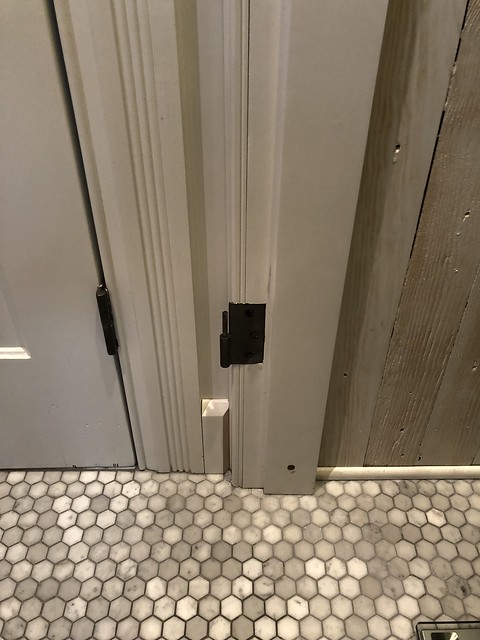
<p>After mortising the jamb I mount the jamb half of the hinges into the mortise and then move onto the next step.&nbsp;</p>
<p class="MediaContainer PhotoContainer"><a href="https://farm5.staticflickr.com/4555/38803765932_11da1c3a5e_z.jpg" rel="PhotoPopup" popupheight="640" popupwidth="480"><img alt="" src="https://farm5.staticflickr.com/4555/38803765932_11da1c3a5e.jpg" width="375" height="500" style="border-width: 0px; border-style: solid;" /></a></p>
<p class="MediaContainer PhotoContainer"><em>The tiny baseboard piece is just resting in place right now.</em></p>
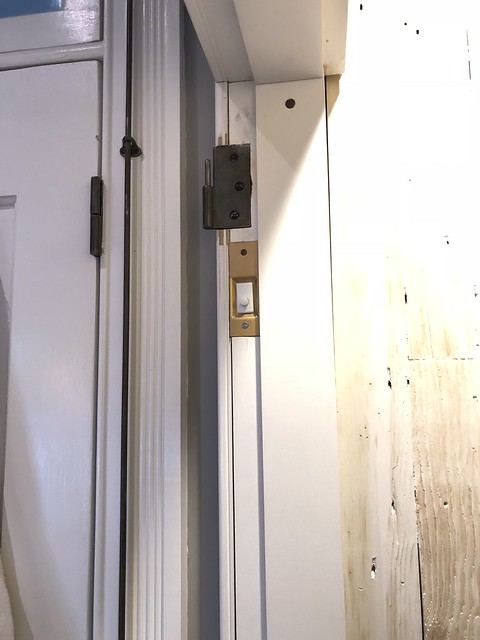
<p>You might notice that our upper hinge in this door is very high. That's as a result of a mistake I made on the contact closure switch. I mounted the switch too high on the jamb and as a result the hinge had to be a little too high or WAY too low.&nbsp;</p>
<p>
</p>
<div class="MediaContainer PhotoContainer"><a href="https://farm5.staticflickr.com/4548/27058515509_d3ae534916_z.jpg" rel="PhotoPopup" popupheight="640" popupwidth="480"><img alt="" src="https://farm5.staticflickr.com/4548/27058515509_d3ae534916.jpg" width="375" height="500" style="border-width: 0px; border-style: solid;" /></a></div>
<p>I went with a little too high. I also had a minor issue with the router bit and template, which caused it to jump slightly and took a little too much material from behind the upper hinge. I'll end up filling that with a little wood filler once everything is said and done.</p>
<h2>Step 2 - Trimming the Door</h2>
<p>With our hinges in place on the jamb we want to get the door fitting nice and tight in the opening. Please note, it will be way too tight to fit properly at this step, but it's always easy to take more off, much harder to add material back, so we want it to be slightly oversized.&nbsp;</p>
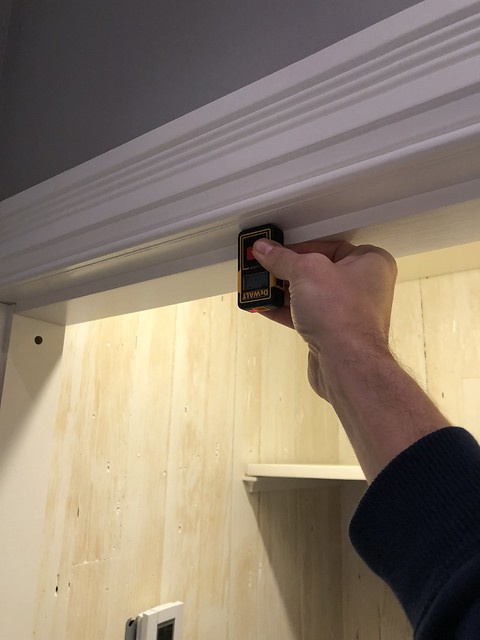
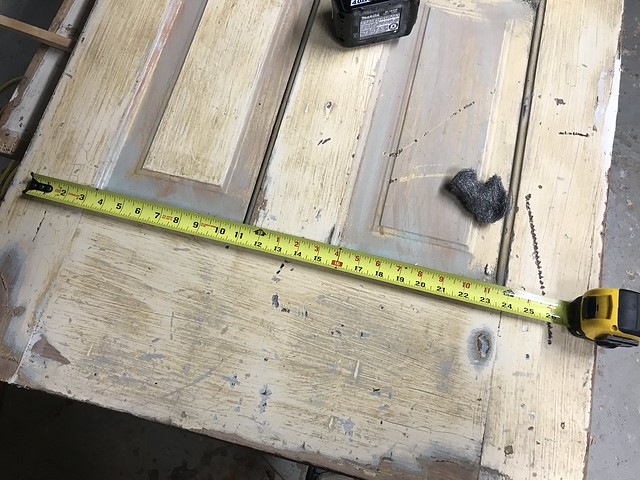
<p>My first step is to use a small laser measuring device to determine the height and width of the jamb opening at several different locations. This little DeWalt pocket laser distance measurer is perfect. It has a max range of 30', is USB chargeable, and is extremely accurate in my experience. I take measurements at three places across the top of the jamb, and at three places down the sides. The hope is that they are all the same and the opening is square. If it's close enough I can go onto the next step. But if something is seriously out of square and we'll need to transfer this over to the door, it may be easiest to make a simple template of the opening with some thin mdf and hot glue (think counter top template), and then use it to transfer the measurements over to your door.&nbsp;</p>
<p>
</p>
<div class="MediaContainer PhotoContainer"><a href="https://farm5.staticflickr.com/4543/24787173668_639c009c0f_z.jpg" rel="PhotoPopup" popupheight="640" popupwidth="480"><img alt="" src="https://farm5.staticflickr.com/4543/24787173668_639c009c0f.jpg" width="375" height="500" style="border-width: 0px; border-style: solid;" /></a></div>
<p>With our measurements of the door jamb in hand, we need to begin trimming the door. I like to start with trimming the height of the door to be correct. Keep in mind that old doors are typically built with mortise and tenon joints. This means that the door is holding itself together, and you don't want to compromise that if you don't have to. In our case, I needed to take off enough material from the height that if I cut it all from the bottom, it could have compromised the door's structure. Rather than taking it all from the bottom, I opted to take some from the bottom and some from the top.</p>
<p>
</p>
<div class="MediaContainer PhotoContainer"><a href="https://farm5.staticflickr.com/4554/24901485538_920a2beef6_z.jpg" rel="PhotoPopup" popupheight="640" popupwidth="360"><img alt="" src="https://farm5.staticflickr.com/4554/24901485538_920a2beef6.jpg" width="281" height="500" style="border-width: 0px; border-style: solid;" /></a></div>
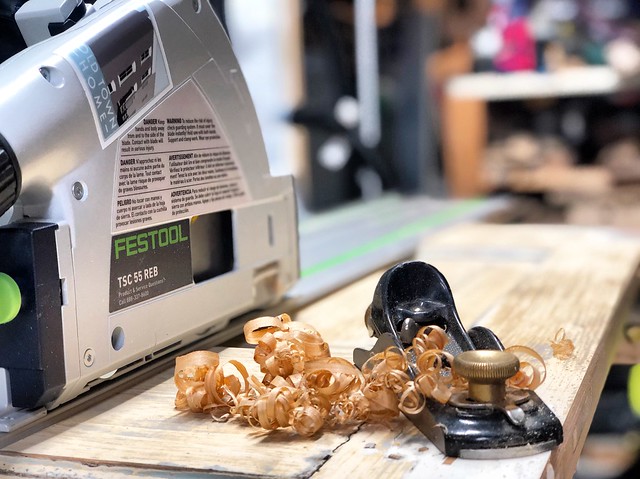
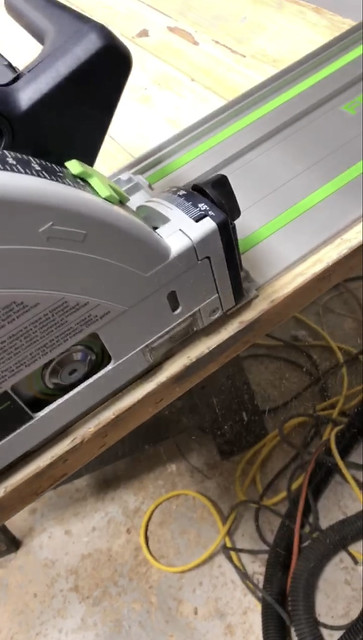
<p>To do this I marked the cut line, dropped the track on the door, and zipped the bottom off with the track saw. A track saw makes ridiculously short work of trimming a door. I can't stress enough how great a track saw is for this purpose, and if you don't have one, you should definitely consider adding it to your tool collection. Otherwise I'd be clamping straight edges based on offset measurements, then taping to prevent splintering and using our circular saw. While the Festool is an expensive model, <a target="_blank" href="https://www.amazon.com/gp/product/B01IVTAO8Y/ref=as_li_tl?ie=UTF8&amp;camp=1789&amp;creative=9325&amp;creativeASIN=B01IVTAO8Y&amp;linkCode=as2&amp;tag=oltoho-20&amp;linkId=be62347b8a42c77b5031229eac46b2ed">Makita</a><img alt="" src="//ir-na.amazon-adsystem.com/e/ir?t=oltoho-20&amp;l=am2&amp;o=1&amp;a=B01IVTAO8Y" width="1" height="1" style="border: none !important; margin: 0px !important;" /> and <a target="_blank" href="https://www.amazon.com/gp/product/B072K4W58Z/ref=as_li_tl?ie=UTF8&amp;camp=1789&amp;creative=9325&amp;creativeASIN=B072K4W58Z&amp;linkCode=as2&amp;tag=oltoho-20&amp;linkId=1a93979dddcbc93ebd1b63b06af2e07b">DeWalt</a><img alt="" src="//ir-na.amazon-adsystem.com/e/ir?t=oltoho-20&amp;l=am2&amp;o=1&amp;a=B072K4W58Z" width="1" height="1" style="border: none !important; margin: 0px !important;" /> both have cordless track saws that are far less expensive and work just as well. Best of all, these saws all work universally on the various other brand tracks with minor adjustments. So you can mix and match based on best deal.</p>
<p>
</p>
<div class="MediaContainer PhotoContainer"><a href="https://farm5.staticflickr.com/4556/37887801745_19949511b3_z.jpg" rel="PhotoPopup" popupheight="640" popupwidth="363"><img alt="" src="https://farm5.staticflickr.com/4556/37887801745_19949511b3.jpg" width="283" height="500" style="border-width: 0px; border-style: solid;" /></a></div>
<p>After cutting the top and bottom I move onto trimming<strong>&nbsp;the hinge side of the door.</strong> It's important to determine the total amount you need to take off of the door's width, and then trim from each side accordingly to make sure the trimmed door is balanced with equal sized stiles on either side. Assuming a square door opening, I make sure the amount I'm trimming from the hinges side of the door is square to the cut on the top and bottom of the door. Again, I measure everything, make my marks, and then drop the track on the door and cut.</p>
<p>
</p>
<div class="MediaContainer PhotoContainer"><a href="https://farm5.staticflickr.com/4492/37611644200_5291af39e7_z.jpg" rel="PhotoPopup" popupheight="480" popupwidth="640"><img alt="" src="https://farm5.staticflickr.com/4492/37611644200_5291af39e7.jpg" width="500" height="375" style="border-width: 0px; border-style: solid;" /></a></div>
<p>Next, I double and triple check my measurements, and maybe even take the door to the opening to test fit and make sure I'm on the right track with things. Then I do the same on the knob side of the door and trim off only enough material to make the door just fit in the opening. This is important, just keep thinking "measure 800 times, cut a bunch but only what you need to cut."</p>
<p>
</p>
<div class="MediaContainer PhotoContainer"><a href="https://farm5.staticflickr.com/4571/38660217961_4952f2a638_z.jpg" rel="PhotoPopup" popupheight="640" popupwidth="480"><img alt="" src="https://farm5.staticflickr.com/4571/38660217961_4952f2a638.jpg" width="375" height="500" style="border-width: 0px; border-style: solid;" /></a></div>
<p>Once the final side is cut I take the door to the opening and prop it in place checking for a good snug fit (that is ultimately way too tight of a fit for it to actually work once hinges are on).</p>
<h2>Step 3 - Hinge Mortising</h2>
<p>With the door theoretically cut to the correct rough size it needs to be, we're ready for the next step of marking the hinge locations and mortising the hinges on the side of the door.&nbsp;</p>
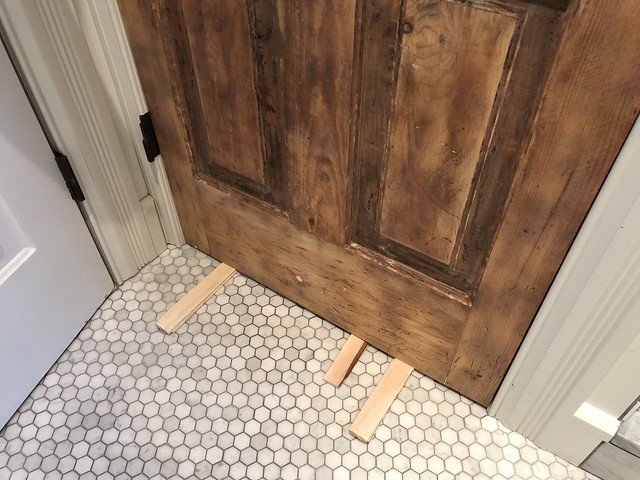
<p>When it comes to doors, it's always better to have more space at the bottom of the door than the top. A minor gap at the bottom won't be noticed, but at the top it will always stand out since it's much closer to eye level. So before marking the hinge locations I like to slide several shims under the door when it's propped in the opening to force it to the top of the doorway.&nbsp;</p>
<p>
</p>
<div class="MediaContainer PhotoContainer"><a href="https://farm5.staticflickr.com/4583/38628721512_87eb925baa_z.jpg" rel="PhotoPopup" popupheight="480" popupwidth="640"><img alt="" src="https://farm5.staticflickr.com/4583/38628721512_87eb925baa.jpg" width="500" height="375" style="border-width: 0px; border-style: solid;" /></a></div>
<p>Once the door is forced to the top of the opening, then you can use a pencil to mark the locations of the hinge mortises based on where you cut them in the first step of the install. Make clear and simple lines at the top and bottom of each hinge, then transfer those marks onto the side of the door with a carpenter's/rafter square.</p>
<p>Next up, grab your router and the same hinge template you used in step 1. Hopefully you have the same depth settings on the router and you can just tack the hinge template onto the side of the door and route out your mortises for your hinges.&nbsp;</p>
<p>
</p>
<div class="MediaContainer PhotoContainer"><a href="https://farm5.staticflickr.com/4568/26901707829_e113c1b191_z.jpg" rel="PhotoPopup" popupheight="480" popupwidth="640"><img alt="" src="https://farm5.staticflickr.com/4568/26901707829_e113c1b191.jpg" width="500" height="375" style="border-width: 0px; border-style: solid;" /></a></div>
<p>In our case the mortise template made a mortise that was just a hair too small for our hinges, so I needed to widen it ever so slightly with our chisels. Since the door we're using is a little thinner than many old doors, the hinge mortising went straight through front to back, so there were no rounded corners to carve out. But just like in step 1, if you need to you can just use a good sharp chisel.</p>
<p>
</p>
<div class="MediaContainer PhotoContainer"><a href="https://farm5.staticflickr.com/4572/37887803585_cf3e29266e_z.jpg" rel="PhotoPopup" popupheight="640" popupwidth="403"><img alt="" src="https://farm5.staticflickr.com/4572/37887803585_cf3e29266e.jpg" width="315" height="500" style="border-width: 0px; border-style: solid;" /></a></div>
<p>With the hinge mortises cut on the door, I mount the hinges in their opening. In our scenario I can mount the hinges as far forward or backward as needed to get the right look in the door opening. In our case I mounted them slightly overhanging the rear of the door. Ideally we would have had 3-1/2" x 3" hinges so there's be no overlap, but finding exact salvaged hardware can be difficult, and I knew this would still work well. The only consider I'll need to worry about later is possibly placing a few smaller stop blocks on the jamb to ensure the thinner door doesn't try to over close when shut.</p>
<p>
</p>
<div class="MediaContainer PhotoContainer"><a href="https://farm5.staticflickr.com/4559/38835671231_ff068d98f3_z.jpg" rel="PhotoPopup" popupheight="640" popupwidth="480"><img alt="" src="https://farm5.staticflickr.com/4559/38835671231_ff068d98f3.jpg" width="375" height="500" style="border-width: 0px; border-style: solid;" /></a></div>
<p>After mounting the hinges I took the door to the opening for the first real fit. Dropping the hinges on their posts and the door was looking good. However, it was slightly "wider" now than when we initially fit it in the opening since the hinges added about 1/8" on the left of the door. Since we have the door hung we can close it as far as it will need to close and then mark the new cut line on the top and bottom of the door based on where the edge of the jamb sits. This is also a great way to account for a minor out of square situation with your jamb.</p>
<p>With the new location marked we make one final trim with the track saw, then pop the door back on the hinges and see how we're doing.&nbsp;</p>
<p>
</p>
<div class="MediaContainer PhotoContainer"><a href="https://farm5.staticflickr.com/4525/38690599391_96bb7e9fbc_z.jpg" rel="PhotoPopup" popupheight="640" popupwidth="480"><img alt="" src="https://farm5.staticflickr.com/4525/38690599391_96bb7e9fbc.jpg" width="375" height="500" style="border-width: 0px; border-style: solid;" /></a></div>
<p>And with that, we have a very old door hanging in a new opening using salvaged antique hardware.&nbsp;</p>
<p>
</p>
<div class="MediaContainer PhotoContainer"><a href="https://farm5.staticflickr.com/4581/38784395932_49d5279cbb_z.jpg" rel="PhotoPopup" popupheight="640" popupwidth="512"><img alt="" src="https://farm5.staticflickr.com/4581/38784395932_49d5279cbb.jpg" width="400" height="500" style="border-width: 0px; border-style: solid;" /></a></div>
<p>We still have lock/knob hardware to mount and install, but that will vary pretty drastically based on what kind of hardware you're using. In our case we're using a rim lock, which is one of the most forgiving to mount since it's all on the surface and requires no mortising. We'll still also need to do a final sanding of the door since the track saw leaves very sharp and clean lines that tend to look out of place on old doors. Then, when we're all done with hardware, we'll still need to paint the door.&nbsp;</p>
<p>
</p>
<div class="MediaContainer PhotoContainer"><a href="https://farm5.staticflickr.com/4526/24870324338_f335342cc8_z.jpg" rel="PhotoPopup" popupheight="640" popupwidth="480"><img alt="" src="https://farm5.staticflickr.com/4526/24870324338_f335342cc8.jpg" width="375" height="500" style="border-width: 0px; border-style: solid;" /></a></div>
<p>In a nutshell, hanging a salvaged door is far from an impossible task, and is actually quite reasonable when you take it one step at a time. It can feel daunting initially, but remembering the golden rule, measure twice, cut once, will take you far.&nbsp;</p>
<p>Do you have any experience hanging salvaged doors? If so, any tips or tricks you'd like to share that might help? And if you've never done it before but have wanted to, does this seem like something you'd be willing to try given what we've outlined? Would love to hear some of your experiences.</p>
<p>&nbsp;&nbsp;&nbsp;</p><p><a href="https://www.oldtownhome.com/2017/12/4/How-To-Install-a-Salvaged-Door-with-Antique-Hinges/">Read Full Post</a></p>]]></content>
    <category term="Header Image" />
    <category term="How To" />
    <category term="Projects:Salvage" />
    <category term="Salvage" />
    <category term="Salvaged Doors" />
    <category term="Woodworking" />
    <PostImage>https://c1.staticflickr.com/5/4690/39061856102_5ed9a95763_c.jpg</PostImage>
    <media:thumbnail url="https://c1.staticflickr.com/5/4690/39061856102_5ed9a95763_t.jpg" />
    <ExtensionElements>
      <Item>PostImage</Item>
      <Item>media:thumbnail</Item>
    </ExtensionElements>
  </entry>
  <entry>
    <guid>c524d7c0-65c5-4361-9bf0-5f3019af2b85</guid>
    <id>https://www.oldtownhome.com/2016/9/30/Coping-as-a-DIY-Double-Entendre/</id>
    <title>Coping as a DIY Double Entendre</title>
    <summary type="html"><![CDATA[<p>Holes in the ceiling, dust on the floor, mess all around, and when it comes to projects, there's always more, more, more. </p><div class="MediaContainer PhotoContainer"><a href="https://farm6.staticflickr.com/5004/5643409575_dd1aefa066_z.jpg" rel="PhotoPopup" popupheight="480" popupwidth="640"><img alt="" src="https://farm6.staticflickr.com/5004/5643409575_dd1aefa066.jpg" width="500" height="375" style="border-width: 0px; border-style: solid;"></a></div><p>In DIY, like in life, coping is an important skill to master...or at least a skill one must make an attempt at mastering. But what is it to cope?</p><div><strong><em>verb</em></strong></div><p>The thing is, when I'm talking about coping and DIY, I could actually be talking about a few different aspects of the above definition. For example, a heathy dose of denial might be the best way to cope with a home disaster, but a jigsaw may be my tool of choice when coping a joint. </p><p>Over the years we've taken on a lot of projects in an attempt to master various skills...or become slightly more than mediocre at them.&nbsp;</p><p>
</p><div class="MediaContainer PhotoContainer"><a href="https://farm8.staticflickr.com/7483/15580318420_21711b2711_z.jpg" rel="PhotoPopup" popupheight="640" popupwidth="480"><img alt="" src="https://farm8.staticflickr.com/7483/15580318420_21711b2711.jpg" width="375" height="500" style="border-width: 0px; border-style: solid;"></a></div><p>And while I've gained a good amount of confidence when it comes to moulding, one of the things that intimidated me tremendously for the longest time is my lacking skills when it comes to coping a joint.</p> <a href="https://www.oldtownhome.com/2016/9/30/Coping-as-a-DIY-Double-Entendre/">more</a>]]></summary>
    <published>2016-09-30T10:32:00.000-04:00</published>
    <updated>2016-09-30T10:32:00.000-04:00</updated>
    <link rel="alternate" href="https://www.oldtownhome.com/2016/9/30/Coping-as-a-DIY-Double-Entendre/" />
    <author>
      <name>Alex</name>
    </author>
    <content type="html"><![CDATA[<p>Holes in the ceiling, dust on the floor, mess all around, and when it comes to projects, there's always more, more, more. </p>
<div class="MediaContainer PhotoContainer"><a href="https://farm6.staticflickr.com/5004/5643409575_dd1aefa066_z.jpg" rel="PhotoPopup" popupheight="480" popupwidth="640"><img alt="" src="https://farm6.staticflickr.com/5004/5643409575_dd1aefa066.jpg" width="500" height="375" style="border-width: 0px; border-style: solid;" /></a></div>
<p>In DIY, like in life, coping is an important skill to master...or at least a skill one must make an attempt at mastering. But what is it to cope?</p>
<h2>cope<sup>1</sup></h2>
<div><strong><em>verb</em></strong></div>
<ul>
    <li>(of a person) deal effectively with something difficult.<br />
    "his ability to cope with stress"<br />
    <em>synonyms: manage, survive, subsist, look after oneself, fend for oneself, carry on, get by/through, bear up, hold one's own, keep one's end up, keep one's head above water;</em></li>
    <li>(of a machine or system) have the capacity to deal successfully with.<br />
    "the roads are barely adequate to cope with the present traffic"</li>
</ul>
<p>The thing is, when I'm talking about coping and DIY, I could actually be talking about a few different aspects of the above definition. For example, a heathy dose of denial might be the best way to cope with a home disaster, but a jigsaw may be my tool of choice when coping a joint. </p>
<p>Over the years we've taken on a lot of projects in an attempt to master various skills...or become slightly more than mediocre at them.&nbsp;</p>
<p>
</p>
<div class="MediaContainer PhotoContainer"><a href="https://farm8.staticflickr.com/7483/15580318420_21711b2711_z.jpg" rel="PhotoPopup" popupheight="640" popupwidth="480"><img alt="" src="https://farm8.staticflickr.com/7483/15580318420_21711b2711.jpg" width="375" height="500" style="border-width: 0px; border-style: solid;" /></a></div>
<p>And while I've gained a good amount of confidence when it comes to moulding, one of the things that intimidated me tremendously for the longest time is my lacking skills when it comes to coping a joint.</p>
<p>If you're not familiar with coping as a way of fitting two pieces of wood together, and your typical coping mechanism when talking about making a corner joint in moulding is to drop to the floor and assume the fetal position, let me fill you in on a few tips and tricks that help me cope with the daunting task of coping.</p>
<p>When you're working on crown, baseboard, or any other moulding projects that make an inside corner, such as in the corner of a room, you have a few options to make that intersection look clean and professional.</p>
<p>The old standby method of making an inside corner joint is to grab your miter saw, set the angle of the saw to the appropriate angle of the corner joint (often specified by many tables of calculations that involve complex angles when it comes to crown moulding), and cut each piece of moulding so it matches up evenly in the corner. While this all sounds fine and dandy, when your corners aren't quite 90 degrees, and your ceiling, walls, or floors aren't exactly plumb or level, you often end up with pretty sizable gaps or ugly joints. You typically cope with those issues using copious amount of caulk. </p>
<p>
</p>
<div class="MediaContainer PhotoContainer"><a href="https://farm6.staticflickr.com/5268/5643586751_6d49d05885_z.jpg" rel="PhotoPopup" popupheight="480" popupwidth="640"><img alt="" src="https://farm6.staticflickr.com/5268/5643586751_6d49d05885.jpg" width="500" height="375" style="border-width: 0px; border-style: solid;" /></a></div>
<p>However, there's another way, and would you believe it, its called, wait for it, Coping! It's related to part two of the definition above, "(of a machine or system) have the capacity to deal successfully with." In the case of "coping a joint," we're talking about the system as the moulding, and how we're giving the ability for one piece of moulding to deal successfully with another. This happens by leaving one piece of moulding uncut, and then cutting the second piece of moulding to match the profile.</p>
<p>The first time I hung crown moulding in our living room, Wendy took one look at all of the problems and said "Uhhhh...maybe we should have hired someone?" I had mitered and not coped the corners, and Wendy wasn't coping very well with my amateur first attempt at crown. </p>
<p>
</p>
<div class="MediaContainer PhotoContainer"><a href="https://farm6.staticflickr.com/5301/5644157976_5faa1803c3_z.jpg" rel="PhotoPopup" popupheight="480" popupwidth="640"><img alt="" src="https://farm6.staticflickr.com/5301/5644157976_5faa1803c3.jpg" width="500" height="375" style="border-width: 0px; border-style: solid;" /></a></div>
<p>In retrospect I was far too nervous to cope the crown, but I shouldn't have been. I actually think it would have been a little easier and I wouldn't have drawn the doubtful eye of my lovely wife quite so rapidly in our early days of DIY. But she was right, it did look like crap before caulk and paint.</p>
<p>Now that I have many rooms of crown moulding, baseboards, and various other inside corner mouldings under my belt, I've gotten pretty comfortable with coping. I've even developed a few favorite approaches to coping. You might even call them my preferred coping mechanisms. Let's take a second today to talk a little about my best practices when it comes to coping, and how it becomes a bearable task when you have a few favorite tools.</p>
<p>
</p>
<div class="MediaContainer PhotoContainer"><a href="https://farm9.staticflickr.com/8306/29943882615_89d62db28d_z.jpg" rel="PhotoPopup" popupheight="480" popupwidth="640"><img alt="" src="https://farm9.staticflickr.com/8306/29943882615_89d62db28d.jpg" width="500" height="375" style="border-width: 0px; border-style: solid;" /></a></div>
<p>First things first with coping, you need to figure out which of your two boards you'll be cutting, and which one you'll be leaving at length. I like to work my way around the room placing the very first board on the wall that goes from edge to edge, no cut or copes. Then I stack in the second board to begin the coping process. For our example today I'm going to be covering how I cope my baseboard cap joint in the living room in our Foursquare.</p>
<p>
</p>
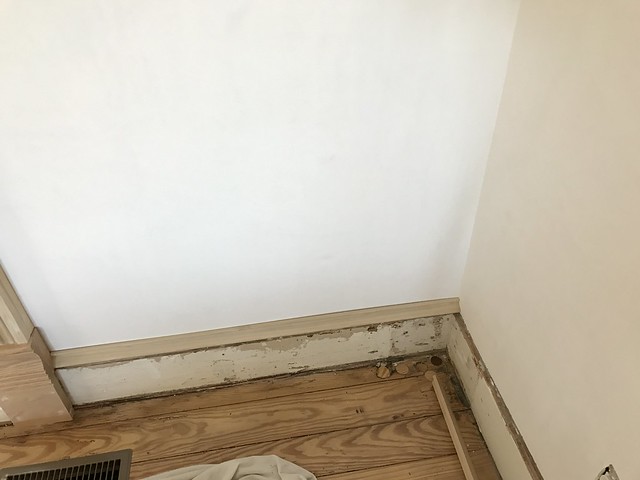
<div class="MediaContainer PhotoContainer"><a href="https://farm6.staticflickr.com/5687/29317516713_cd021d8d19_z.jpg" rel="PhotoPopup" popupheight="480" popupwidth="640"><img alt="" src="https://farm6.staticflickr.com/5687/29317516713_cd021d8d19.jpg" width="500" height="375" style="border-width: 0px; border-style: solid;" /></a></div>
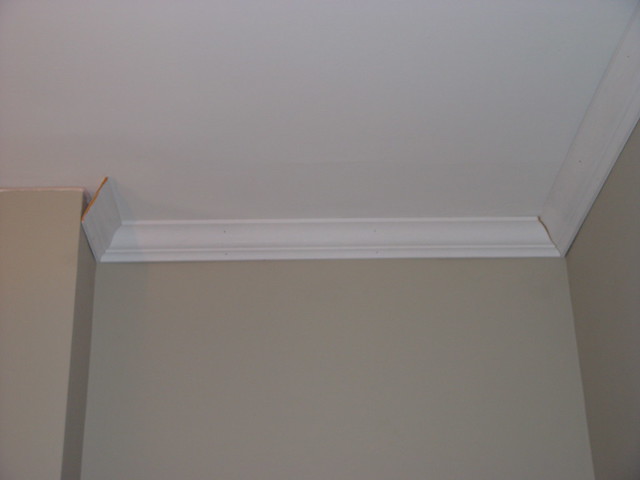
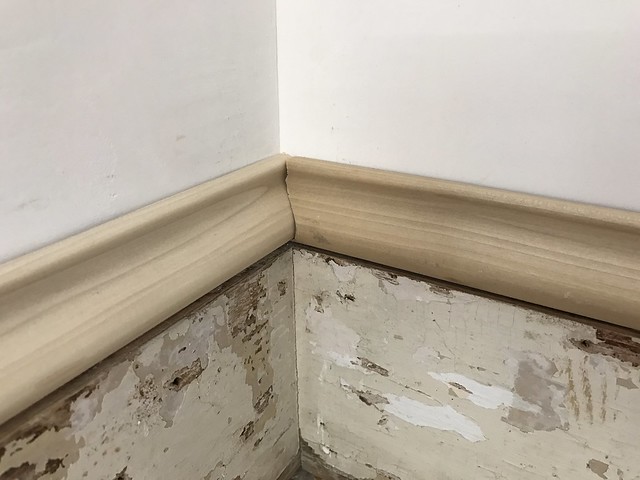
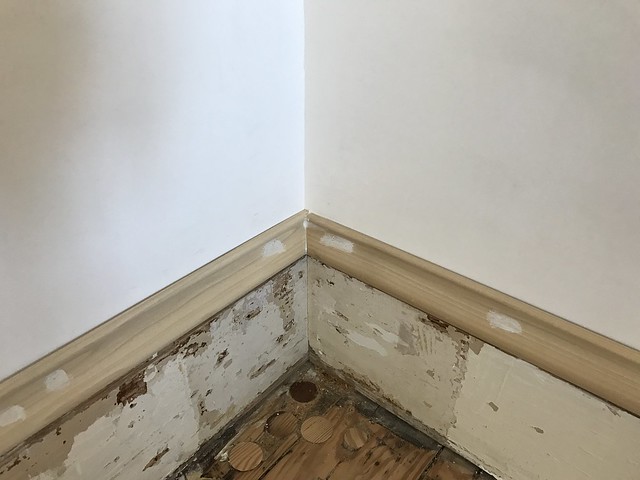
<p>In the case of the photo above, you can see that the baseboard cap moulding on the left goes all of the way to the wall, while the piece on the right will need to be coped to match the other piece. Also in the above photo, I need to work on coping with the fast that one of my wood plugs was just a bit too low and didn't get sanded with the rest of them. I'll handle this by telling myself that the shoe moulding will eventually cover most of it, and the remaining visible section will only be noticed by the closest of inspections. Yes, my coping here is through justification. Okay, back to woodworking.</p>
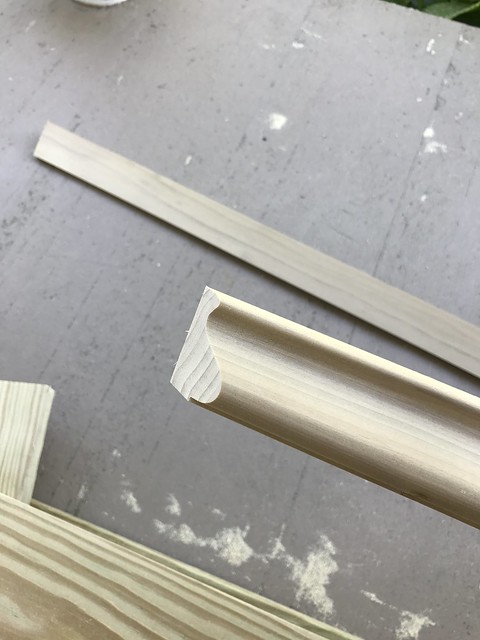
<p>The first thing we're going to do here is to cut the right board as if we're mitering the joint. This is a 90 degree angle, so I set the miter saw to 45 degrees and cut only the right board as if it were going to be mitered.</p>
<p>
</p>
<div class="MediaContainer PhotoContainer"><a href="https://farm9.staticflickr.com/8002/29317516773_d084d69dd8_z.jpg" rel="PhotoPopup" popupheight="480" popupwidth="640"><img alt="" src="https://farm9.staticflickr.com/8002/29317516773_d084d69dd8.jpg" width="500" height="375" style="border-width: 0px; border-style: solid;" /></a></div>
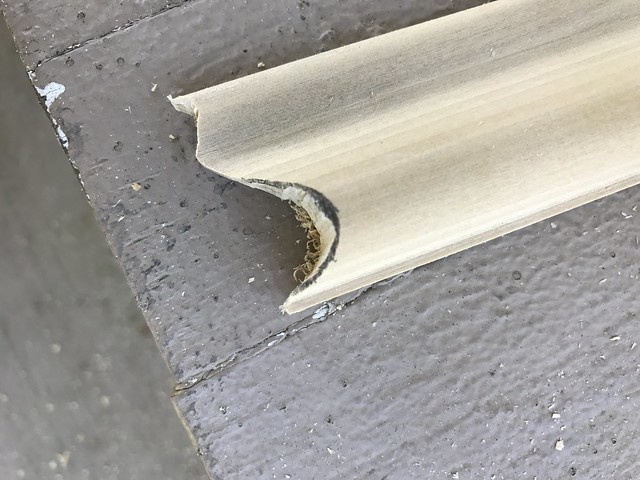
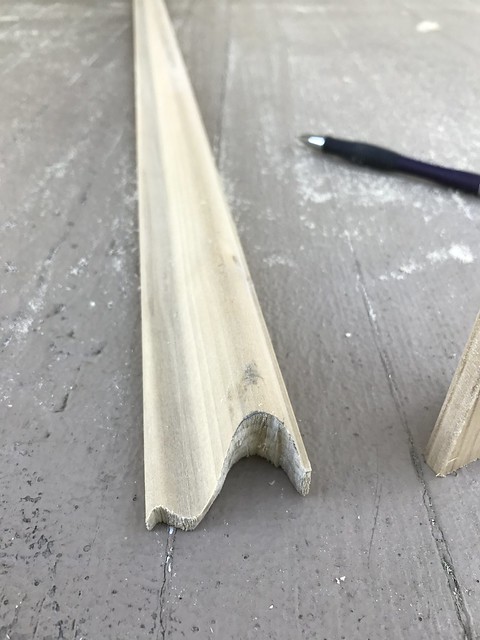
<p>The thing about making a cut as if you're mitering is that the cut reveals exactly the material you should be removing from the moulding. You can see from this end piece that I'll need to remove all of the moulding on the flat section of the piece miter cut.</p>
<p>
</p>
<div class="MediaContainer PhotoContainer"><a href="https://farm9.staticflickr.com/8457/29316866244_af96634473_z.jpg" rel="PhotoPopup" popupheight="640" popupwidth="480"><img alt="" src="https://farm9.staticflickr.com/8457/29316866244_af96634473.jpg" width="375" height="500" style="border-width: 0px; border-style: solid;" /></a></div>
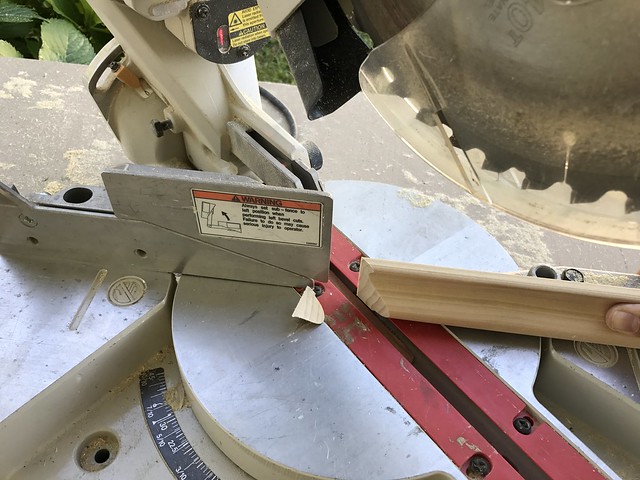
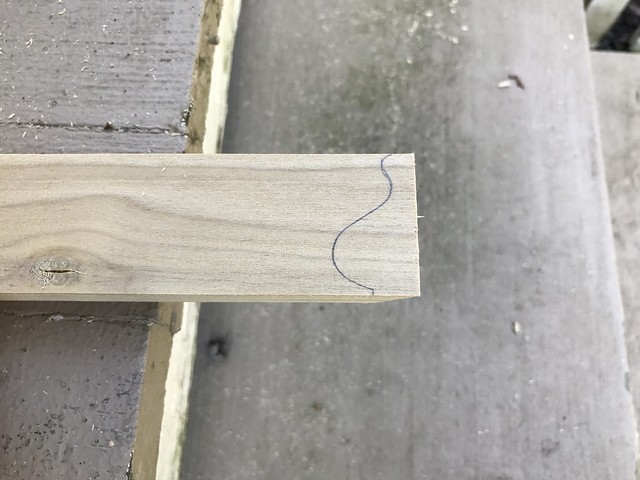
<p>The next step in my process is to determine the cut I'll be making from the back of the moulding. I do this by using a small scrap piece of molding and creating the profile cut line I'll need to follow with my saw.&nbsp;</p>
<p>
</p>
<div class="MediaContainer PhotoContainer"><a href="https://farm9.staticflickr.com/8485/29829890502_bd2907ac9e_z.jpg" rel="PhotoPopup" popupheight="480" popupwidth="640"><img alt="" src="https://farm9.staticflickr.com/8485/29829890502_bd2907ac9e.jpg" width="500" height="375" style="border-width: 0px; border-style: solid;" /></a></div>
<p>This is an instance where my own personal method for coping deviates from the more traditional coping approaches. I like to make my initial cuts from the back of the moulding stock rather than the front. I do this for several reasons that I'll explain later.</p>
<p>
</p>
<div class="MediaContainer PhotoContainer"><a href="https://farm9.staticflickr.com/8165/29860777441_a6572e8780_z.jpg" rel="PhotoPopup" popupheight="480" popupwidth="640"><img alt="" src="https://farm9.staticflickr.com/8165/29860777441_a6572e8780.jpg" width="500" height="375" style="border-width: 0px; border-style: solid;" /></a></div>
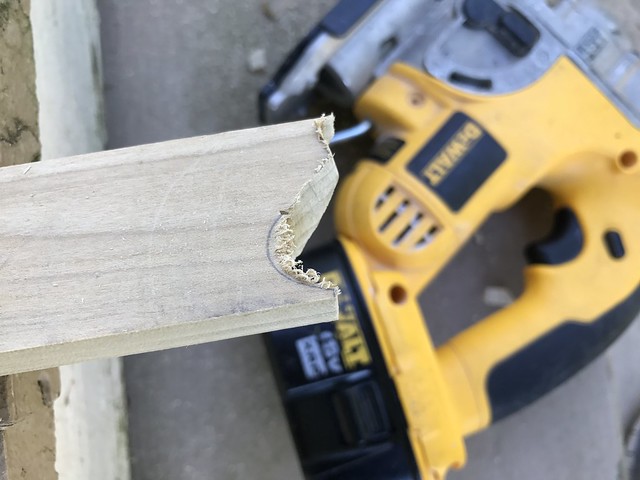
<p>Classic coping tends to use a small coping hand saw and some clamps to hold the work steady. I know I tend to like the old school methods for woodworking, but this is one case where I pretty much despise using a coping saw. I feel like it takes too long and I'm always struggling to get it just right. Perhaps I need to try the coping saw more to get the hang of it, but my tool of preference is to use my variable speed cordless jigsaw.</p>
<p>
</p>
<div class="MediaContainer PhotoContainer"><a href="https://farm9.staticflickr.com/8088/29909758526_3fef88e9c3_z.jpg" rel="PhotoPopup" popupheight="640" popupwidth="480"><img alt="" src="https://farm9.staticflickr.com/8088/29909758526_3fef88e9c3.jpg" width="375" height="500" style="border-width: 0px; border-style: solid;" /></a></div>
<p>This is one of the main reasons I like making the cut from the back of the stick. The jigsaw can damage or scratch the front of stock while cutting, so if I'm making my cut from the back, I don't have to worry about the dings the jigsaw plat can put in the wood.</p>
<p>When I'm making my cuts I just keep taking a little more out of the material with each pass. These steps repeat until I'm able to get a good clean cut that is close to working well with the joint.</p>
<p>
</p>
<div class="MediaContainer PhotoContainer"><a href="https://farm9.staticflickr.com/8462/29943879555_ab61f4d60a_z.jpg" rel="PhotoPopup" popupheight="480" popupwidth="640"><img alt="" src="https://farm9.staticflickr.com/8462/29943879555_ab61f4d60a.jpg" width="500" height="375" style="border-width: 0px; border-style: solid;" /></a></div>
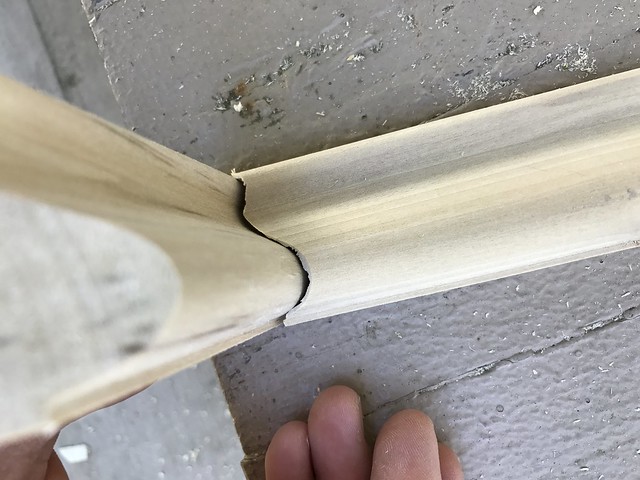
<p>Once I'm close I flip the moulding over to see how I'm doing and how close I am to my desired cut line and make my first test fit of the process. It was close, but not quite perfect.</p>
<p>
</p>
<div class="MediaContainer PhotoContainer"><a href="https://farm8.staticflickr.com/7730/29941762185_edc80a6f4e_z.jpg" rel="PhotoPopup" popupheight="480" popupwidth="640"><img alt="" src="https://farm8.staticflickr.com/7730/29941762185_edc80a6f4e.jpg" width="500" height="375" style="border-width: 0px; border-style: solid;" /></a></div>
<p>Typically this test fit is still a good deal off. In this case, since I knew I wanted to use this as an example, I colored in the remaining wood that needed to be removed using my pencil. This little bit of excess is what stood in my way of a solid looking coped joint.</p>
<p>
</p>
<div class="MediaContainer PhotoContainer"><a href="https://farm9.staticflickr.com/8174/29941762025_bcaed3f8d2_z.jpg" rel="PhotoPopup" popupheight="480" popupwidth="640"><img alt="" src="https://farm9.staticflickr.com/8174/29941762025_bcaed3f8d2.jpg" width="500" height="375" style="border-width: 0px; border-style: solid;" /></a></div>
<p>Working with the jigsaw on the front of the moulding, I carefully nibbled off a little material at a time. I also made sure I angled the blade in on the back, which would ensure there would be no obstructions behind the front of the joint where I couldn't see. You can see from this photo that the jigsaw still dented the moulding just a little, but this will sand out easily. It's much better to make small cuts from the front than to do the whole thing.</p>
<p>
</p>
<div class="MediaContainer PhotoContainer"><a href="https://farm9.staticflickr.com/8224/29827460952_4d0f0df749_z.jpg" rel="PhotoPopup" popupheight="640" popupwidth="480"><img alt="" src="https://farm9.staticflickr.com/8224/29827460952_4d0f0df749.jpg" width="375" height="500" style="border-width: 0px; border-style: solid;" /></a></div>
<p>After several more passes making little cuts at a time, I eventually get to a point where the joint is looking pretty good. Once I'm happy I clean up the rough areas with a small round wood file to remove any heavily jagged leftovers.</p>
<p>
</p>
<div class="MediaContainer PhotoContainer"><a href="https://farm6.staticflickr.com/5082/29907406876_d78ea78659_z.jpg" rel="PhotoPopup" popupheight="480" popupwidth="640"><img alt="" src="https://farm6.staticflickr.com/5082/29907406876_d78ea78659.jpg" width="500" height="375" style="border-width: 0px; border-style: solid;" /></a></div>
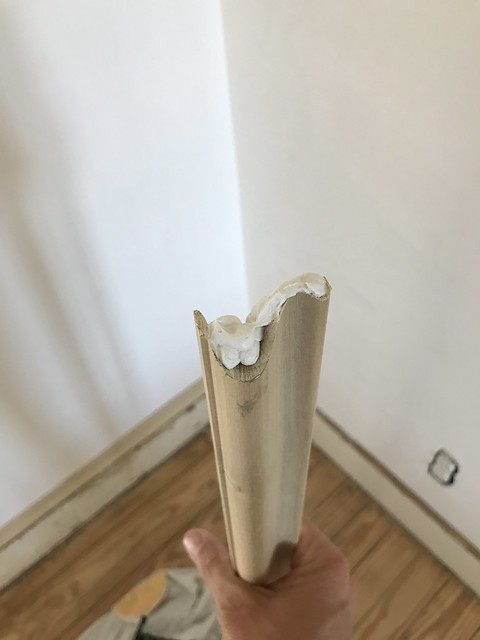
<p>I you'll notice, this joint is close, but it's not perfect. I could have kept working to get it exact, but the important thing to note here is that we'll be painting this moulding, not staining it. When you're not staining the moulding you can leave a little gap and just fill it in with caulk. I like to backfill my joints with BigStretch caulk to ensure a nice a solid joint for many years to come.</p>
<p>
</p>
<div class="MediaContainer PhotoContainer"><a href="https://farm9.staticflickr.com/8203/29907406016_6c93fcda3a_z.jpg" rel="PhotoPopup" popupheight="640" popupwidth="480"><img alt="" src="https://farm9.staticflickr.com/8203/29907406016_6c93fcda3a.jpg" width="375" height="500" style="border-width: 0px; border-style: solid;" /></a></div>
<p>Once the caulk is in place and the moulding is cut to length, all that's left is to put the joint together, nail or fasten, and then clean out the little bit of excess caulk that likely squeezed out of the joint.</p>
<p>
</p>
<div class="MediaContainer PhotoContainer"><a href="https://farm6.staticflickr.com/5801/29941759745_0326c7d126_z.jpg" rel="PhotoPopup" popupheight="480" popupwidth="640"><img alt="" src="https://farm6.staticflickr.com/5801/29941759745_0326c7d126.jpg" width="500" height="375" style="border-width: 0px; border-style: solid;" /></a></div>
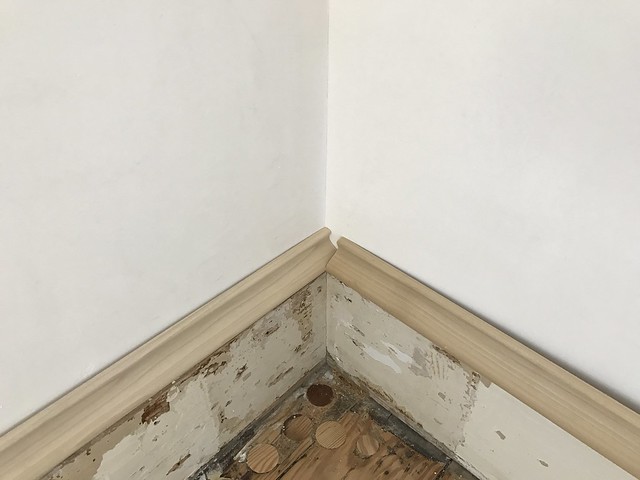
<p>The end result is a great looking joint with less changes of separating over the years and generally a better and more achievable look than traditional mitering. The joint is also much stronger than mitering and tends to fail far less often in the home.</p>
<p>
</p>
<div class="MediaContainer PhotoContainer"><a href="https://farm9.staticflickr.com/8331/29314609254_f154dfae78_z.jpg" rel="PhotoPopup" popupheight="480" popupwidth="640"><img alt="" src="https://farm9.staticflickr.com/8331/29314609254_f154dfae78.jpg" width="500" height="375" style="border-width: 0px; border-style: solid;" /></a></div>
<p>As I mentioned, I like to work my way around the room, placing a piece of moulding, coping the end, then trimming the other end to fit the area before coping the next piece of moulding. After all these years, you could same I'm a serious coping convert that has begun to taking his coping seriously.</p>
<p>Yes, projects take a long time to complete, and yes, some projects cause a lot of sweat, tears, and even blood. We all have coping mechanisms when it comes to dealing with these frustrations. Some lash out in frustration with threats of hiring people to finish the work, while others curl into a ball and ignore what's going on. (I'll let you draw your own conclusions on that one.) But when it comes down to it, the best means of coping is often to acquire the skills necessary to execute a given project the way you'd like. In this case, I hope my guide above will help you cope with moulding adversity by giving you the basis for the skills you need to cope a moulding joint like a pro.</p><p><a href="https://www.oldtownhome.com/2016/9/30/Coping-as-a-DIY-Double-Entendre/">Read Full Post</a></p>]]></content>
    <category term="2nd House Living Room" />
    <category term="Header Image" />
    <category term="How To" />
    <category term="Projects:Woodworking" />
    <category term="Water House" />
    <category term="Woodworking" />
    <PostImage>https://c2.staticflickr.com/6/5324/30054068585_8fd283f1dc.jpg</PostImage>
    <media:thumbnail url="https://c2.staticflickr.com/6/5324/30054068585_8fd283f1dc_t.jpg" />
    <ExtensionElements>
      <Item>PostImage</Item>
      <Item>media:thumbnail</Item>
    </ExtensionElements>
  </entry>
  <entry>
    <guid>96986e73-d9f5-4668-ae9c-abe3e5959b04</guid>
    <id>https://www.oldtownhome.com/2013/5/30/Bringing-Teak-Outdoor-Furniture-Back-from-the-Brink/</id>
    <title>Bringing Teak Outdoor Furniture Back from the Brink</title>
    <summary type="html"><![CDATA[<p>Back in 2003 as first time homeowners, we were excited for spring as it meant we'd be able to use our very own backyard space. After extensive research and flexing our well honed bargain shopping muscles, we found a set of solid teak furniture for a steal at our local Crate &amp; Barrel outlet. </p><p>After deciding on the new purchase, we stuck the chairs in the small trunk of our Ford Mustang, drove them home, then walked the ten or so blocks back up to get the table. Too large to fit in our car, and without ZipCar or friends that had a truck or SUV, we carried the large and awkward table back to our house (after taking several rest breaks along the way). There's no way we were going to pay for shipping for such a short distance. </p><p>Wendy excitedly assembled the table in our backyard, carefully making sure to use the right screws and parts. </p><p>
</p><div class="MediaContainer PhotoContainer"><a href="http://farm6.staticflickr.com/5143/5643715642_0cf6b868e2_z.jpg" rel="PhotoPopup" popupheight="480" popupwidth="640"><img alt="" src="https://farm6.staticflickr.com/5143/5643715642_0cf6b868e2.jpg" width="500" height="375" style="border-width: 0px; border-style: solid;"></a></div><p>Wow, it's amazing how new everything looks. Ah, memories!&nbsp;</p><p>
</p> <a href="https://www.oldtownhome.com/2013/5/30/Bringing-Teak-Outdoor-Furniture-Back-from-the-Brink/">more</a>]]></summary>
    <published>2013-05-30T09:17:00.000-04:00</published>
    <updated>2013-05-30T09:17:00.000-04:00</updated>
    <link rel="alternate" href="https://www.oldtownhome.com/2013/5/30/Bringing-Teak-Outdoor-Furniture-Back-from-the-Brink/" />
    <author>
      <name>Alex</name>
    </author>
    <content type="html"><![CDATA[<p>Back in 2003 as first time homeowners, we were excited for spring as it meant we'd be able to use our very own backyard space. After extensive research and flexing our well honed bargain shopping muscles, we found a set of solid teak furniture for a steal at our local Crate &amp; Barrel outlet. </p>
<p>After deciding on the new purchase, we stuck the chairs in the small trunk of our Ford Mustang, drove them home, then walked the ten or so blocks back up to get the table. Too large to fit in our car, and without ZipCar or friends that had a truck or SUV, we carried the large and awkward table back to our house (after taking several rest breaks along the way). There's no way we were going to pay for shipping for such a short distance. </p>
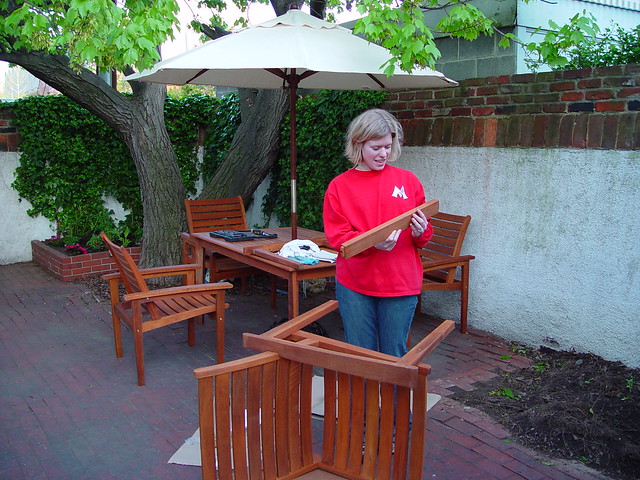
<p>Wendy excitedly assembled the table in our backyard, carefully making sure to use the right screws and parts. </p>
<p>
</p>
<div class="MediaContainer PhotoContainer"><a href="http://farm6.staticflickr.com/5143/5643715642_0cf6b868e2_z.jpg" rel="PhotoPopup" popupheight="480" popupwidth="640"><img alt="" src="https://farm6.staticflickr.com/5143/5643715642_0cf6b868e2.jpg" width="500" height="375" style="border-width: 0px; border-style: solid;"></a></div>
<p>Wow, it's amazing how new everything looks. Ah, memories!&nbsp;</p>
<p>
</p>
<div class="MediaContainer PhotoContainer"><a href="http://farm6.staticflickr.com/5062/5643149005_4023ffbb0a_z.jpg" rel="PhotoPopup" popupheight="640" popupwidth="480"><img alt="" src="https://farm6.staticflickr.com/5062/5643149005_4023ffbb0a.jpg" width="375" height="500" style="border-width: 0px; border-style: solid;"></a></div>
<p>We had our yard set up in no time, and we've enjoyed this furniture for more than ten years since that day. </p>
<p>
</p>
<div class="MediaContainer PhotoContainer"><a href="http://farm6.staticflickr.com/5010/5643149329_f3281fb139_z.jpg" rel="PhotoPopup" popupheight="480" popupwidth="640"><img alt="" src="https://farm6.staticflickr.com/5010/5643149329_f3281fb139.jpg" width="500" height="375" style="border-width: 0px; border-style: solid;"></a></div>
<p>Over the years we've applied various oils to the surface, quenching the thirsty wood. At one point we switched over to a teak protector that Smith &amp; Hawken offered. While it seemed to work well at first, I feel like it's slowly stripped some of that great teak character from the wood. Instead it created a bit of a barrier to the wood, which seemed to keep moisture out, but also let the wood slowly dry from within. </p>
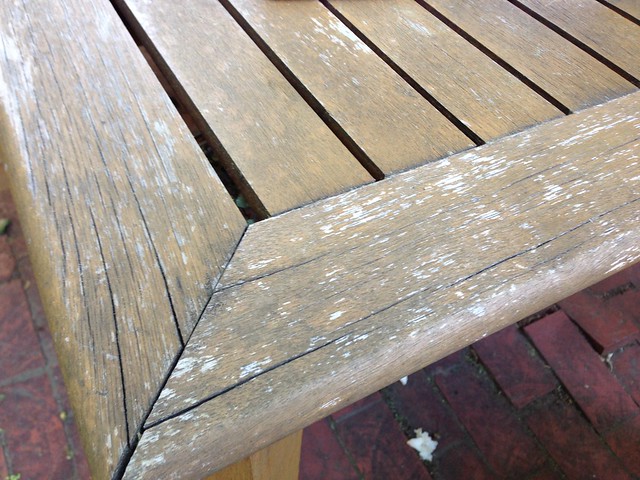
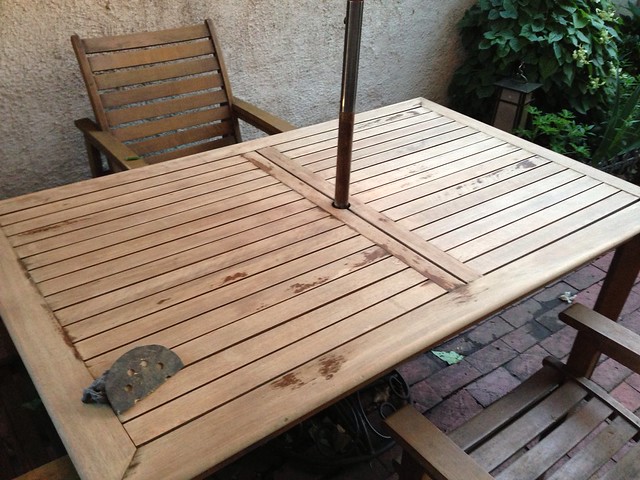
<p>Though we previously disassembled and stored the furniture each winter, the last two years we've been a bit more lax with the care of our teak furniture and failed to take it inside. This left it open to the elements, weathering and beginning to crack. We felt the table and chairs had a good run, and maybe it was time to retire it?</p>
<p>
</p>
<div class="MediaContainer PhotoContainer"><a href="http://farm3.staticflickr.com/2860/8862602172_a7a6466a1c_z.jpg" rel="PhotoPopup" popupheight="480" popupwidth="640"><img alt="" src="https://farm3.staticflickr.com/2860/8862602172_a7a6466a1c.jpg" width="500" height="375" style="border-width: 0px; border-style: solid;"></a></div>
<p>Last weekend, with the <a href="http://www.oldtownhome.com/2013/5/21/Your-Baby-is-Ugly/index.aspx">looming baby shower</a>, Wendy said, "That table is not acceptable. We've got to do something with it." Presented with the challenge, I decided another coat of the protector we had used in the past was not in order. Instead, I felt we could restore the wood of the tabletop to something a whole lot nicer. Something a whole lot more natural. Something more fitting of the&nbsp;sophisticated&nbsp;event we planned to throw in under 24 hours when I began this undertaking.</p>
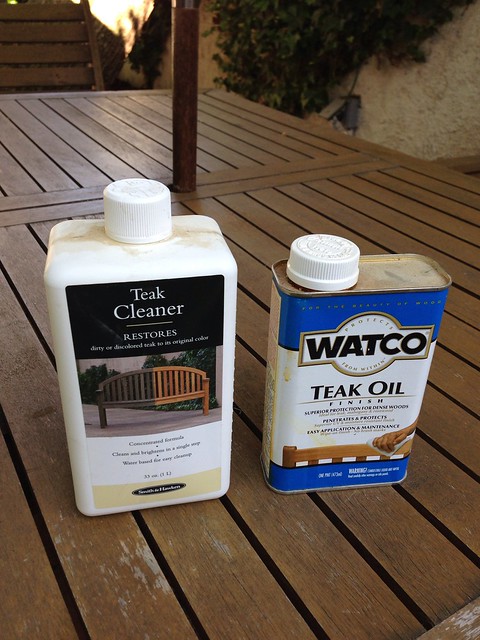
<p>I ventured into our basement and discovered a bottle of teak cleaner that we purchased from Smith &amp; Hawken as a companion to the protector we'd been using. I also found a partial can of teak oil, which is exactly what we'd ultimately need.</p>
<p>
</p>
<div class="MediaContainer PhotoContainer"><a href="http://farm4.staticflickr.com/3764/8862605802_179e348c98_z.jpg" rel="PhotoPopup" popupheight="640" popupwidth="480"><img alt="" src="https://farm4.staticflickr.com/3764/8862605802_179e348c98.jpg" width="375" height="500" style="border-width: 0px; border-style: solid;"></a></div>
<div class="MediaContainer">
<iframe src="http://rcm-na.amazon-adsystem.com/e/cm?t=oltoho-20&amp;o=1&amp;p=8&amp;l=as1&amp;asins=B002TTM3BO&amp;IS1=1&amp;ref=qf_sp_asin_til&amp;fc1=3A3128&amp;lt1=_blank&amp;m=amazon&amp;lc1=61838A&amp;bc1=FAFAF8&amp;bg1=FAFAF8&amp;f=ifr" style="width: 120px; height: 240px;" scrolling="no" marginwidth="0" marginheight="0" frameborder="0"></iframe>
<iframe src="http://rcm-na.amazon-adsystem.com/e/cm?t=oltoho-20&amp;o=1&amp;p=8&amp;l=as1&amp;asins=B003DL72KO&amp;IS1=1&amp;ref=qf_sp_asin_til&amp;fc1=3A3128&amp;lt1=_blank&amp;m=amazon&amp;lc1=61838A&amp;bc1=FAFAF8&amp;bg1=FAFAF8&amp;f=ifr" style="width: 120px; height: 240px;" scrolling="no" marginwidth="0" marginheight="0" frameborder="0"></iframe>
</div>
<p>Starting with our gray and cracking table I followed the instructions on the cleaner and soaked the table with the hose sprayer.</p>
<p>
</p>
<div class="MediaContainer PhotoContainer"><a href="http://farm8.staticflickr.com/7382/8861999549_c239017f94_z.jpg" rel="PhotoPopup" popupheight="640" popupwidth="480"><img alt="" src="https://farm8.staticflickr.com/7382/8861999549_c239017f94.jpg" width="375" height="500" style="border-width: 0px; border-style: solid;"></a></div>
<p>Using a sock as a rag, I began applying the cleaner, which claimed to bring back the original luster of the teak. </p>
<p>
</p>
<div class="MediaContainer PhotoContainer"><a href="http://farm9.staticflickr.com/8400/8862005205_ae75465188_z.jpg" rel="PhotoPopup" popupheight="640" popupwidth="480"><img alt="" src="https://farm9.staticflickr.com/8400/8862005205_ae75465188.jpg" width="375" height="500" style="border-width: 0px; border-style: solid;"></a></div>
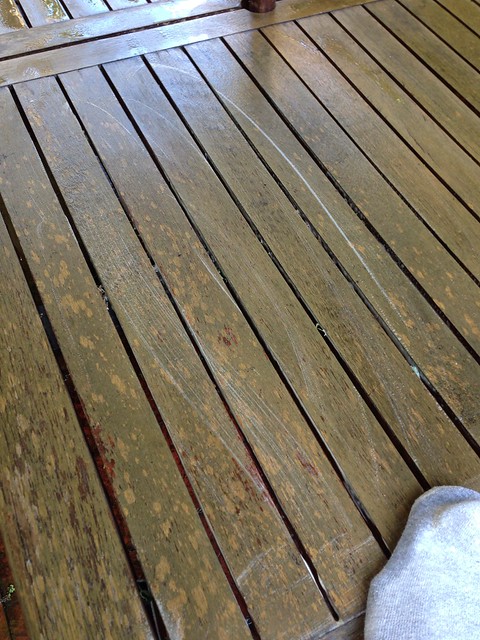
<p>As you can see, the product sort of sudsed up and created a bit of a lather. The areas that were gray immediately turned the more typical rich teak color, while the areas that still had a layer of the substance we used got sort of orange and splotchy.</p>
<p>I can't say for certain how well the cleaner actually worked versus not using anything other than a lot of scrubbing. Ultimately I didn't try an area without the cleaner as a control, but it did seem to loosen up the flaking table top. </p>
<p>At first it didn't seem to be doing anything, but one of the directions instructed me to use the included scrubbing pad (which I'm pretty sure I threw away years ago). I could see bits of the old wood beginning to peak through, so I grabbed a dish sponge with&nbsp;abrasive&nbsp;pad and gave that a shot.&nbsp;</p>
<p>
</p>
<div class="MediaContainer PhotoContainer"><a href="http://farm8.staticflickr.com/7395/8862622652_37476130b0_z.jpg" rel="PhotoPopup" popupheight="640" popupwidth="480"><img alt="" src="https://farm8.staticflickr.com/7395/8862622652_37476130b0.jpg" width="375" height="500" style="border-width: 0px; border-style: solid;"></a></div>
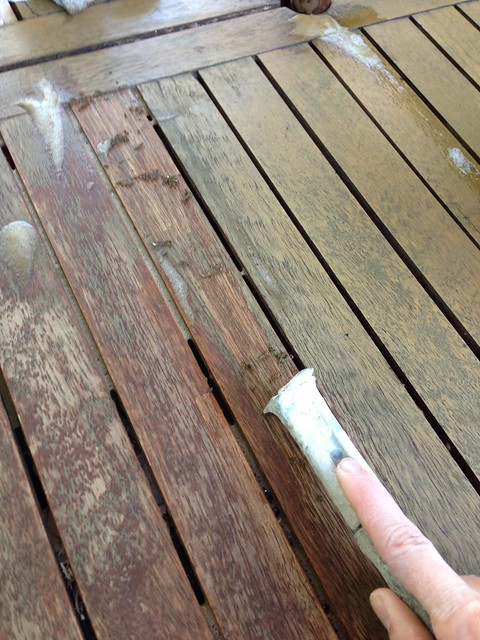
<p>Though it worked a little bit, I knew I'd need something with a bit more bite to it. I ventured back into the basement and grabbed a few paint scrapers and a pack of #3 steel wool pads. The scraper worked really well, but I had to be extremely careful that I wasn't tearing up the surface of the wood.</p>
<p>
</p>
<div class="MediaContainer PhotoContainer"><a href="http://farm3.staticflickr.com/2856/8862626318_6da48177ee_z.jpg" rel="PhotoPopup" popupheight="640" popupwidth="480"><img alt="" src="https://farm3.staticflickr.com/2856/8862626318_6da48177ee.jpg" width="375" height="500" style="border-width: 0px; border-style: solid;"></a></div>
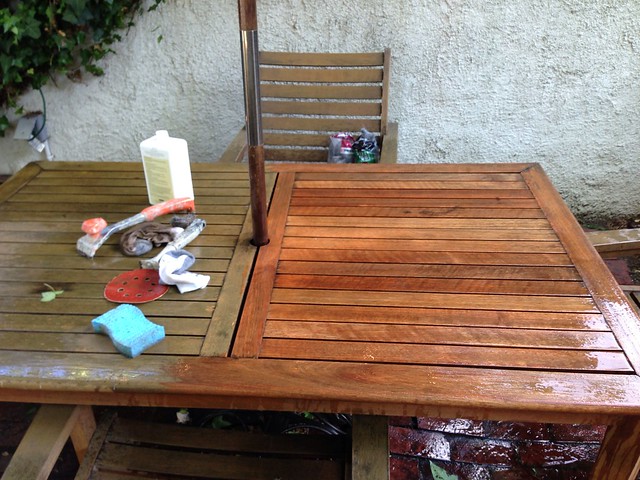
<p>As you can see, when I started dragging the scraper and really scrubbing with the steel wool, especially after soaking the table a bit more, all of the previous goo started pulling free. </p>
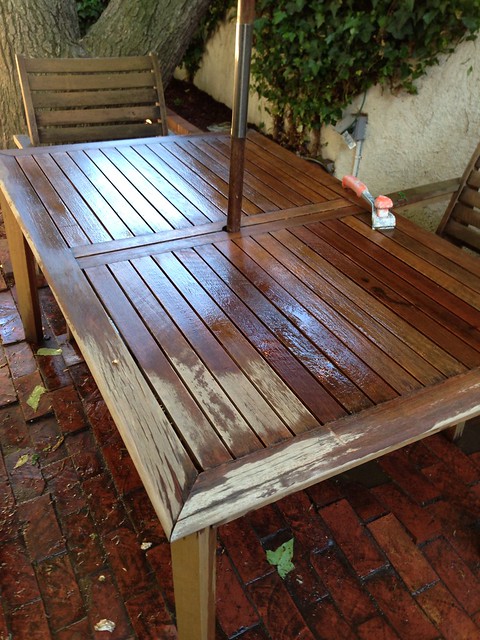
<p>I could see the original gray wood made beautiful once again by the water that had been sprayed on the table. I kept working my way around the table until I was able to take a half and half look at a before and after. </p>
<p>
</p>
<div class="MediaContainer PhotoContainer"><a href="http://farm8.staticflickr.com/7333/8862021955_6f533d56e5_z.jpg" rel="PhotoPopup" popupheight="480" popupwidth="640"><img alt="" src="https://farm8.staticflickr.com/7333/8862021955_6f533d56e5.jpg" width="500" height="375" style="border-width: 0px; border-style: solid;"></a></div>
<p>I hadn't even applied oil at this point, and this look was spectacular when it was simply wet. </p>
<p>I kept working until I had removed all of the buildup from the top of the table. Once it was all removed, I had a difficult endeavor in patience while waiting for the water to dry.&nbsp;</p>
<p>
</p>
<div class="MediaContainer PhotoContainer"><a href="http://farm4.staticflickr.com/3811/8862637494_84a1609dfa_z.jpg" rel="PhotoPopup" popupheight="640" popupwidth="480"><img alt="" src="https://farm4.staticflickr.com/3811/8862637494_84a1609dfa.jpg" width="375" height="500" style="border-width: 0px; border-style: solid;"></a></div>
<p>I ended up turning to the hammock while watching the Nationals play on the IPad. Rough wait, I tell ya!</p>
<p>
</p>
<div class="MediaContainer PhotoContainer"><a href="http://farm8.staticflickr.com/7339/8862058611_e3c6e18940_z.jpg" rel="PhotoPopup" popupheight="640" popupwidth="480"><img alt="" src="https://farm8.staticflickr.com/7339/8862058611_e3c6e18940.jpg" width="375" height="500" style="border-width: 0px; border-style: solid;"></a></div>
<p>It was a cool day, and as the sun set and it turned to night, I continued my efforts. Finally the table was just about dry so I could proceed.</p>
<p>
</p>
<div class="MediaContainer PhotoContainer"><a href="http://farm4.staticflickr.com/3817/8862647930_d9ea12b779_z.jpg" rel="PhotoPopup" popupheight="480" popupwidth="640"><img alt="" src="https://farm4.staticflickr.com/3817/8862647930_d9ea12b779.jpg" width="500" height="375" style="border-width: 0px; border-style: solid;"></a></div>
<p>Using some 220 grit sandpaper and "00" steel wool, I sanded the entire tabletop until it was smooth. This removed any of the fuzz or grain that had been left by the standing water, and it evened out any of the stains or areas that needed some extra attention. </p>
<p>
</p>
<div class="MediaContainer PhotoContainer"><a href="http://farm4.staticflickr.com/3748/8862644784_f2e6da1e30_z.jpg" rel="PhotoPopup" popupheight="480" popupwidth="640"><img alt="" src="https://farm4.staticflickr.com/3748/8862644784_f2e6da1e30.jpg" width="500" height="375" style="border-width: 0px; border-style: solid;"></a></div>
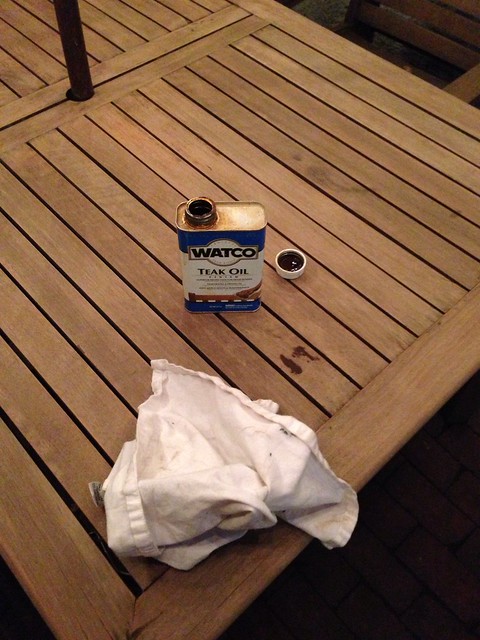
<p>Once fully sanded, I broke open the teak oil and grabbed *the napkin*.  I'm talking about <a href="http://www.oldtownhome.com/2012/3/9/When-Renovating-Isnt-Sunshine-and-Rainbows/">the good linen napkin of ours I had used as a paint rag some time ago</a>. Wendy has never let me forget this action of mine, so I make a point to get quite a bit of good use out of my terrible mistake. </p>
<p>
</p>
<div class="MediaContainer PhotoContainer"><a href="http://farm9.staticflickr.com/8403/8862064227_e43e1f2218_z.jpg" rel="PhotoPopup" popupheight="640" popupwidth="480"><img alt="" src="https://farm9.staticflickr.com/8403/8862064227_e43e1f2218.jpg" width="375" height="500" style="border-width: 0px; border-style: solid;"></a></div>
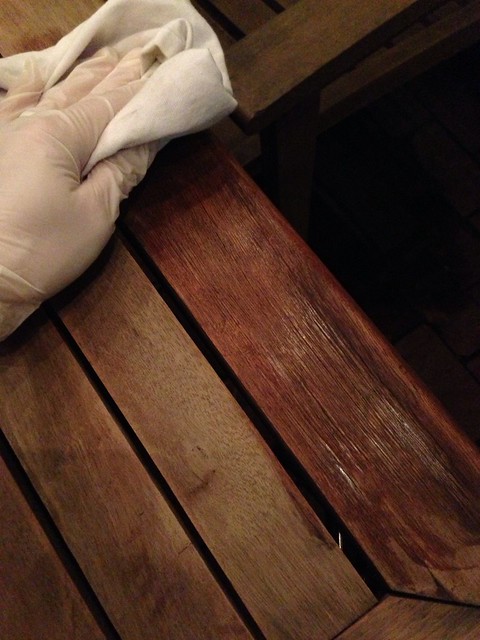
<p>I hadn't opened the teak oil in so long that I ultimately had to use a vise grip plier to convince the lid open. But as soon as I applied that first bit of oil to the gray and dry table, it drank it right up!</p>
<p>
</p>
<div class="MediaContainer PhotoContainer"><a href="http://farm8.staticflickr.com/7287/8862067257_664f97601d_z.jpg" rel="PhotoPopup" popupheight="640" popupwidth="480"><img alt="" src="https://farm8.staticflickr.com/7287/8862067257_664f97601d.jpg" width="375" height="500" style="border-width: 0px; border-style: solid;"></a></div>
<p>After half of the first coat had been applied, the table once again started to show the previous luster we loved so much. It was deep and rich. </p>
<p>
</p>
<div class="MediaContainer PhotoContainer"><a href="http://farm6.staticflickr.com/5341/8862679878_97eee13ee2_z.jpg" rel="PhotoPopup" popupheight="480" popupwidth="640"><img alt="" src="https://farm6.staticflickr.com/5341/8862679878_97eee13ee2.jpg" width="500" height="375" style="border-width: 0px; border-style: solid;"></a></div>
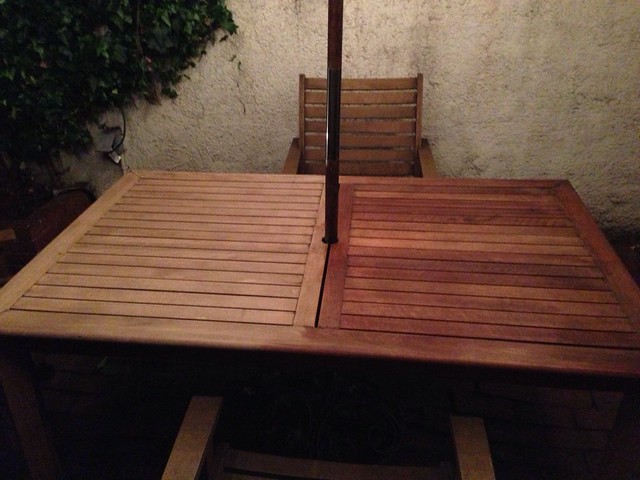
<p>The project had stretched well into the night, but I finally finished up the first coat of oil.&nbsp;</p>
<p>
</p>
<div class="MediaContainer PhotoContainer"><a href="http://farm8.staticflickr.com/7311/8862073537_773c949f32_z.jpg" rel="PhotoPopup" popupheight="480" popupwidth="640"><img alt="" src="https://farm8.staticflickr.com/7311/8862073537_773c949f32.jpg" width="500" height="375" style="border-width: 0px; border-style: solid;"></a></div>
<p>However, it wasn't until the next morning (and <a href="http://www.oldtownhome.com/2013/5/29/Oh-Baby-Pulling-Off-a-Festive-and-Elegant-Baby-Shower/index.aspx">day of the baby shower</a>) that I had a chance to really look at how great the newly spruced up table looked. To say I was pleased is an understatement.</p>
<p>
</p>
<div class="MediaContainer PhotoContainer"><a href="http://farm8.staticflickr.com/7455/8865668480_8d15f7cd3a_z.jpg" rel="PhotoPopup" popupheight="640" popupwidth="480"><img alt="" src="https://farm8.staticflickr.com/7455/8865668480_8d15f7cd3a.jpg" width="375" height="500" style="border-width: 0px; border-style: solid;"></a></div>
<p>We noticed the next day after the shower that the table had essentially absorbed the entire oil application, so I went ahead and quenched the wood with a second coat. It turned out looking really great, and we even used the table for a dinner party seafood event with friends on Memorial Day.</p>
<p>
</p>
<div class="MediaContainer PhotoContainer"><a href="http://farm8.staticflickr.com/7295/8885704522_7f6cc01cf6_z.jpg" rel="PhotoPopup" popupheight="640" popupwidth="480"><img alt="" src="https://farm8.staticflickr.com/7295/8885704522_7f6cc01cf6.jpg" width="375" height="500" style="border-width: 0px; border-style: solid;"></a></div>
<p>At this point we've only done the tabletop, but I'm sort of itching to do the legs of the table and the chairs as well. This may allow us to continue using the set for at least a few more seasons. We shall see on that one. At the very least, we've got ourselves a great looking teak tabletop for this season, and if we do get a new set, I may end up using this teak as salvaged wood to build other outdoor odds and ends. </p>
<p>Do you have any experience with teak? Maybe an outdoor furniture set that needs a little TLC to bring back some of it's former glory? I hope my experience will prove to be useful in helping you breathe life back into your furniture.</p><p><a href="https://www.oldtownhome.com/2013/5/30/Bringing-Teak-Outdoor-Furniture-Back-from-the-Brink/">Read Full Post</a></p>]]></content>
    <category term="Exclude-Teaser-Projects:Garden" />
    <category term="Exclude-Teaser-Projects:Home Improvement" />
    <category term="Exclude-Teaser-Projects:Woodworking" />
    <category term="Header Image" />
    <category term="How To" />
    <category term="Outdoor Furniture" />
    <category term="Projects:Cleaning Organizing" />
    <category term="Projects:Garden" />
    <category term="Projects:Home Improvement" />
    <category term="Projects:Woodworking" />
    <category term="Restoration" />
    <PostImage>http://farm8.staticflickr.com/7300/8885213491_91044c48b8.jpg</PostImage>
    <media:thumbnail url="https://farm8.staticflickr.com/7300/8885213491_91044c48b8_t.jpg" />
    <ExtensionElements>
      <Item>PostImage</Item>
      <Item>media:thumbnail</Item>
    </ExtensionElements>
  </entry>
  <entry>
    <guid>3820978d-fc87-47c8-8cf4-c19cf95d5396</guid>
    <id>https://www.oldtownhome.com/2013/1/23/Sweating-the-Small-Stuff-How-To-Solder-Copper-Pipe/</id>
    <title>Sweating the Small Stuff: How To Solder Copper Pipe</title>
    <summary type="html"><![CDATA[<p>In 1997 as a college student with mediocre to zero skills in just about anything useful, I was looking for summer work but didn't have anything worthwhile lined up. Forget wanting a to find a job that had anything to do with life skills, I just wanted something that would give me a paycheck so that I could buy gas to drive over to Wendy's parents' house every night. Life was simple back then.</p><p>As the summer approached, I wasn't having much luck finding seasonal work, but my mom actually gave me a lead on a possible position as an assistant to a contractor friend of hers. Skeptical of the position, and making some $2.00 per hour less than the prior summer, I took the contractor up on his offer and started the week I got home from college. After all, gas was only $0.99 per gallon back then, so I guess I didn't really *need* the extra money. </p><p>Little did I know that working as his assistant while he performed full scale renovations on beautiful old homes would turn into a lifelong passion for me. Of the many basic skills I learned that summer, most became the building blocks for what eventually allowed me to develop the level of comfort and general aptitude for what we do in our home. </p><p>Easily one of the most valuable "how tos" he put me through in my four months of working with him came on the day he looked at me and said, "Hey, grab that blow torch!"</p><p>Wide eyed, I looked at him as if he had made a horrible blunder or just didn't realize what he had said. Surely he meant wrench, hammer, screw driver, sandwich,&nbsp;hamster, or anything more suitable than "this thing that blows really hot fire out of it." Much to my surprise, he hadn't fallen into a bit of tool Tourettes and had intended for me to actually grab the blow torch and propane canister from the tool box. How do I know it was intentional? Because he followed it up with, "I'm going to show you how to sweat a copper plumbing joint."</p><p>Why, oh why, would he want me to do this critical task in this unsuspecting homeowner's soon-to-be-beautiful bathroom? Didn't he fear I might just burn the whole joint down? Or worse, what if I caused a massive leak? (That's worse, right?) His next response put some of my fears to rest. "Hey, if I can do it a monkey can do it, so that means you can almost absolutely do it." Hmm, impressive logic, can't argue with that. </p> <a href="https://www.oldtownhome.com/2013/1/23/Sweating-the-Small-Stuff-How-To-Solder-Copper-Pipe/">more</a>]]></summary>
    <published>2013-01-23T12:13:00.000-05:00</published>
    <updated>2013-01-23T12:13:00.000-05:00</updated>
    <link rel="alternate" href="https://www.oldtownhome.com/2013/1/23/Sweating-the-Small-Stuff-How-To-Solder-Copper-Pipe/" />
    <author>
      <name>Alex</name>
    </author>
    <content type="html"><![CDATA[<p>In 1997 as a college student with mediocre to zero skills in just about anything useful, I was looking for summer work but didn't have anything worthwhile lined up. Forget wanting a to find a job that had anything to do with life skills, I just wanted something that would give me a paycheck so that I could buy gas to drive over to Wendy's parents' house every night. Life was simple back then.</p>
<p>As the summer approached, I wasn't having much luck finding seasonal work, but my mom actually gave me a lead on a possible position as an assistant to a contractor friend of hers. Skeptical of the position, and making some $2.00 per hour less than the prior summer, I took the contractor up on his offer and started the week I got home from college. After all, gas was only $0.99 per gallon back then, so I guess I didn't really *need* the extra money. </p>
<p>Little did I know that working as his assistant while he performed full scale renovations on beautiful old homes would turn into a lifelong passion for me. Of the many basic skills I learned that summer, most became the building blocks for what eventually allowed me to develop the level of comfort and general aptitude for what we do in our home. </p>
<p>Easily one of the most valuable "how tos" he put me through in my four months of working with him came on the day he looked at me and said, "Hey, grab that blow torch!"</p>
<p>Wide eyed, I looked at him as if he had made a horrible blunder or just didn't realize what he had said. Surely he meant wrench, hammer, screw driver, sandwich,&nbsp;hamster, or anything more suitable than "this thing that blows really hot fire out of it." Much to my surprise, he hadn't fallen into a bit of tool Tourettes and had intended for me to actually grab the blow torch and propane canister from the tool box. How do I know it was intentional? Because he followed it up with, "I'm going to show you how to sweat a copper plumbing joint."</p>
<p>Why, oh why, would he want me to do this critical task in this unsuspecting homeowner's soon-to-be-beautiful bathroom? Didn't he fear I might just burn the whole joint down? Or worse, what if I caused a massive leak? (That's worse, right?) His next response put some of my fears to rest. "Hey, if I can do it a monkey can do it, so that means you can almost absolutely do it." Hmm, impressive logic, can't argue with that. </p>
<p>Over the next several minutes he taught me how to make a sound and leak-free copper connection in a plumbing supply line. Now that I've been putting these skills to use over the years, I can pass along my tried and true approach to making up a soldered copper connection, or "sweating a copper joint." I know there may be a kajillion how-to web pages on this very topic, but this is the way that I learned, so I wanted to share it with you.&nbsp;</p>
<p>The first and most important part of the process is ensuring you have all of the necessary supplies to complete the work. There are quite a few supplies necessary when preparing to solder so you'll want to gather everything ahead of time to make the job easier.</p>
<p>
</p>
<div class="MediaContainer PhotoContainer"><a href="http://farm9.staticflickr.com/8186/8406522885_7ef6445c48_z.jpg" rel="PhotoPopup" popupheight="640" popupwidth="427"><img alt="" src="https://farm9.staticflickr.com/8186/8406522885_7ef6445c48.jpg" width="333" height="500" style="border-width: 0px; border-style: solid;"></a></div>
<p>You'll need:</p>
<ul>
    <li><a href="http://www.amazon.com/gp/product/B001D1KOY2/ref=as_li_qf_sp_asin_tl?ie=UTF8&amp;camp=1789&amp;creative=9325&amp;creativeASIN=B001D1KOY2&amp;linkCode=as2&amp;tag=oltoho-20" target="_blank">Copper pipe cutter</a><img alt="" src="http://www.assoc-amazon.com/e/ir?t=oltoho-20&amp;l=as2&amp;o=1&amp;a=B001D1KOY2" width="1" height="1" style="border: none !important; margin: 0px !important;">
    </li>
    <li><a href="http://www.amazon.com/gp/product/B00004T828/ref=as_li_qf_sp_asin_tl?ie=UTF8&amp;camp=1789&amp;creative=9325&amp;creativeASIN=B00004T828&amp;linkCode=as2&amp;tag=oltoho-20" target="_blank">Swivel Head Deburring Tool</a><img alt="" src="http://www.assoc-amazon.com/e/ir?t=oltoho-20&amp;l=as2&amp;o=1&amp;a=B00004T828" width="1" height="1" style="border: none !important; margin: 0px !important;"></li>
    <li><a href="http://www.amazon.com/gp/product/B000FH89YW/ref=as_li_qf_sp_asin_tl?ie=UTF8&amp;camp=1789&amp;creative=9325&amp;creativeASIN=B000FH89YW&amp;linkCode=as2&amp;tag=oltoho-20">Inside Cleaning Brush</a><img alt="" src="http://www.assoc-amazon.com/e/ir?t=oltoho-20&amp;l=as2&amp;o=1&amp;a=B000FH89YW" width="1" height="1" style="border: none !important; margin: 0px !important;">
    </li>
    <li><a href="http://www.amazon.com/gp/product/B000FSW4BU/ref=as_li_qf_sp_asin_tl?ie=UTF8&amp;camp=1789&amp;creative=9325&amp;creativeASIN=B000FSW4BU&amp;linkCode=as2&amp;tag=oltoho-20" target="_blank">Outside Cleaning Brush for Tubing</a><img alt="" src="http://www.assoc-amazon.com/e/ir?t=oltoho-20&amp;l=as2&amp;o=1&amp;a=B000FSW4BU" width="1" height="1" style="border: none !important; margin: 0px !important;"></li>
    <li><a href="http://www.amazon.com/gp/product/B0012TAWS8/ref=as_li_qf_sp_asin_tl?ie=UTF8&amp;camp=1789&amp;creative=9325&amp;creativeASIN=B0012TAWS8&amp;linkCode=as2&amp;tag=oltoho-20" target="_blank">Lead Free Solder</a><img alt="" src="http://www.assoc-amazon.com/e/ir?t=oltoho-20&amp;l=as2&amp;o=1&amp;a=B0012TAWS8" width="1" height="1" style="border: none !important; margin: 0px !important;"></li>
    <li><a href="http://www.amazon.com/gp/product/B000KKT4A2/ref=as_li_qf_sp_asin_tl?ie=UTF8&amp;camp=1789&amp;creative=9325&amp;creativeASIN=B000KKT4A2&amp;linkCode=as2&amp;tag=oltoho-20" target="_blank">Tinning Flux</a><img alt="" src="http://www.assoc-amazon.com/e/ir?t=oltoho-20&amp;l=as2&amp;o=1&amp;a=B000KKT4A2" width="1" height="1" style="border: none !important; margin: 0px !important;">
    </li>
    <li>Flux brush</li>
    <li><a href="http://www.amazon.com/gp/product/B002DVN7OU/ref=as_li_qf_sp_asin_tl?ie=UTF8&amp;camp=1789&amp;creative=9325&amp;creativeASIN=B002DVN7OU&amp;linkCode=as2&amp;tag=oltoho-20" target="_blank">Propane Fuel Cylinder</a><img alt="" src="http://www.assoc-amazon.com/e/ir?t=oltoho-20&amp;l=as2&amp;o=1&amp;a=B002DVN7OU" width="1" height="1" style="border: none !important; margin: 0px !important;"> and Torch
    </li>
    <li><a href="http://www.amazon.com/gp/product/B0000DINGM/ref=as_li_qf_sp_asin_tl?ie=UTF8&amp;camp=1789&amp;creative=9325&amp;creativeASIN=B0000DINGM&amp;linkCode=as2&amp;tag=oltoho-20" target="_blank">Spark Lighter</a><img alt="" src="http://www.assoc-amazon.com/e/ir?t=oltoho-20&amp;l=as2&amp;o=1&amp;a=B0000DINGM" width="1" height="1" style="border: none !important; margin: 0px !important;">
    (optional, if needed for propane)</li>
    <li>Bucket with water</li>
    <li>Rag</li>
    <li><a href="http://www.oldtownhome.com/2011/8/2/Toolbox-Tuesday-Dont-Overlook-Your-Safety-Glasses/index.aspx">Safety glasses</a></li>
    <li><a href="http://www.oldtownhome.com/2011/6/7/Toolbox-Tuesday-The-Gloves-Come-Off-Not-All-Work-Gloves-are-Created-Equal/index.aspx">Work gloves</a></li>
    <li>Metal guard (24 gauge minimum)&nbsp;</li>
</ul>
<p>To begin, cut your piece of copper pipe to length using your cutter. I go with the "two rotations for every quarter turn" method of cutting. In other words, I turn the cutting tool's handle one quarter of a turn for every two rotations on the pipe. This keeps the cut nice and even without denting the pipe in the process, a very important aspect of the cut. The cutting process will leave a ridge along the inside of the pipe once you've completed the cut. This is where the deburring tool comes in.</p>
<p>
</p>
<div class="MediaContainer PhotoContainer"><a href="http://farm9.staticflickr.com/8465/8406535037_24fb73658f_z.jpg" rel="PhotoPopup" popupheight="427" popupwidth="640"><img alt="" src="https://farm9.staticflickr.com/8465/8406535037_24fb73658f.jpg" width="500" height="333" style="border-width: 0px; border-style: solid;"></a></div>
<p>This tool is moved in a circle within the cut length of pipe and takes the ridge left by the copper cutter off of the metal. This is extremely important as the bur will impact the flow of water inside the pipe, potentially resulting in premature failure of your joint or fitting.</p>
<p>Once deburred, you need to make sure the end of the pipe and the inside of the fitting are both very clean. The best way to accomplish this is through the use of a wire brush for the fitting...</p>
<p>
</p>
<div class="MediaContainer PhotoContainer"><a href="http://farm9.staticflickr.com/8336/8407632962_19f2a39848_z.jpg" rel="PhotoPopup" popupheight="427" popupwidth="640"><img alt="" src="https://farm9.staticflickr.com/8336/8407632962_19f2a39848.jpg" width="500" height="333" style="border-width: 0px; border-style: solid;"></a></div>
<p>...and a wire hand wheel for the pipe.&nbsp;</p>
<p>
</p>
<div class="MediaContainer PhotoContainer"><a href="http://farm9.staticflickr.com/8474/8407629040_1a8875eb3b_z.jpg" rel="PhotoPopup" popupheight="427" popupwidth="640"><img alt="" src="https://farm9.staticflickr.com/8474/8407629040_1a8875eb3b.jpg" width="500" height="333" style="border-width: 0px; border-style: solid;"></a></div>
<p>This is a simple process to clean the pipe and fitting, and the end result comparison of the clean versus uncleaned fitting is strikingly obvious.</p>
<p class="MediaContainer PhotoContainer"><a href="http://farm9.staticflickr.com/8219/8406542185_ce97561964_z.jpg" rel="PhotoPopup" popupheight="427" popupwidth="640"><img alt="" src="https://farm9.staticflickr.com/8219/8406542185_ce97561964.jpg" width="500" height="333" style="border-width: 0px; border-style: solid;"></a></p>
<p class="MediaContainer PhotoContainer"><em>Clean on the right...if not strikingly obvious.</em></p>
<p>When the pipe and fitting are thoroughly cleaned, just wipe it off with a rag (to remove any dust) and grab your tinning flux.&nbsp;</p>
<p>
</p>
<div class="MediaContainer PhotoContainer"><a href="http://farm9.staticflickr.com/8072/8406526205_109a09668b_z.jpg" rel="PhotoPopup" popupheight="427" popupwidth="640"><img alt="" src="https://farm9.staticflickr.com/8072/8406526205_109a09668b.jpg" width="500" height="333" style="border-width: 0px; border-style: solid;"></a></div>
<p>Though the name may imply an alternate function, this has nothing to do with time travel, Deloreans, or Doc Brown. Instead, flux acts to draw the melted solder into the joint once it's heated sufficiently. I prefer the Oatey 95 brand of tinning flux. It's what I've always used and I think it works really well.&nbsp;</p>
<p>Apply the flux to both the pipe and to the interior of the fitting...</p>
<p>
</p>
<div class="MediaContainer PhotoContainer"><a href="http://farm9.staticflickr.com/8193/8407639076_c533a50230_z.jpg" rel="PhotoPopup" popupheight="427" popupwidth="640"><img alt="" src="https://farm9.staticflickr.com/8193/8407639076_c533a50230.jpg" width="500" height="333" style="border-width: 0px; border-style: solid;"></a></div>
<p>...and place the fitting on the pipe, trying to work the flux around in the joint.</p>
<p>
</p>
<div class="MediaContainer PhotoContainer"><a href="http://farm9.staticflickr.com/8054/8407644744_f89fbe7c63_z.jpg" rel="PhotoPopup" popupheight="427" popupwidth="640"><img alt="" src="https://farm9.staticflickr.com/8054/8407644744_f89fbe7c63.jpg" width="500" height="333" style="border-width: 0px; border-style: solid;"></a></div>
<p>Finally, grab the propane torch and turn on the gas.</p>
<p>
</p>
<div class="MediaContainer PhotoContainer"><a href="http://farm9.staticflickr.com/8472/8407647786_b2b4fb1f75_z.jpg" rel="PhotoPopup" popupheight="427" popupwidth="640"><img alt="" src="https://farm9.staticflickr.com/8472/8407647786_b2b4fb1f75.jpg" width="500" height="333" style="border-width: 0px; border-style: solid;"></a></div>
<p>My torch has a supply line and&nbsp;ignitor&nbsp;nozzle. I prefer this to the standard fitting as this allows me to work at any angle without worry of more gas heading to the flame than I want. Lighting it is as easy as clicking a button.</p>
<p>
</p>
<div class="MediaContainer PhotoContainer"><a href="http://farm9.staticflickr.com/8505/8407650478_ee21bcf3db_z.jpg" rel="PhotoPopup" popupheight="640" popupwidth="427"><img alt="" src="https://farm9.staticflickr.com/8505/8407650478_ee21bcf3db.jpg" width="333" height="500" style="border-width: 0px; border-style: solid;"></a></div>
<p>This also allows me to clamp the propane&nbsp;canister&nbsp;to something else so it doesn't fall over while I'm working.This works well, though I should probably buy one of those little&nbsp;canister&nbsp;caddies that I can carry around.</p>
<p>
</p>
<div class="MediaContainer PhotoContainer"><a href="http://farm9.staticflickr.com/8075/8406739141_14a1085d1e_z.jpg" rel="PhotoPopup" popupheight="640" popupwidth="427"><img alt="" src="https://farm9.staticflickr.com/8075/8406739141_14a1085d1e.jpg" width="333" height="500" style="border-width: 0px; border-style: solid;"></a></div>
<p>The soldering process only takes about 30 seconds. It's best to pre-extend enough solder from the spool so you won't have to deal with it when the flame is lit.</p>
<p>
</p>
<div class="MediaContainer PhotoContainer"><a href="http://farm9.staticflickr.com/8323/8406558415_96291b4d67_z.jpg" rel="PhotoPopup" popupheight="427" popupwidth="640"><img alt="" src="https://farm9.staticflickr.com/8323/8406558415_96291b4d67.jpg" width="500" height="333" style="border-width: 0px; border-style: solid;"></a></div>
<p>When heating the fitting, it's best to heat the opposite side of the fitting from where you are going to&nbsp;initially&nbsp;apply the solder. This ensures the whole fitting is heated thoroughly before the solder melts and is sucked into the flux. If the fitting isn't entirely up to temperate it can cause a pinhole leak in your joint.</p>
<p>
</p>
<div class="MediaContainer PhotoContainer"><a href="http://farm9.staticflickr.com/8076/8406692229_04149e873a_z.jpg" rel="PhotoPopup" popupheight="427" popupwidth="640"><img alt="" src="https://farm9.staticflickr.com/8076/8406692229_04149e873a.jpg" width="500" height="333" style="border-width: 0px; border-style: solid;"></a></div>
<p>It's also best to apply the solder to several points around the joint to ensure full coverage. Just keep the flame on the joint (moving around the joint if you'd like) the whole time so it doesn't begin to cool during the process.</p>
<p>
</p>
<div class="MediaContainer PhotoContainer"><a href="http://farm9.staticflickr.com/8086/8407794286_395a87cdbd_z.jpg" rel="PhotoPopup" popupheight="427" popupwidth="640"><img alt="" src="https://farm9.staticflickr.com/8086/8407794286_395a87cdbd.jpg" width="500" height="333" style="border-width: 0px; border-style: solid;"></a></div>
<p>Once the fitting reaches temperate, the tinning flux will begin to change color and smooth out, then the solder will melt and will be visibly sucked into the joint. This ensures a solid and secure bond throughout the connection.</p>
<p>
</p>
<div class="MediaContainer PhotoContainer"><a href="http://farm9.staticflickr.com/8467/8407798562_f2b49a62b7_z.jpg" rel="PhotoPopup" popupheight="427" popupwidth="640"><img alt="" src="https://farm9.staticflickr.com/8467/8407798562_f2b49a62b7.jpg" width="500" height="333" style="border-width: 0px; border-style: solid;"></a></div>
<p>When the solder has been applied and everything looks good, turn off the flame and gas and wipe the solder from the joint with a rag before it cools. Follow this up with a wet rag dipped in the nearby water to cool and quench the fitting.</p>
<p>
</p>
<div class="MediaContainer PhotoContainer"><a href="http://farm9.staticflickr.com/8228/8406719823_12b5e0ab39_z.jpg" rel="PhotoPopup" popupheight="427" popupwidth="640"><img alt="" src="https://farm9.staticflickr.com/8228/8406719823_12b5e0ab39.jpg" width="500" height="333" style="border-width: 0px; border-style: solid;"></a></div>
<p>After allowing the fitting and joint to fully cool for several minutes, you will need to test your connection. What you do next is actually the single most important aspect of the whole process, so it's important you follow this step. When you turn on your water to bring your pipe up to pressure, and you inspect the fitting to ensure no leaks, repeat aloud "<strong>No drips, no runs, no errors.</strong>" If you fail to say this the&nbsp;odds that this or a future fitting will leak increase by 73%. This is a proven fact, there's no arguing it, sorry.</p>
<p>When sweating a smaller fitting, like the one I was working on, you can actually look through the end to see that the solder has been pulled through from one end right to the other, all thanks to the flux. This is evident from the telltale silver on the interior of the pipe and fitting.</p>
<p>
</p>
<div class="MediaContainer PhotoContainer"><a href="http://farm9.staticflickr.com/8368/8407827764_faf05fcaae_z.jpg" rel="PhotoPopup" popupheight="427" popupwidth="640"><img alt="" src="https://farm9.staticflickr.com/8368/8407827764_faf05fcaae.jpg" width="500" height="333" style="border-width: 0px; border-style: solid;"></a></div>
<p>Though the process is called sweating because you heat the pipe and fitting until it starts to "sweat," I can actually attest that it's also because of the tremendous amount of pressure I felt when first trying this approach, and how much it made me sweat. All in all, it's a straightforward means for installing copper supply lines, and there's little overall risk if you take the proper safety precautions (primarily to wear gloves and goggles, protect wood from direct contact with the flame by using metal, keep water nearby, and treat the torch with great care and caution). </p>
<p>
</p>
<div class="MediaContainer PhotoContainer"><a href="http://farm9.staticflickr.com/8334/8406714029_6f52cccec0_z.jpg" rel="PhotoPopup" popupheight="427" popupwidth="640"><img alt="" src="https://farm9.staticflickr.com/8334/8406714029_6f52cccec0.jpg" width="500" height="333" style="border-width: 0px; border-style: solid;"></a></div>
<p>I hope you find this little story and tutorial useful and that it might inspire you to give it a try if you've never soldered before, or even help you pick up a trick or two for making this process easier. </p>
<p>Did you ever have any good high school or college jobs that provided you with long lasting information that you've been able to use throughout the rest of your life? Did you ever do any work for a contractor? Learn any great tricks? I'd love to hear all about it.</p>
<script type="text/javascript" src="http://wms.assoc-amazon.com/20070822/US/js/link-enhancer-common.js?tag=oltoho-20">
</script>
<noscript>
<img src="http://wms.assoc-amazon.com/20070822/US/img/noscript.gif?tag=oltoho-20" alt="">
</noscript><p><a href="https://www.oldtownhome.com/2013/1/23/Sweating-the-Small-Stuff-How-To-Solder-Copper-Pipe/">Read Full Post</a></p>]]></content>
    <category term="Header Image" />
    <category term="How To" />
    <category term="Plumbing" />
    <category term="Projects:Home Improvement" />
    <PostImage>http://farm9.staticflickr.com/8045/8406711091_4112da4ed3.jpg</PostImage>
    <media:thumbnail url="https://farm9.staticflickr.com/8045/8406711091_4112da4ed3_t.jpg" />
    <ExtensionElements>
      <Item>PostImage</Item>
      <Item>media:thumbnail</Item>
    </ExtensionElements>
  </entry>
  <entry>
    <guid>64e444e3-8e66-4dec-9d82-0da0b89382cc</guid>
    <id>https://www.oldtownhome.com/2012/9/5/Living-On-the-Edge-Adding-a-Decorative-Edge-to-Butcher-Block-Counters/</id>
    <title>Living On the Edge: Adding a Decorative Edge to Butcher Block Counters</title>
    <summary type="html"><![CDATA[<p>Today we wanted to give you all a brief tutorial on creating a&nbsp;decorative&nbsp;edge on the old fashioned butcher block counters. It's a quick, cheap, and easy way to spruce up your project, and it's something you can do yourself without much difficulty.</p><p><em>If this is your first time on the site, be sure to check out the <a href="http://www.oldtownhome.com/2012/10/18/Final-Kitchen-Details-Our-Big-Kitchen-Reveal/index.aspx">whole kitchen reveal</a>, including our butcher block installation throughout our kitchen.</em></p><p>Thanks to a few of our blog commenters and their suggestions, Wendy's eagerness to spruce up our kitchen, and a tiny bit of good old fashioned reciprocal Instagram peer pressure from <a href="http://justovertheriver.blogspot.com/">Just Over the River</a>, we decided to pursue IKEA butcher block counters as our upgraded kitchen counter top of choice. Though this change of counter surface wasn't even a blip on our DIY radar earlier in the year, once we started to look into the option we noticed just how affordable and "easy" of an upgrade it could be. But as I pointed out when we <a href="http://www.oldtownhome.com/2012/8/30/Completing-Our-Wine-Bar-In-Spite-of-IKEAs-Slow-Shipping/index.aspx">talked about our wine bar aspect of the project</a>, the plain Jane square edge of the IKEA stock block left something to be desired in my opinion. </p><p>Rather than leave the edge of the counter the stock rounded corner with square edge, we decided we could dress it up a little with a bit of wood working magic. We drew our inspiration from this photo that I found on Pinterest and sent to Wendy. </p><p>
</p><div class="MediaContainer PhotoContainer"><a href="http://farm9.staticflickr.com/8305/7937019334_ae4bc8b2f5_z.jpg" rel="PhotoPopup" popupheight="400" popupwidth="572"><img alt="" src="https://farm9.staticflickr.com/8305/7937019334_ae4bc8b2f5.jpg" width="500" height="350" style="border-width: 0px; border-style: solid;"></a><br>
<em>Photo Credit: <a href="http://www.jaaronwoodcountertops.com/wood-countertop-gallery/walnut-countertop-8.html" target="_blank">J. Aaron wood countertops</a></em></div><p>Sure, that kitchen's counter top is probably a hulking 2"-3" thick at the edge, but you get the idea. The concept was hatched, I knew what had to be done, and I knew just how to do it. Here's a look at what we were starting with.&nbsp;</p> <a href="https://www.oldtownhome.com/2012/9/5/Living-On-the-Edge-Adding-a-Decorative-Edge-to-Butcher-Block-Counters/">more</a>]]></summary>
    <published>2012-09-05T09:56:14.657-04:00</published>
    <updated>2012-09-05T09:56:14.657-04:00</updated>
    <link rel="alternate" href="https://www.oldtownhome.com/2012/9/5/Living-On-the-Edge-Adding-a-Decorative-Edge-to-Butcher-Block-Counters/" />
    <author>
      <name>Alex</name>
    </author>
    <content type="html"><![CDATA[<p>Today we wanted to give you all a brief tutorial on creating a&nbsp;decorative&nbsp;edge on the old fashioned butcher block counters. It's a quick, cheap, and easy way to spruce up your project, and it's something you can do yourself without much difficulty.</p>
<p><em>If this is your first time on the site, be sure to check out the <a href="http://www.oldtownhome.com/2012/10/18/Final-Kitchen-Details-Our-Big-Kitchen-Reveal/index.aspx">whole kitchen reveal</a>, including our butcher block installation throughout our kitchen.</em></p>
<p>Thanks to a few of our blog commenters and their suggestions, Wendy's eagerness to spruce up our kitchen, and a tiny bit of good old fashioned reciprocal Instagram peer pressure from <a href="http://justovertheriver.blogspot.com/">Just Over the River</a>, we decided to pursue IKEA butcher block counters as our upgraded kitchen counter top of choice. Though this change of counter surface wasn't even a blip on our DIY radar earlier in the year, once we started to look into the option we noticed just how affordable and "easy" of an upgrade it could be. But as I pointed out when we <a href="http://www.oldtownhome.com/2012/8/30/Completing-Our-Wine-Bar-In-Spite-of-IKEAs-Slow-Shipping/index.aspx">talked about our wine bar aspect of the project</a>, the plain Jane square edge of the IKEA stock block left something to be desired in my opinion. </p>
<p>Rather than leave the edge of the counter the stock rounded corner with square edge, we decided we could dress it up a little with a bit of wood working magic. We drew our inspiration from this photo that I found on Pinterest and sent to Wendy. </p>
<p>
</p>
<div class="MediaContainer PhotoContainer"><a href="http://farm9.staticflickr.com/8305/7937019334_ae4bc8b2f5_z.jpg" rel="PhotoPopup" popupheight="400" popupwidth="572"><img alt="" src="https://farm9.staticflickr.com/8305/7937019334_ae4bc8b2f5.jpg" width="500" height="350" style="border-width: 0px; border-style: solid;"></a><br>
<em>Photo Credit: <a href="http://www.jaaronwoodcountertops.com/wood-countertop-gallery/walnut-countertop-8.html" target="_blank">J. Aaron wood countertops</a></em></div>
<p>Sure, that kitchen's counter top is probably a hulking 2"-3" thick at the edge, but you get the idea. The concept was hatched, I knew what had to be done, and I knew just how to do it. Here's a look at what we were starting with.&nbsp;</p>
<div class="MediaContainer PhotoContainer"><a href="http://farm9.staticflickr.com/8289/7863484564_5ce5032a2b_z.jpg" rel="PhotoPopup" popupheight="640" popupwidth="480"><img alt="" src="https://farm9.staticflickr.com/8289/7863484564_5ce5032a2b.jpg" width="375" height="500" style="border-width: 0px; border-style: solid;"></a></div>
<p>The tools you're going to need are pretty standard:</p>
<ol>
    <li><a href="http://www.oldtownhome.com/2011/6/28/Toolbox-Tuesday-A-Router-Worth-its-Weight-in-Gold-Almost/">Router</a></li>
    <li>Router bit for edge profile</li>
    <li>Straight Fence (I used some excess MDF I knew had a good straight line to it)</li>
    <li>Lots of clamps</li>
    <li>Ruler and measuring tape</li>
    <li>Saw horses or cutting work surface.</li>
</ol>
<p>Due to the limited room to move in our basement, and to the weight of the counters, we opted to do our cutting in the area behind our house on saw horses. This made it much easier to get it into the house. </p>
<p>The first and most critical step is the selection of the router bit you'd like to use for the edge. You can go with something more simple or fancy, it's up to you. Just keep in mind the thickness of the material you're working with. If you start using multiple bits and you only have 1 1/2" thick counters, the cut will be all routed area and no true edge, and this will look a little strange. </p>
<p>In our case we wanted to maintain a true flat front, but give a nice edge above that front. We chose an ogee bit that we already had on hand. </p>
<p>
</p>
<div class="MediaContainer PhotoContainer"><a href="http://farm9.staticflickr.com/8445/7937296568_6e5015a920_z.jpg" rel="PhotoPopup" popupheight="640" popupwidth="480"><img alt="" src="https://farm9.staticflickr.com/8445/7937296568_6e5015a920.jpg" width="375" height="500" style="border-width: 0px; border-style: solid;"></a></div>
<p>With the bit selected, it's best to run a piece of scrap wood to get an idea of the depth of cut and what it will look like. But in the interest of full disclosure, I actually just started cutting the side of our long piece of counter, a little at a time, and then assessing after each cut. It's a bit more dangerous this way, but I figured I could just cut it off if I made a mistake, we had enough excess. </p>
<p>The real key to cutting with a router is taking a little off at a time. When using a large bit to remove a lot of material, if you try to take it all in one pass you'll end up with a chewed up and ugly edge that shows lots of signs of burn. Instead, try not to remove more than 1/8"-3/16" of material with each pass. In our case, once I had the depth and final setting of the cut set, I used the straight edge board with minor adjustments each time to take a little bit of wood off with each pass. This reduces the likelihood of splintering and burn, especially when working with a really hard wood, like oak. </p>
<p>If you've got all of your supplies, setup your workspace and give yourself plenty of room to work around your material. </p>
<p>
</p>
<div class="MediaContainer PhotoContainer"><a href="http://farm8.staticflickr.com/7274/7863482920_9de2808966_z.jpg" rel="PhotoPopup" popupheight="640" popupwidth="480"><img alt="" src="https://farm8.staticflickr.com/7274/7863482920_9de2808966.jpg" width="375" height="500" style="border-width: 0px; border-style: solid;"></a></div>
<p>Next up, start making measurements on your counter tops for where you'll place your straight edge fence. In our case, we were using an aluminum guard on our router with a straight edge to it.&nbsp;</p>
<p>
</p>
<div class="MediaContainer PhotoContainer"><a href="http://farm8.staticflickr.com/7106/7863403514_d93efec14b_z.jpg" rel="PhotoPopup" popupheight="640" popupwidth="480"><img alt="" src="https://farm8.staticflickr.com/7106/7863403514_d93efec14b.jpg" width="375" height="500" style="border-width: 0px; border-style: solid;"></a></div>
<p>This guard gave us 3 1/4" from the edge of the cutting bit to the edge of the guard. I also knew that we would ultimately want to have the router cut back 9/16" from the edge of the counter. So I made marks on the counter at:&nbsp;3 1/4",&nbsp;3 7/16",&nbsp;3 5/8",&nbsp;3 3/4", and&nbsp;3 13/16".&nbsp;</p>
<p><em><strong>Note: Be sure to use pencil for these marks. I know this probably goes without saying, but using pen or something else will stain your butcher block. Pencil will easily sand away after you're all done.</strong></em></p>
<p>By using these lines to clamp my fence, this setup would allow me to take no more than 3/16" in any given pass. The final pass was reduced to just 1/16" to allow the router to take a bit less material and work a little less hard, giving a better final cut. But remember, these are my specific numbers for my specific setup. Your measurements will surely differ, but the 3/16" material removal rule of thumb applies for just about anyone.</p>
<p>Using your many clamps, clamp your fence to the second set of lines (remember, the first line should be taking essentially no material). After running our router through on the first pass, you'll see just the slightest bit of material removed. Use this to ensure the line is straight and true to the edge. Any mistakes you can identify at this point will save you a whole lot of hassle down the road.</p>
<p>
</p>
<div class="MediaContainer PhotoContainer"><a href="http://farm9.staticflickr.com/8428/7863419334_83e03819ac_z.jpg" rel="PhotoPopup" popupheight="640" popupwidth="480"><img alt="" src="https://farm9.staticflickr.com/8428/7863419334_83e03819ac.jpg" width="375" height="500" style="border-width: 0px; border-style: solid;"></a></div>
<p>Slide your fence back to the next set of lines. Remember, routers like to be used in a specific direction. I my case it's a left to right manner. Because of this, and the fact that you want to work counter clockwise around the surface, it's best to start with the left most edge you are planning to cut. </p>
<p>
</p>
<div class="MediaContainer PhotoContainer"><a href="http://farm9.staticflickr.com/8422/7863421192_2960d95ba9_z.jpg" rel="PhotoPopup" popupheight="640" popupwidth="480"><img alt="" src="https://farm9.staticflickr.com/8422/7863421192_2960d95ba9.jpg" width="375" height="500" style="border-width: 0px; border-style: solid;"></a></div>
<p>After the second cut you should begin seeing just a little bit more of an edge. Again, check your work to be sure it looks the way you want it to look, and make any alignment corrections before moving on. </p>
<p>The third cut will begin to really show you the edge you are developing. This is the second to last cut, so be sure to move through the cut at a consistent pace and without stopping.&nbsp;</p>
<p>
</p>
<div class="MediaContainer PhotoContainer"><a href="http://farm9.staticflickr.com/8302/7863425718_7d0f28b5f2_z.jpg" rel="PhotoPopup" popupheight="640" popupwidth="480"><img alt="" src="https://farm9.staticflickr.com/8302/7863425718_7d0f28b5f2.jpg" width="375" height="500" style="border-width: 0px; border-style: solid;"></a></div>
<p>The final pass it meant to take off just a bit of remaining material and give you a nice and clean edge. It's extremely important to move consistently and without pause, not going too fast or too slow. If you linger too long, you end up with a blackened burn mark, too fast and you end up with splintering. You'll know the right speed if you just get a feel for your router.</p>
<p>
</p>
<div class="MediaContainer PhotoContainer"><a href="http://farm9.staticflickr.com/8282/7863427510_f1b0ee3cff_z.jpg" rel="PhotoPopup" popupheight="640" popupwidth="480"><img alt="" src="https://farm9.staticflickr.com/8282/7863427510_f1b0ee3cff.jpg" width="375" height="500" style="border-width: 0px; border-style: solid;"></a></div>
<p>As you can see from my photo, I went a little too slow right at the beginning of the cut and left a bit of a darkened area. I ended up sanding that out before I placed the counter top, but it's much easier if you don't have to worry about sanding.</p>
<p>
</p>
<div class="MediaContainer PhotoContainer"><a href="http://farm9.staticflickr.com/8445/7863437172_72672b6549_z.jpg" rel="PhotoPopup" popupheight="640" popupwidth="480"><img alt="" src="https://farm9.staticflickr.com/8445/7863437172_72672b6549.jpg" width="375" height="500" style="border-width: 0px; border-style: solid;"></a></div>
<p>The final step is just to lightly sand the edges to give it just a bit of an eased and word appearance. You aren't really sanding much at all, just taking the sharp edges off of the newly routed area. This light sanding will also take any fuzz off of the areas where you cut across the grain of the wood.&nbsp;</p>
<p>After you've finished up the whole project, you can take a step back and look at your handiwork. The whole thing should probably only take about an hour for setup and cutting, and you will have a long lasting upgrade to the standard butcher block counter tops that will let your project stand out. Here's a look at our wine bar counters, after completing the decorative edge.</p>
<p>
</p>
<div class="MediaContainer PhotoContainer"><a href="http://farm9.staticflickr.com/8293/7863444306_bdb0cd5acb_z.jpg" rel="PhotoPopup" popupheight="640" popupwidth="480"><img alt="" src="https://farm9.staticflickr.com/8293/7863444306_bdb0cd5acb.jpg" width="375" height="500" style="border-width: 0px; border-style: solid;"></a></div>
<p>We consider the end result to be a success. In our opinion, adding this little detail makes the counters look more custom and expensive than stock IKEA butcher block. Better yet, the style fits far more with the aesthetic of our home.&nbsp;</p>
<div class="MediaContainer PhotoContainer"><a href="http://farm9.staticflickr.com/8313/7887045392_126954bd87_z.jpg" rel="PhotoPopup" popupheight="480" popupwidth="640"><img alt="" src="https://farm9.staticflickr.com/8313/7887045392_126954bd87.jpg" width="500" height="375" style="border-width: 0px; border-style: solid;"></a></div>
<p>The last, very important step in this process is to celebrate your hard work! We've already begun enjoying our new wine bar area, complete with the new counters and upgraded details.&nbsp;</p>
<div class="MediaContainer PhotoContainer"><a href="http://farm9.staticflickr.com/8315/7926490856_05e9b13b33_z.jpg" rel="PhotoPopup" popupheight="612" popupwidth="612"><img alt="" src="https://farm9.staticflickr.com/8315/7926490856_05e9b13b33.jpg" width="500" height="500" style="border-width: 0px; border-style: solid;"></a></div>
<p>If you have a local carpenter or cabinet shop, there's a good chance they can do the same thing for you, but it might run you $100 or more, plus the pain and effort of transporting the butcher block. But honestly, where's the fun in hiring someone to do something when you can totally do it yourself?</p>
<p>So what's your take on the new edge? Worth the extra time and effort and saw dust lined clothing to complete this upgrade, or would you have stuck to the tried and true straight edge? Have you been completing any IKEA hacks of your own? We'd love to hear what you've been up to.</p>
<p><em>For more information on how we installed the various aspects of our counters, and how we customized them even more, be sure to check out:</em></p>
<ul>
    <li><em><a href="http://www.oldtownhome.com/2012/11/8/IKEA-Butcher-Block-Counter-Top-Review/index.aspx">IKEA Butcher Block Review</a></em></li>
    <li><em><a href="http://www.oldtownhome.com/2012/8/30/Completing-Our-Wine-Bar-In-Spite-of-IKEAs-Slow-Shipping/index.aspx">Creating a Wine Bar/Prep Area with IKEA Cabinets and Butcher Block</a></em></li>
    <li><em><a href="http://www.oldtownhome.com/2012/9/11/Stick-a-Fork-in-Them-The-IKEA-Butcher-Block-Counters-are-Done/index.aspx">Installing a Corner Sink in Butcher Block</a></em></li>
    <li><em><a href="http://www.oldtownhome.com/2012/11/14/Best-Method-for-Treating-a-Butcher-Block-Counter-Top/index.aspx">How to Treat a Butcher Block Counter</a></em></li>
    <li><a href="http://www.oldtownhome.com/2012/10/18/Final-Kitchen-Details-Our-Big-Kitchen-Reveal/"><em>Big Kitchen Reveal</em></a></li>
</ul><p><a href="https://www.oldtownhome.com/2012/9/5/Living-On-the-Edge-Adding-a-Decorative-Edge-to-Butcher-Block-Counters/">Read Full Post</a></p>]]></content>
    <category term="Butcher Block Counters" />
    <category term="Header Image" />
    <category term="How To" />
    <category term="IKEA" />
    <category term="IKEA Hack" />
    <category term="Kitchen" />
    <category term="Projects:Woodworking" />
    <category term="Wine Bar" />
    <PostImage>http://farm9.staticflickr.com/8036/7937505694_44934d52a3.jpg</PostImage>
    <media:thumbnail url="https://farm9.staticflickr.com/8036/7937505694_44934d52a3_t.jpg" />
    <ExtensionElements>
      <Item>PostImage</Item>
      <Item>media:thumbnail</Item>
    </ExtensionElements>
  </entry>
</feed>