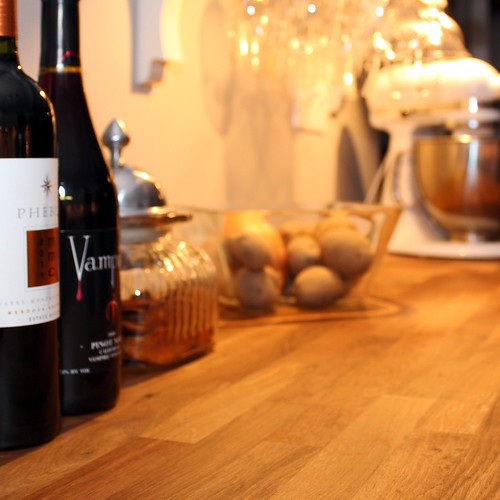
One of the themes of our kitchen renovation has been that "we're thrilled" with the results. I can't stress just how genuine this feeling is. We're not "thrilled" like the guests on an HGTV reality show where they just redid a room by putting live moss all over the walls, or like the homeowners are when the guest designers just spray painted a family heirloom. Oh no, we're actually thrilled with what our kitchen now looks like given what it started as (remember, green laminate counters, bad appliances, etc.), and where it is now.
All of that "thrilled" being said, that doesn't mean we don't have opinions on the various aspects of materials, appliances, and finishes we chose. Today I want to take a few minutes to give everyone my opinions on our butcher block counter tops from IKEA, just in case someone is considering using this for their own purposes.
Warning: I'm going to be brutally honest here. It doesn't mean we don't like the product, because we do like it, but I did notice a few items I wish I had known going into the project.
We began considering the use of IKEA counter tops after seeing it in quite a few blogger projects around the Internet, and after a few commenters here and on our various other social media profiles suggested (ahem, insisted) we give it a look. When we began researching, we were lured into the behemoth of Scandinavian delight by the excellent prices being offered on the website.
Walking in we were of the mindset that we could pick up new counters for the whole kitchen for about $120. A specific option was on a closeout sale at just $60 per eight foor section. But once we actually started to put our materials list together, that price quickly escalated.
The cheap stuff was beech wood in the thin cut of only 3/4", but we realized we were more interested in the thicker, 1-1/2" profile, and the color of the more expensive oak would look much better in our kitchen. Instead of new counters for $120, we ended up with new counters for around $400.
Though $400 was a great price, it wasn't quite as low as we were anticipating. We did shop around at a few other places, such as Lumber Liquidators, a mill I like in Ohio called Baird Brothers, and a few local retailers, but all were considerably more expensive. Since this project is ultimately a "temporary" solution, we were sticking with the cheaper option, even though it came with a bit of compromise.
Once we finally got to unpacking the counters, we were happy with the overall quality of them. They were not perfect, as I was able to pick out several areas of wood filler on the nicer top side of the counters, but given the type of wood and price, we were willing to accept these imperfections.
One major problem I uncovered during my unpacking of one of the large pieces was this rather huge crack. It started at the end of the piece and extended a good foot into the material. I'm not sure what caused it, but we were luckily able to situate our cuts to eliminate this split. I'm sure IKEA would have gladly exchanged the item, but the last thing I wanted to do was to pack up the piece in the car and waste three hours driving down to IKEA, exchanging the broken piece, and coming back home. No thank you.
Another issue that we ran into was something I mentioned in another post. We had long planned on adding a routed decorative edge to the counters, but I was rather disappointed when I uncovered a hole in the front edge of the wine bar while routing the edge.
Looking at photos of the area that I was cutting you can see evidence of the knot, but it looks like it was just turned to the inside and partially filled with glue when the whole thing was assembled. I had to get creative with wood filler to get it looking ok, and it will always look a little off, but it's not the worst thing in the world. I just wish I had been a little luckier and chosen that edge as the back edge rather than the front.
The final minor annoyance with the butcher block material that IKEA provides has to do with its construction. The edges of the butcher block are finished with solid 1-1/2" bands of oak, and they look good and solid (except for the hole we hit). But once you get inside the outer band of wood and end grain pieces, the whole thing is just laminated and finger jointed lumber. Take a look at this excess cross section that I cut out of the right 1/3 of one of the eight foot pieces of counter.
You can see the middle section is sometimes even comprised of two thin pieces on the top and bottom, and one or even two thick pieces of a lower quality wood in the middle. You can also see a significant hole left from a knot. Luckily, I didn't end up with this on an edge, but had I run into that on a final cut, I would have been pretty upset.
On one hand, this construction makes the material far less expensive to manufacture (hence the lower prices) by using less wood, lower quality wood, and excess wood in the construction. It can also make the end result more dimensionally stable since two pieces are less likely to warp against each other. But when the product is advertised as "can be cut, sanded, drilled..." It should clearly outline this aspect of construction as it impacts the installation. I made the cut at the right side of the longest length of counter not knowing this, and I exposed this mishmash of wood.
If I had known about detail I would have been able to make a better cut plan that would have allowed me to situate the right end of the counter at the end of the piece, making use of the solid end grain.
The other major problem with this construction is the possibility of a hitting a poorly chosen excess piece for lamination. This happened to us, and we didn't realize it was even there until we had assembled and installed the whole thing and began our finish sanding process. Murphy's law, the imperfection showed up absolutely front and center in the middle of the longest piece of counter top.
Though most will never notice, the perfectionist in me stares at it every day. It looks like a small piece of oak was damaged and epoxy filled. After sanding, the epoxy/resin filling started to show. Now we have that white spot to the right of the sink. Again, had I known of this possibility and seen it I would have spun the piece around and that imperfection would have been either hidden or cut out of the final piece. Here it is from another angle where you can barely notice it.
I'm not sure if the other materials from different suppliers are any different, so if anyone knows I'd love to hear.
Though I would have preferred the counters be solid throughout, and that I would have known of the potential issues I was facing (but I didn't see anyone really mentioning this online when doing our research) I would have been better prepared to handle the minor adversities in the project. However, I do have to remind myself that we chose the most economical approach, and you do often get what you pay for, especially when dealing with a natural resource that varies in price from the low to high quality products. For us, this is also a temporary solution, so it would have been foolish to go a more expensive route.
Though I'm sure this post may sound like I'm upset or don't like the product we purchased and installed, I'm actually quite happy with how consistent it was, how easily it was to work with (I mean, easy for a nearly 200 pound piece of wood), and how great it all looks when installed.
In other words, I'm being nit picky here, but I feel like too often blogs will point out all of the quick and easy DIY aspects of a product or material without really talking about the drawbacks for fear they will make themselves look less competent. At this point, I'm secure enough in my own ability to accept the fact you could possibly think I'm a stumbling buffoon. After all, isn't the Internet primarily for celebrating the stumbling and bumbling buffoon? I think we can all agree on that.
Regardless of the points I covered above, the counters look great in our kitchen and we would absolutely buy them again. The only change I would make would be to more thoroughly inspect the counters at pickup, as well as before making any cuts. I'd also try to arrange my cuts to keep the end grain at the ends as much as possible to reduce the risk of seeing the middle cross sections.
We still have a few remnant pieces in the basement that I'm looking to do something with. Wendy has a few ideas, so we'll see how those turn out.
Do you have experience with IKEA butcher block counters? I'd love to hear if you have any similar stories or notes from your work. I'd also love to hear if you have any experience with butcher block from other manufacturers, especially Lumber Liquidators. I loved how the LL cherry looks, and I just wonder if their construction has similar issues to the ones we saw.